WHEN former Penang island councillor Geeta Suresh Chand accepted a bundle of old papers from a friend in 1999, she never expected to become custodian of a century-old slice of Penang history.
What caught her attention was not just what the papers recorded, but how they were written.
The bundle contained 20 sets of legal indentures and related documents dating from 1881 to 1950 – each bearing the distinct handwriting of people who produced them.
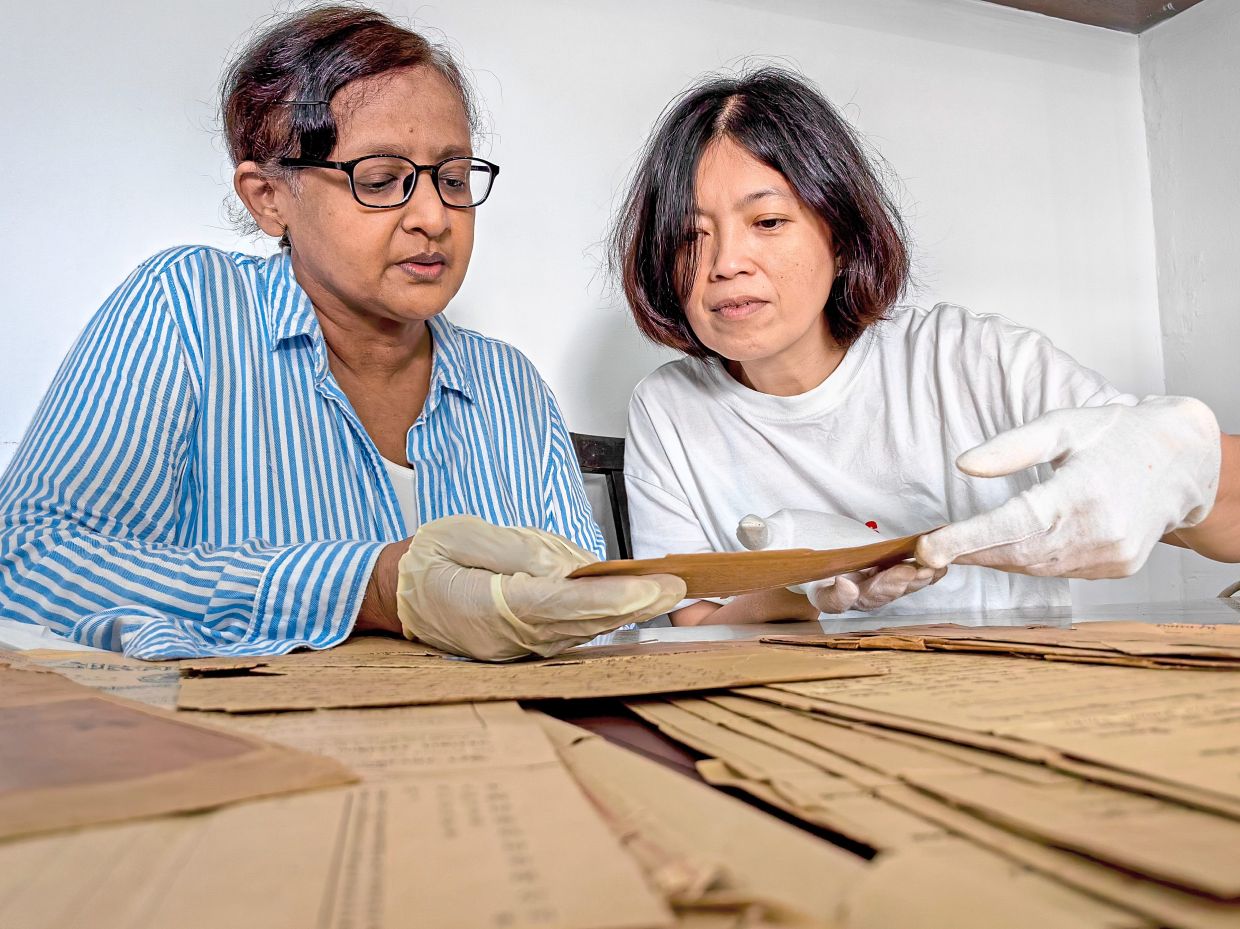
“I was not only fascinated by the quality of the paper and ink, but the handwriting.
“The pages carried different handwriting styles, each seemingly leaving behind a trace of the person who had written it.
“Some were very formal and controlled, while others had beautiful flourishes,” said Geeta, a former lawyer.
The signatures appeared in English, Chinese, Hindi and Tamil, reflecting the diverse communities that lived and did business in Penang more than a century ago.
Among names that stood out was Yeap Chor Ee (1867-1952), the prominent businessman, philanthropist and founder of Ban Hin Lee Bank.
One of the collection’s standout documents is a 1917 indenture of statutory reconveyance, broadly equivalent to a modern statutory discharge of charge.
The document records the repayment of a loan and release of a mortgaged property involving Mah Thye Choe, Chan Ah Yee and Yeap Chor Ee.
Another document from the same year bears the seal of solicitor Yeoh Guan Seok – a prominent Penang-born lawyer and community leader.
His name lives on in Jalan Yeoh Guan Seok.
Dating to 1881, the collection’s oldest document bears the signature of an Indian lawyer named Sharma, alongside signatures in Hindi and Tamil.
The documents also offer a glimpse into the property market of colonial-era Penang – recording transactions, land prices and boundaries involving streets that are familiar to Penangites such as Jalan Anson.
Even the spelling of street names provides clues to how they have evolved over time.
A 1918 document refers to Jalan Kuala Kangsar as “Kwalla Kangsar Road”, while a 1950 insurance policy uses today’s familiar Kuala Kangsar Road spelling.
The legal language has changed too.
The terminology associated with British administration gradually gave way to language reflecting the transition towards Malaya’s political landscape around 1950.
“These are not just old deeds to me,” Geeta said.
“They tell us how people lived, conducted business, borrowed money and owned property, and dealt with the legal system at that time.”
For her, the documents also preserve something that modern digital records rarely capture so visibly – physical evidence of the people who created them.
“Today, we type something, make a correction and move on.
“But back then, writing was a skill. You had to control the pen, maintain the pressure and form every letter carefully.”
Geeta said a legal document could run for several pages, and every word had to be prepared with care.
“There was no backspace, no copy-and-paste and no spell-checker.
“If you made a mistake, you could not simply correct it with a click, making the documents valuable records of a bygone era.”
Records of change
The more than 100-year-old land deeds and mortgage documents provide insights into Penang’s social, economic and legal history.
They reveal how land, capital and credit circulated as the island developed into a major commercial centre.
Rather than being just old penmanship, they trace the development of colonial law and administration, the growth of legal and clerical professions, changing office practices and role of Penang’s Asian commercial communities in property economy.
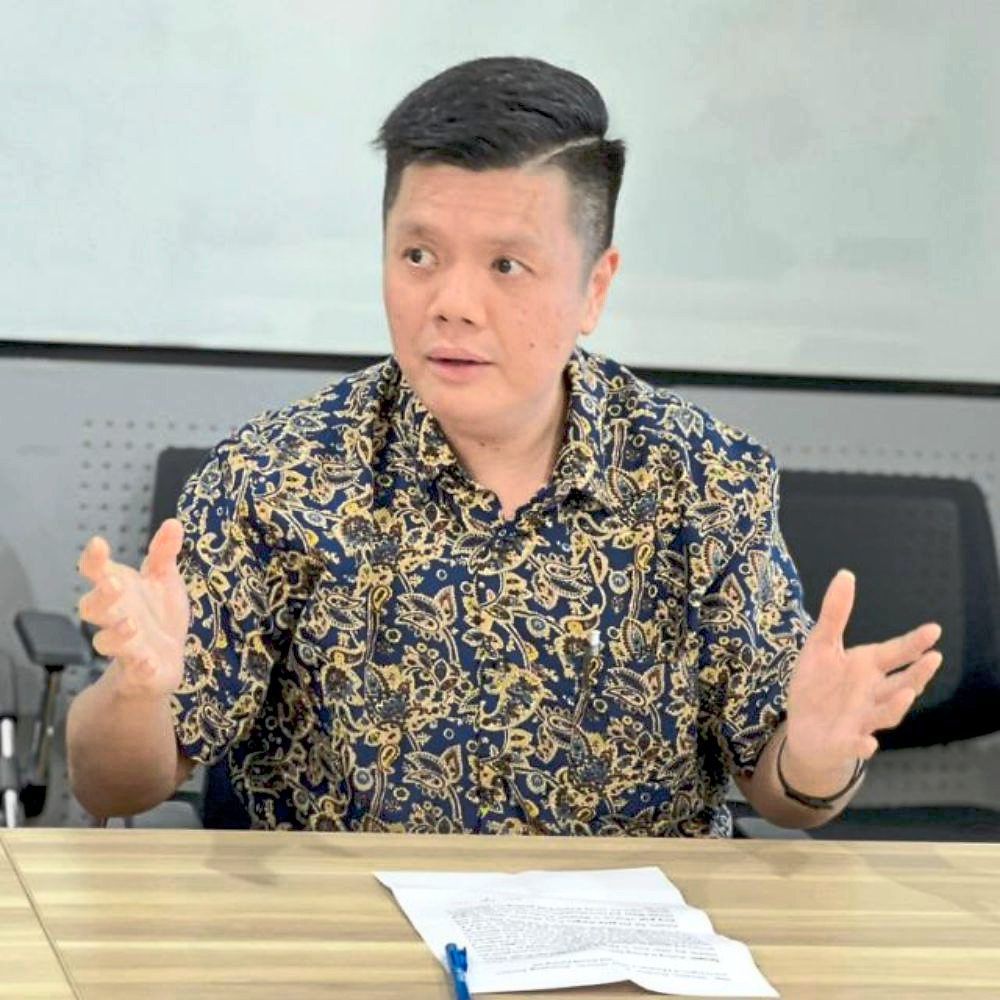
Universiti Sains Malaysia (USM) History Section senior lecturer and programme chairman Dr Tan Chee Seng said the documents offered a window into how Penang’s legal and commercial practices evolved.
Tan, who joined USM’s School of Humanities in 2016, specialises in Modern Chinese History and Overseas Chinese History.
He has worked in the field since 2000.
“The documents connected with Yeap Chor Ee are particularly noteworthy because they allow us to move beyond a biographical account of a prominent businessman and examine the documentary mechanisms through which property, capital and credit actually circulated,” he said.
Tan said among the collection were Indentures of Statutory Mortgage and Reconveyance, including a 1917 statutory mortgage involving a loan secured against land on Kwalla Kangsar Road and another statutory mortgage dated 1936.
He said one of the most compelling aspects of the collection was the contrast between fully handwritten 1917 mortgage and the largely pre-printed 1936 documents.
“In less than two decades, one can see the movement towards a more standardised modern office and legal bureaucracy.”
The earlier document required lengthy legal clauses, property descriptions and conditions to be written by hand.
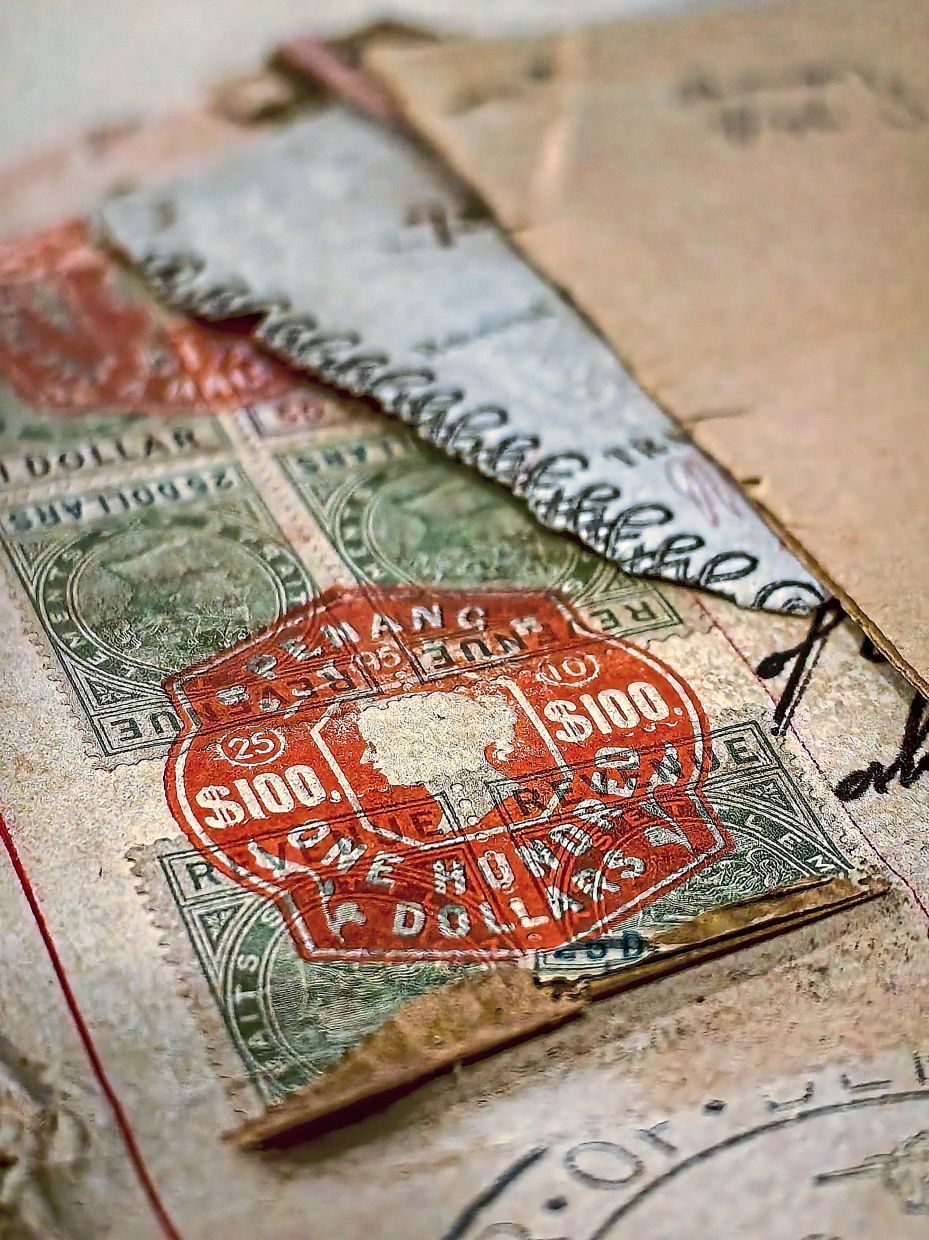
By 1936, much of the legal wording had been pre-printed, with transaction-specific details such as names, dates and amounts filled in by hand.
Tan said the change reflected the increasing standardisation of legal and administrative procedures as the volume of transactions grew.
But the shift towards printed forms did not mean handwriting disappeared.
“Signatures, marks, annotations, seals and handwritten particulars continued to authenticate transactions,” he said.
The documents therefore capture a period when traditional penmanship, colonial bureaucracy and evolving office technology existed side by side.
Physical features including revenue stamps, seals, signatures, personal marks and registration endorsements also provided clues on how transactions were processed, he added.
Some documents contain Chinese characters or personal marks alongside English legal text.
Tan, however, cautioned against drawing conclusions about a person’s ethnicity, wealth or social status from handwriting alone.
“Handwriting should be considered together with the language, legal terminology, signatures, seals, witnesses and institutional context of each document.
“The collection also illustrates the changing nature of office work, from largely handwritten legal documents to printed forms and typewritten material.
“This enabled legal offices and government departments to reproduce standard clauses more efficiently while retaining handwritten elements for signatures, amendments and transaction-specific details,” he said.
For Tan, it is this combination of personal and institutional evidence that lend historical value to the documents.
“The handwriting tells us about people, but the documents as a whole tell us about the making of modern Penang.”
Conserving history
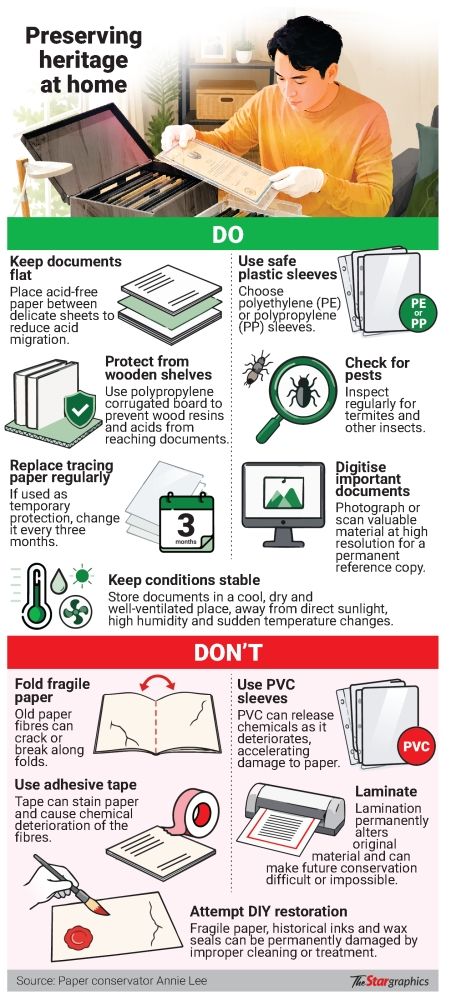
The survival of Geeta’s collection is remarkable because paper itself is vulnerable to time.
Its longevity depends on the materials, the ink, how it was handled and the environment in which it was stored.
Paper conservator Annie Lee, who has 13 years of experience in the field, said every old document should be treated as an artefact rather than simply a piece of old paper.
Lee has worked on a wide range of heritage materials, including municipal council architectural plans, temple scriptures, school archives and private vintage paper collections.
“Every piece of paper is an artefact possessing collection value and potential to be passed down to the next generation.
“Paper restoration and preservation are equally important,” she said.
The chemistry of the materials, she said, was critical when dealing with 19th-century documents.
Many Western legal documents from the late 1800s were produced using imported British paper and iron gall ink, she said.
While iron gall ink was widely used for centuries because of its permanence, its chemical composition could contribute to acidity over time, said Lee.
As acidity increases, paper fibres can become brittle and fragile even when the writing remains clear.
She said Chinese carbon-based ink had different properties and was remarkably stable, helping Chinese manuscripts survive for centuries.
This means conservation is not simply about cleaning an old document or making it look new.
The aim, she said, was to stabilise the document while preserving as much of the original material as possible.
For century-old indentures affected by acidity or cracking, Lee said conservation may involve treating the documents in a specialised distilled-water bath to reduce acidity without damaging historical carbon-based or Chinese inks.
Fragile or cracked areas could then be reinforced with Japanese kozo paper, she said.
Kozo paper is an extremely thin, acid-free mulberry tissue that adds strength without obscuring the original script or wax seals.
Conservators can also photograph documents before and after treatment, while producing high-resolution scans as a permanent digital record.
Geeta said the collection was being kept in a cool, shaded cabinet while she seeks further conservation advice.
She said digitisation could not replace the physical documents.
“A scan can preserve the words and visual appearance, but it cannot fully reproduce the texture of the paper, physical characteristics of the ink, impressions, seals and other material evidence.
“The original remains the historical artefact,” she said.
Geeta plans to compare historical land details in the deeds with present-day public land records.
She is also hoping historians, researchers, museums, universities, heritage organisations such as George Town World Heritage Incorporated (GTWHI) and descendants of those named in the documents would come forward to study the collection.
While she intends to keep the physical documents in her care, her broader aim is to share their historical value with the public.
“These documents are essential for understanding lineage – both for families and historic institutions – and connecting with the figures who built Penang,” she said.