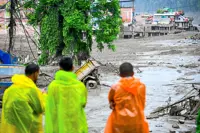
KATHMANDU: The government has sent an urgent request to the board of the Fund for Responding to Loss and Damage, a global climate finance mechanism, seeking financial assistance for Nepal following the deadly Bhotekoshi flood of August 26.
The mechanism was established at COP27 in 2022 and operationalised at COP28. A letter cosigned by Finance Minister Swarnim Wagle and Forests and Agriculture Minister Geeta Chaudhary, a copy of which has been seen by the Post, seeks an immediate response to the catastrophic flash flood.
“We write to draw your urgent attention to the catastrophic flash flood that struck the Bhotekoshi river basin, causing widespread loss of life, displacement, destruction of homes and critical infrastructure, and severe disruption to essential services, livelihoods, markets, and connectivity across downstream communities,” the letter reads.
Maheshwar Dhakal, joint secretary at the Ministry of Forests and a member of the fund’s board, told the Post that the letter does not specify the actual scale of the losses and that it is up to the board to decide on financial assistance.
“Almost all major donors and global development partners are members of the board, and Nepal’s claims and potential risks are well-established, so the board must compensate us,” he said.
The disaster has affected a fragile transboundary mountain river system and generated cascading consequences extending far beyond the immediate flood zone, according to the letter. Search, rescue, relief and rapid damage-assessment operations are continuing, it says.
“The full scale of economic and non-economic loss and damage has yet to be determined; however, preliminary information indicates that the consequences are extensive and exceed Nepal’s immediate response capacity,” the letter reads.
If Nepal is able to secure support from the fund, it would set an example for other vulnerable countries, Dhakal said. The scale of damage caused by the flood, and the search, rescue, relief, rehabilitation and reconstruction required in its aftermath, has become a major challenge for Nepal, he said.
“Since we are genuinely suffering from the adverse effects of climate change, we have approached the board. The next board meeting is expected to convene on December 10, but we want to get an immediate response and support before that,” he told the Post, noting that this is the first time Nepal has sought support from the entity.
As a least developed and highly climate-vulnerable mountainous country, Nepal contributes negligibly to global greenhouse gas emissions yet continues to bear disproportionate and escalating climate impacts, the letter says.
It adds that the Bhotekoshi disaster demonstrates how extreme events in the cryosphere can rapidly cascade from high mountains to densely populated downstream areas, undermining development gains and affecting water, food, energy, health, infrastructure, ecosystems and human security.
“In view of the exceptional urgency and magnitude of this disaster, the Government of Nepal respectfully requests the Board to take a special decision to respond rapidly, directly, and effectively in accordance with its Governing Instrument,” the letter says.
“Time is of the essence,” it adds. “A prompt response would help protect affected populations, restore essential services, prevent further suffering and demonstrate that the fund can translate international solidarity into timely support for vulnerable countries and communities when it is most urgently needed.”
During an interview with Kantipur Television on Monday, Foreign Minister Shisir Khanal said Nepal would raise the flood and its impacts with the international community. He said a letter had already been sent to the board on Monday through the Ministry of Finance.
In December 2024, Nepal drew the attention of the International Court of Justice to the impacts of climate change, making a strong plea for climate justice to alleviate the suffering of Nepali citizens.
Making a presentation to the court’s public hearings on the “Obligations of States in respect of Climate Change”, then Foreign Minister Arzu Rana Deuba said global warming and consequent climate change increasingly threaten Nepal’s snow-capped mountains and glaciers. - Kathmandu Post/ANN