
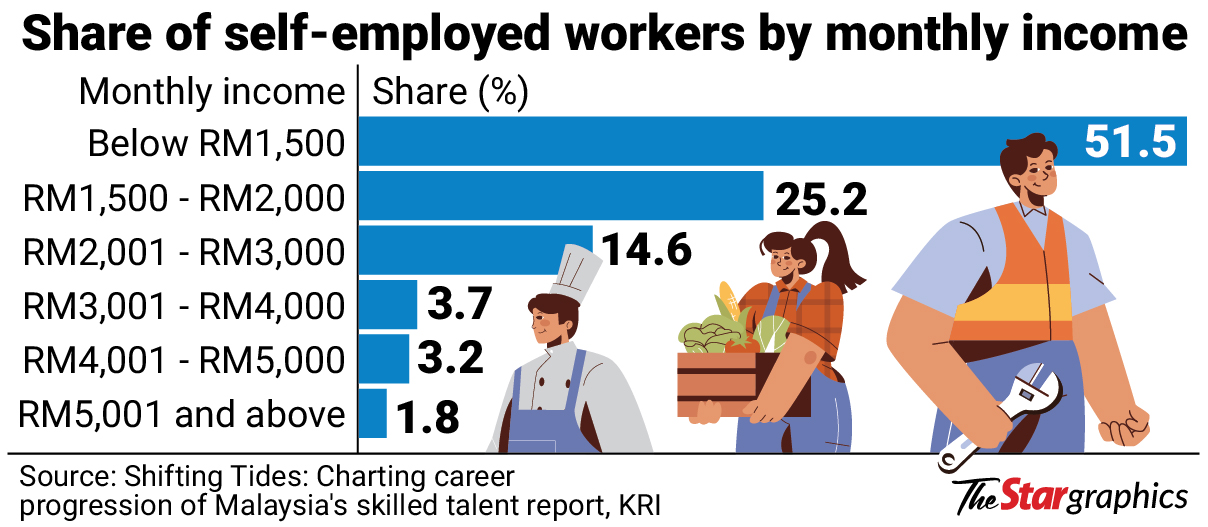
PETALING JAYA: More than half of the freelancers in the country earn below RM1,500 a month, with many lacking basic social protection, according to a Khazanah Research Institute (KRI) report.
The report revealed that 51.5% of freelancers earn below the RM1,500 threshold, while 41.1% have no social protection under the Employees Provident Fund (EPF) or the Social Security Organisation (PERKESO).
KRI associate director of research Dr Rachel Gong said individuals entering the market without sufficient professional experience or community networks are the most vulnerable.
ALSO READ: Upskilling access for gig workers
“They take much longer to learn the operational ins and outs of their respective industries, resulting in fewer jobs and lower incomes.”
Gong warned that a lack of safety nets leave these workers vulnerable to sudden crises.
“For example, if they do not have PERKESO coverage, they are not eligible to receive any income while recovering from an accident.
“If they are not contributing to EPF, they are at risk of not having enough savings when they are no longer able to work,” she said.
Released on June 24, the report, titled “AI and the Future of Work: Worker Rights in the Sharing Economy”, also showed that 246 Malaysia-based platforms now command a market worth of about RM18.8bil.
It also said that more than 1.6 million new participants joined the sector between 2016 and 2024.
Freelancers are part of Malaysia’s sharing economy, which involves the peer-to-peer exchange of goods and services through community-based transactions, although not always via digital platforms.
The sector also includes ride-hailing, delivery, logistics and other on-demand services.
The report also highlighted a rise in the number of highly educated youths entering non-standard employment, nearly doubling from 8.6% in 2013 to 15.8% in 2021 due to limited high-skilled job creation and structural mismatches.
Gong attributed this trend to mismatched expectations and low starting salaries.
“There is a discrepancy between what employers expect of graduates and what fresh graduates can actually do, as well as between what graduates would like to be paid and what employers in Malaysia – the majority of whom are MSMEs – can and will pay.”
Gong added that a preference for flexibility also drives many young workers towards freelancing.
The study also noted how algorithmic management replaces human supervisors, removing the human oversight that traditionally protects workers’ interests.
For example, automated systems cannot accommodate personal crises, such as leaving work early to care for a sick parent, creating significant information and power imbalances.
“Data transparency and platform accountability regulations should be introduced to require platforms to provide workers with information on how tasks and rates are assigned,” Gong said.
Although government initiatives such as the Gig Workers Act 2025 and pandemic-era PERKESO subsidies are already in place, KRI emphasised that future protections must extend beyond basic social security.
This includes expanding skills training, strengthening community building and improving grievance-handling mechanisms.
For example, PERKESO’s Bina Kerjaya 2.0 provides up to RM4,000 in skills training subsidies but restricts participants to one course and excludes degree holders.
Other suggestions include giving informal worker groups a greater voice in policy discussions and establishing accessible complaints mechanisms to ensure effective redress.