




WHETHER you are a boss or a gig worker, here's everything you need to know about the Gig Worker's Bill -- which will soon become an Act of Parliament.
Difference between staff and gig workers
If you work under a contract of service, you are an employee, whether part-time or full-time, permanently or for a fixed time.
Think: becoming a member of the organisation. The employer controls the work hours, duties, place of work, tools and so on. You are protected by the Employment Act or Labour Ordinance.
If you work under a contract for services, you are possibly a gig worker.
Think: completing a job for someone or a company. You decide how and when to do it, prepare your own tools and bear more risk than an employee. You will be protected by the Gig Workers Act.
But what about the independent contractor?
"That is what we are re-defining. When we say 'independent contractor', we assume equal standing between both sides under the Contracts Act, like business people entering into a contract.
"But not all independent contractors are 'independent'. Gig workers are not independent. They depend on the tools of the contracting entity such as apps and work management systems.
"Their standing to enter into fair contractual negotiations is much lower," explains Human Resources Minister Steven Sim in an exclusive interview with The Star.
The prior view is that the transactions between independent contractors and companies are governed by contract law, but there have been signs that the Contracts Act does not provide sufficient protection for some independent contractors.
"If you are a motorcyclist with a deal to run any kind of errand for a company and your contract is terminated, how can you afford a lawyer to fight the civil case in court?" Sim asks.
The government, he explains, sees gig workers as a form of labour "and thus we must give them an extra layer of protection".
Yet, they are not employees. They have freedom and flexibility to work just as freelancers.
They remain free to provide services to anyone or any group; they need not be exclusively bound to one contracting entity.
Going by the definition of the new law, nearly all workers whom we refer to as freelancers and independent contractors are legally considered gig workers.
Call in the grass cutter to mow your lawn and he is really performing a gig for you.
"Some who were previously independent contractors are already engaging jobs through platforms.
"There is an app now for you to call a plumber. There is even an app for on-demand babysitters.
"If the job is engaged through a platform, then those who enter into the contract for services are definitely gig workers and the platform providers become the contracting entities," says Sim.
And then there are gig workers performing several who are not on platforms and are still recognised by the upcoming Gig Workers Act.
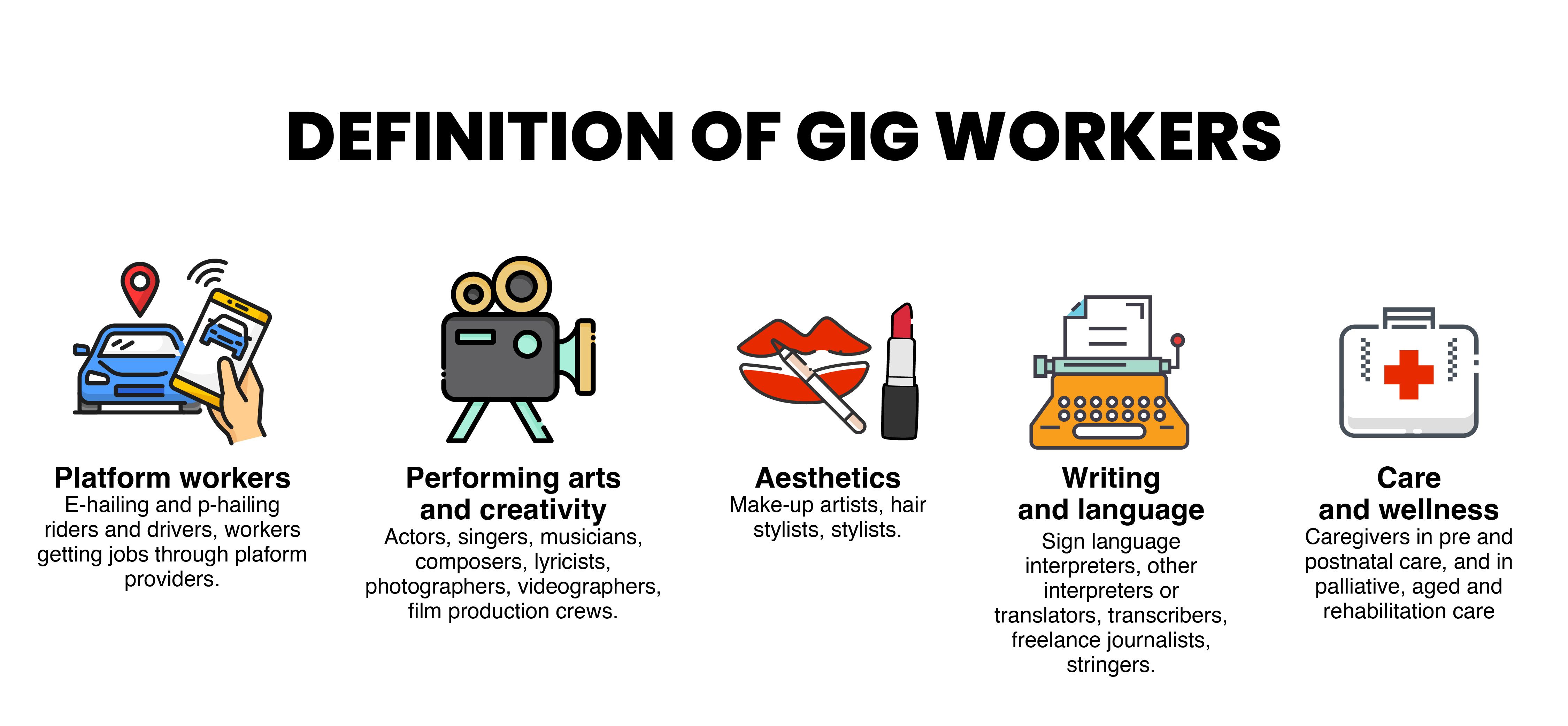
Non-platform gig workers
"The non-platform gig workers are listed under the Schedule of the Act and we will expand the list from time to time," says Sim.
For now, they include:
Performing arts and creativity: actors, singers, musicians, music composers, lyricists, photographers, videographers, all freelance work in film or video production.
Aesthetics: make-up artists, hairdressers and stylists.
Writing and language: Sign language interpreters, other interpreters or translators, transcribers, freelance journalists and stringers.
Care and wellness: caregivers in pre and postnatal mother's care, in palliative, aged and rehabilitation care.
Thus, even if a company hires a freelance singer for an annual dinner event, or if a wedding planner hires a freelance photographer for a single wedding, they are recognised and will be protected under the Act.
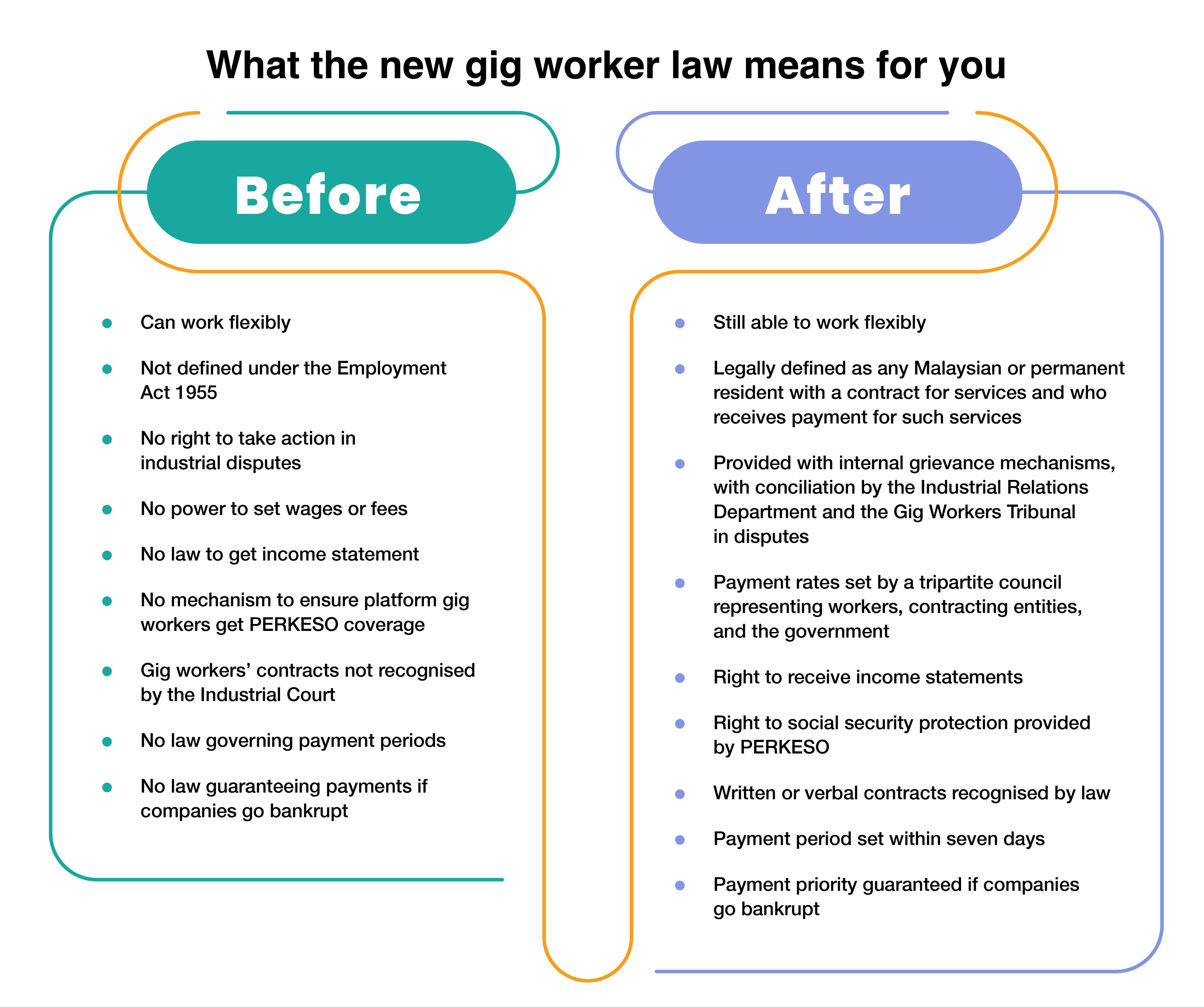
Rights of a gig worker
Among many others, the gig worker will have the right to ask for a payslip or regular income statement.
"That is important because without that, gig workers will have trouble with financial matters such as applying for loans," stresses Sim.
Platform providers will be duty-bound to deduct their gig workers' income to pay the Social Security Organisation (PERKESO) contribution to guarantee needful protection against calamities.
If a gig worker's contract has terms that are worse than what the new law guarantees, that part of the contract is automatically invalid.
Even if the contract was signed before the Act comes into force, the new law applies.
Every gig worker has these basic rights:
> To know what you’re agreeing to — the terms and conditions of your job must be made clear to you. Verbal contracts or even what is sent via text messages are binding.
> To know what job you’re doing — the service you’re expected to perform must be stated.
> To know how much you’ll earn — the rate and payment details must be told to you before you take the job.
> To know how you’ll be paid — whether it’s by bank-in, e-wallet, or cash and what happens to tips or bonuses.
> To be paid on time — once you’ve done the job, you must get your money within the agreed time. If the time is not stated, the law says you must be paid in seven days.
> To be told about any changes — if the boss wants to change the deal, they must discuss and inform you first.
> To be treated fairly — your service cannot be ended without a valid reason.
> To have a way to complain — there must be a proper system for settling disputes.
Extra rights for platform gig workers:
> To know about electronic monitoring — if the platform tracks or rates you using software, they must tell you how it works and what it affects.
> To know about automated decisions — if an algorithm decides which jobs you get or how you’re treated, they must explain that system too.
> To have a human review — if a computer system penalises or deactivates you, you must be able to appeal to a real person.
Your boss or client cannot simply cut your pay, tips, or bonuses. The only times they can deduct are:
(a) to reclaim extra money they accidentally overpaid you (but only if within the last 3 months),
(b) if the law specifically allows it, or
(c) if the Director-General of Labour approves it.
Rights of the platform to suspend or terminate gig workers
The platform providers may deactivate gig workers' access to its platform for up to 14 days in cases of misconduct but must give the gig worker written notice and then conduct an investigation.
If no legitimate reason was found during the investigation, the gig worker's access must be restored and the platform provider must pay 50% of the average daily earnings in that suspension period to the gig worker.
If valid misconduct is found, the platform provider can suspend the gig worker for another seven days or terminate the contract.
Gig workers must be given the chance to present their case during the investigation and if the suspension is extended or contract terminated, the platform provider must supply a detailed written explanation.
Gig Workers Tribunal
The new law provides frameworks for internal investigations, internal grievance mechanisms and conciliation and if the dispute remains unsettled, the case can be referred to the Gig Workers Tribunal.
It is headed by the President who will be appointed and appeals to the High Court are allowed. All hearings must be open to the public.
Neither the boss nor the gig worker can be represented by lawyers.
The boss is to be represented by a suitable employee while the gig worker can choose to be represented by any member from his or her gig workers association or a family member.
"The tribunal hearings are meant to be inquisitorial, simple, cheaper and faster to conduct.
"But if gig workers are worried about not being able to express themselves, they can choose to ask an experienced member of their associations to speak for them.
"That is why we encourage gig workers to form registered associations," says Sim.
Gig Workers Associations
Besides the benefit of gig worker associations being recognised in tribunal hearings, Sim says such associations can also represent the gig workers at the Gig Consultative Council to talk about their rates, the contracts, earnings and work standards.
"When we can lay down industry standards for specific gigs, then we can include more gigs into the Schedule of the Act and widen the scope of protection.
"We want to give labour protection to these workers who have been invisible for a long time," he adds.
Sim says he calls gig workers "invisible" because there was previously no law to recognise their rights as workers.
"Without this new law, the courts cannot see them. What the courts cannot see, they cannot define and when they cannot define them, they cannot defend them," he says.
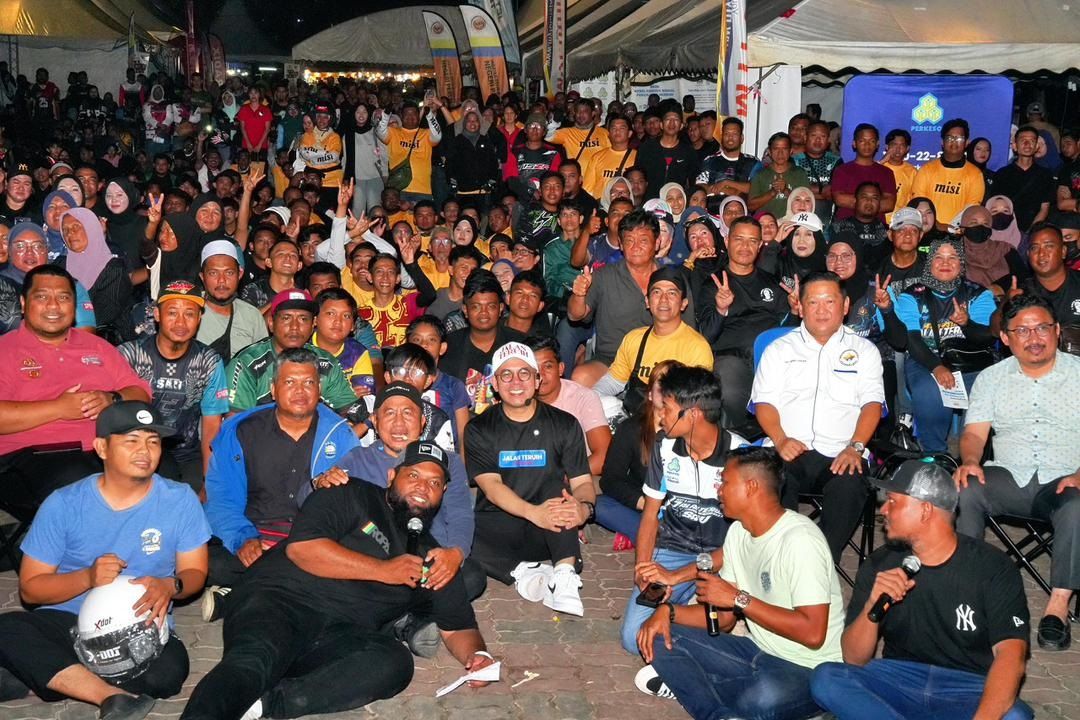
The Human Resources Ministry is now on a nationwide roadshow meeting various types of gig worker groups to explain the implications of the new law.
For details and to download a copy of the Gig Workers Bill, visit www.mohr.gov.my/ruupekerjagig/.


