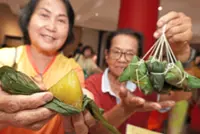
GEORGE TOWN: At about RM2 a piece, the humble jian shui zong offers an affordable Dragon Boat Festival treat at a time when a meat-filled rice dumpling can easily cost RM10 to RM15.
Its Chinese name literally means “alkaline water dumpling”, though it is better known as kee chang in Hokkien and kan sui chong in Cantonese.
The alkaline water gives the glutinous rice its distinctive translucent amber hue and firmer yet springier texture. Traditionally, it is eaten with kaya or dipped in gula melaka syrup.
Penang Chinese Town Hall secretary Yew Mei Yeang said kee chang remained popular despite changing tastes and the growing demand for premium meat dumplings.
“It is lighter than meat dumplings and less oily. The slight bitterness from the alkaline water creates a unique flavour when paired with something sweet,” she said during a Dragon Boat Festival event at the organisation’s premises here yesterday.
Yew said the dumpling was traditionally favoured by poorer families because it was inexpensive to make and had a longer shelf life.
“In the old days, not everyone could afford meat dumplings.
“Kee chang used only simple ingredients, making it a more economical choice for many families.
“It was also easier to store, which was important when refrigeration was not widely available then,” she said.
According to Yew, the dumpling’s origins could be traced to southern China, where glutinous rice treated with alkaline water was prepared as a simple food that could withstand hot weather.
“Unlike meat-filled dumplings, which are closely associated with the Dragon Boat Festival legend of Qu Yuan, kee chang was more of an everyday food because it required only glutinous rice, alkaline water and bamboo leaves.
“The use of alkaline water has been passed down through generations.
“It raises the pH level of the rice, making it less favourable for the growth of many bacteria, yeasts and moulds,” she added.
While meat-filled dumplings today often feature premium ingredients and modern flavours, Yew said the preparation of kee chang has changed little over the centuries.
“Many people still enjoy it the traditional way with brown sugar.
“Some sellers now offer versions filled with red bean paste and other sweet ingredients,” she said.
Glutinous rice dumplings are traditionally eaten during Duanwu, better known as the Dragon Boat Festival, which falls on the fifth day of the fifth month of the lunar calendar.
The festival is linked to Qu Yuan, a respectable Chinese poet and statesman who is believed to have drowned himself in protest against corruption and political turmoil during the Warring States period (475–221 BC).
Legend has it that villagers raced out in boats and threw rice into the river to prevent fish from consuming his body.
The rice was later wrapped in leaves, giving rise to the tradition of making rice dumplings.
This year, Duanwu falls on Friday.