Iconic cover: December 12 1993
PETALING JAYA: The roads leading into Ukay Perdana look like any urban area in Kuala Lumpur, but as you drive deeper, a striking, almost eerie sight rises quietly from among the trees.
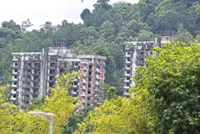
Partly obscured by morning mist, two high-rise towers stand on the hillside – silent and visibly abandoned.

The prestige they once carried is long gone.
These towers are not just any abandoned buildings, but a lasting reminder of one of Malaysia’s darkest urban tragedies.
More than three decades ago, the Highland Towers, which comprised three towers, were among the most sought after residences in the city.
It attracted professionals, expatriates and families drawn by its elevated location at the foot of a hill.
Residents enjoyed sweeping views of the city skyline.
On Dec 11, 1993, everything changed.
After 10 straight days of rain, Block 1 of the Highland Towers suddenly crumbled at about 1.30pm.
The entire structure came crashing down, almost like an implosion, trapping residents beneath concrete and debris.
Residents in Blocks 2 and 3 – the two that still stand – were evacuated immediately after the collapse for fears that they, too, may give way.
The area quickly transformed into a massive rescue ground.
More than 500 personnel were deployed for days, including teams from Singapore, Japan, France, United Kingdom and the United States.
Cranes and excavators moved carefully through the rubble while sniffer dogs searched for those trapped.
The full scale of the destruction was captured on the front page of The Star on Dec 12, 1993.
An aerial photograph showed the collapsed block, surrounded by firefighters in bright red uniforms, heavy machinery and emergency crews.
Only three people were pulled out alive from the rubble – eight-month-old baby Nur Hamidah Nadjib, her mother Umi Rashodah Khoiruman, 22, and Japanese national Shizue Nakajima, 50.
Shizue later succumbed to her injuries at the hospital.
Among the other victims whose bodies were found later were Carlos Rashid and Rozita Abu Bakar, the son and daughter-in-law of former deputy Prime Minister Tun Musa Hitam.
Their young daughter and domestic helper narrowly escaped the collapse.
Search operations continued for 12 days before ending on Dec 22, 1993.
The final tally stood at 48 deaths.
An inquiry revealed that a mass of mud equivalent to 200 jumbo jets, or around 100,000sq m, had come sliding down the hill, breaking retaining walls and destroying the foundation.
A pipe drainage system meant to divert water from a stream flowing into the area burst as a result of the intense rain, while water from nearby deforested hillslopes contributed to the landslide.
The Special Malaysia Disaster Assistance and Rescue Team (SMART), Malaysia’s pride for search and rescue operations and humanitarian efforts, was also formed following the Highland Towers collapse.
Over the years, nearby residents have repeatedly called for the remaining two towers to be demolished, as the abandoned site had become a haven for trespassers, drug users and criminal activity.
In 2016, police also shot dead three armed robbers in a raid at the remains of the condominium.
Several proposals have since surfaced, including a 2021 plan to turn the site into a recreational park, although the idea has yet to materialise.
As recently as last year, the Ampang Jaya Municipal Council said it would seek a High Court order to proceed with demolition of the remaining blocks.
The Star has continued to report on matters regarding slope stability and landslide risks facing communities near such terrain.
Every crack in a wall is a possible sign of danger.
The Highland Towers collapse was not merely a tragedy of the past but one that continues to haunt us, generating debate on hillside developments in Malaysia.