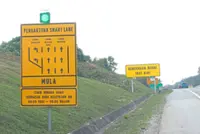
North-South Highway (NSH) users are now greeted by yellow signboards with many arrows pointing upwards.
They are to inform motorists of newly introduced “smart lanes” to ease traffic congestion by converting the emergency lane into an extra traffic lane for light vehicles during peak hours.
The NSH, constructed in 1994, was to alleviate the congestion on the federal route to save significant travelling time.
However, the congestion resulting from the capacity limits of the NSH has eroded the advantage of reducing travel time.
Many corridors of PLUS highways have reached their capacity limits, leading to frequent congestion during normal hours.
The situation becomes worse during peak hours and festive seasons.
On a normal day, the average traffic volume on the PLUS network in Peninsular Malaysia is approximately 1.85 million vehicles.
However, during festive seasons, long weekends and school holidays, this number surges significantly, often exceeding two million vehicles per day.
The volume recorded during the recent Hari Raya Aidilfitri period was 2.3 million vehicles, a 21% increase over normal volume.
In July 2024, PLUS Malaysia Bhd began widening projects to add an extra lane in each direction to alleviate traffic congestion in the two-lane highway in the southern corridor in Johor.
The project is expected to be completed in July 2027.
Meanwhile, for the other congested corridors of the highway, PLUS introduces smart lanes, converting emergency lanes as an additional traffic lane during peak hours and festive seasons to ease congestion.
This was implemented in 2024.
Smart lane activation is identified by the yellow signboards and by green flashing lights.
The speed limit for smart lanes is capped at 60km/h.
However, awareness of users on smart lanes are low as many of them are seen speeding along the smart lane (outside the designated usage hours), oblivious of the narrower lane and despite the green light not flashing.
The use of the emergency lane as a smart lane has introduced safety risks and compromises the ability of vehicles to stop for emergencies.
While it is a cost-effective solution to ease traffic congestion, it is a double-edged sword because it removes the dedicated safe zone for broken-down vehicles for emergency services.
When a smart lane is activated, ambulances, Bomba and police vehicles face obstacles, hindering their ability to promptly reach the scenes of incidents.
For vehicles that have a breakdown or an emergency, they are forced to stop in active lanes, leading to extremely high-risk situations.
In addition, activated smart lanes deprive motorcyclists of the use of their normal lane of travel.
In summary, though the NSH smart lane could ease congestion to some extent, users must be mindful of the safety issues that might arise from it.
Furthermore, smart lanes can only be used when they are activated as indicated by the flashing green light.
WONG SOO KAN
Petaling Jaya