
WHEN potholes appear on city roads, motorists expect Kuala Lumpur City Hall (DBKL) to act swiftly.

This question is not merely theoretical.
It has become a daily frustration for motorists travelling between Kepong in the capital city and neighbouring Sungai Buloh in Selangor.
Kepong MP Lim Lip Eng said he had received numerous complaints about vehicles damaged due to potholes along a stretch of Jalan Kepong spanning the Kuala Lumpur-Selangor border.
While such stretches are often termed as “no man’s land”, a legal expert says this is erroneous.

Lawyer Norman Fernandez has handled road-related cases and undertaken pro bono work involving pothole issues with local councils.
“I have not handled a case where an incident happened in ‘no man’s land’.
“The first step is to identify exactly where the incident occurred,” he said.
“Once that is established, you determine whether it falls under the Federal Government, state or local authority.
“One practical way is to find out who is maintaining that stretch of road.
“Very often, it may come under the local council.
“In some cases, the local council appoints contractors
to maintain the road, repaint lines or carry out repairs. So there is someone responsible,” he reiterated.
Blurred lines
Road maintenance in Malaysia is governed by clear jurisdictions, but problems often arise at boundary points where responsibility shifts between agencies.
Maintenance is also based on road classification, and at district or state boundaries, there is a clear handover between jurisdictions.
These transition zones are usually marked by signage showing where one authority’s responsibility ends and another begins.
Federal roads are maintained by the Public Works Department (JKR) or concessionaires, while state roads fall under the respective state JKR.
Roads within urban areas are managed by local government such as DBKL.
Highways are overseen by the Malaysian Highway Authority (LLM) and maintained by the respective concessionaires such as PLUS Malaysia and Prolintas.
Meanwhile, the Malaysian Road Records Information System (Marris) is used to track road assets.
Transport expert Rosli Khan said the issue of jurisdictional boundaries in road maintenance was outdated and continued to create confusion.
“The way agencies argue over potholes is petty, especially when they start pointing fingers over jurisdiction and budgets,” he said.
He suggested that DBKL be made responsible for all roads within Kuala Lumpur, except for privatised highways.
“For ease of management, JKR should not come into the picture in Kuala Lumpur.
“DBKL should be responsible within its own territory, while JKR handles roads in Selangor and border areas.”
Rosli said agencies often wanted jurisdiction without accountability.
“To avoid friction, responsibilities must be clearly defined.
“Right now, confusion reigns because the framework was never properly set out from the start,” he noted.
From a safety standpoint, he said agencies should prioritise immediate repairs over administrative boundaries.
“The agency on site should fix the pothole first and sort out jurisdiction later.
“After all, the money comes from the same source, taxpayers’ funds.”
Rosli said that introducing new models would not solve the issue.
“What is needed is a clear division of responsibility between Kuala Lumpur, Selangor and local authorities.
“It is ridiculous that some roads in Petaling Jaya and Shah Alam are still under JKR.
“Local authorities should be fully accountable for municipal roads, while JKR focuses on major trunk roads.”
Reality on the ground
Despite some clear divisions, Lim said the situation on the ground was far from seamless.
He said the damaged stretch in Jalan Kepong technically fell under Selangor, leaving DBKL reluctant to intervene despite complaints from Kepong residents.
After he raised the matter, DBKL contacted Selangor JKR and a Gombak JKR team was sent to the site.
“But they only patched the portion on the Selangor side and ignored the Kuala Lumpur side,” he said.
He described this approach as frustrating, adding that agencies should cooperate rather than limit repairs to administrative lines.
Lim also said poor reinstatement works by contractors remained a persistent issue.
StarMetro previously reported that DBKL had found between 40% and 60% of potholes in the city were caused by utility works.
While contractors have been warned to carry out proper repairs or face penalties, concerns over workmanship persist.
Lim cited a recent case in Kepong where a poorly repaired stretch left motorists navigating uneven surfaces.
“The patching was so bad that drivers had to slow down and weave around it.”
He said that the contractor only returned after he highlighted the issue publicly.
“But I am an MP. When I raise the issue, people respond.
“Ordinary residents do not always have that kind of leverage,” he stressed.
Even when DBKL repaired roads properly, subsequent works by utility contractors often undid the improvements, he said.
“When they dig up the road, the patching is often done poorly.”
He added that contractors involved in private residential projects were also contributing to the problem.
Safety vs red tape
Residents echoed similar concerns, citing inconsistent responses and a lack of feedback.
Happy Garden resident Emily Sin said a once-smooth road in her neighbourhood become uneven after utility works.
“After the utility company installed new piping, the road became a patchy and bumpy mess,” she said.
“I lodged a complaint via Adu@KL months ago, but have not received any feedback so far.”
Bukit Indah resident L. Cheng said he had submitted complaints about potholes along Jalan Kelang Lama and Jalan Mega Mendung but had yet to receive any response.
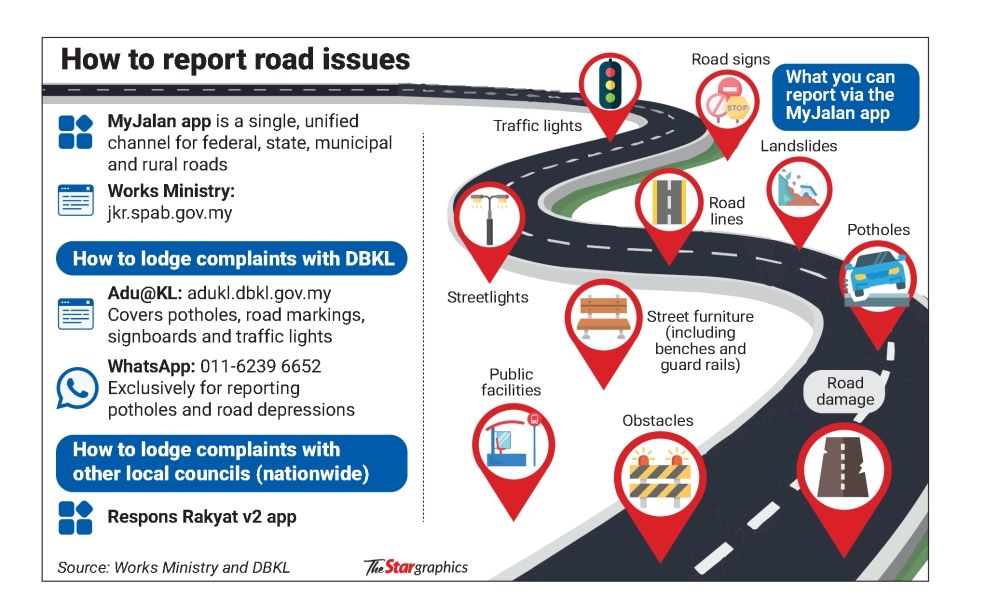
For roads under DBKL, complaints can be lodged via the Adu@KL system or through WhatsApp at 011-6239 6652.
Reports submitted via WhatsApp are registered in the Adu@KL system, although DBKL encourages direct submissions for faster response.
Adu@KL receives about 7,000 complaints on average a year, covering potholes, road markings, signboards and traffic lights.
For federal roads, complaints can be submitted through the MyJalan app, JKR and Works Ministry (KKR) complaint portals, e-mail or hotline.
Deputy Works Minister Datuk Seri Dr Ahmad Maslan had said in Parliament that about 90% of complaints received through MyJalan between August 2023 and January this year, or 15,160 out of 16,671 cases, have been resolved.
However, nearly 70% of total reports involved roads outside the ministry’s jurisdiction and were forwarded to the relevant agencies.
On paper, potholes reported via MyJalan must be repaired within 24 hours, while other road defects should be resolved within 15 days.
A social activist said that a sense of urgency should not stop at jurisdictional boundaries.
“If we already recognise that potholes are a safety risk, then it is only common sense to act immediately rather than be held back by bureaucracy,” said Alliance for a Safe Community (Ikatan) chairman Tan Sri Lee Lam Thye.
“If a pothole poses a safety risk, the responsible authorities should act immediately regardless of where it is located.”
He emphasised that repairs should be carried out comprehensively, not in fragments.
He had observed similar jurisdictional issues in areas bordering Taman Maluri in Kuala Lumpur and Pandan Jaya in Selangor.
“This is a recurring problem.
“The ministry should convene a meeting with all relevant authorities to streamline a coordinated response system,” Lee urged.
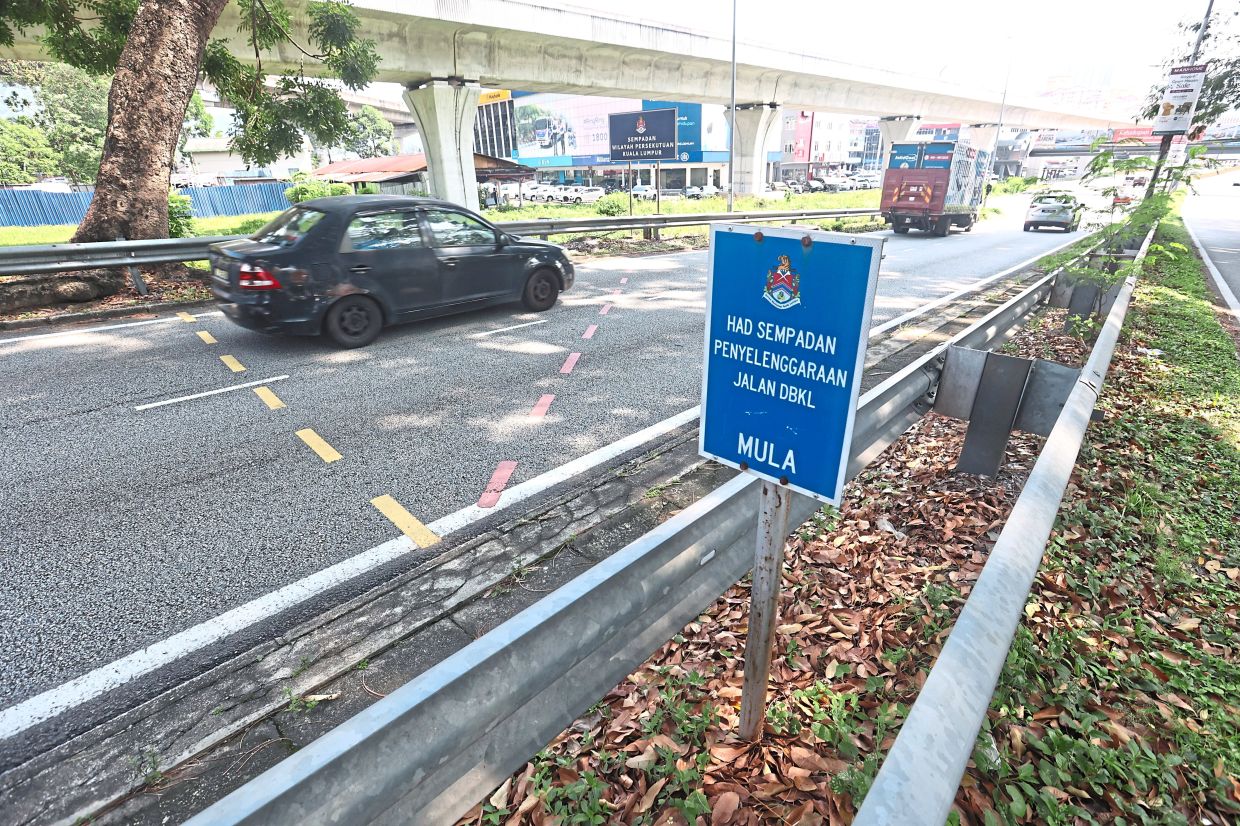



Boundary markers along Jalan Kepong show the maintenance limits between Kuala Lumpur and Selangor near the Kepong-Sungai Buloh border. —Photos: ART CHEN and FAIHAN GHANI/The Star
Rosli: Agencies should prioritise immediate repairs over administrative boundaries.
Fernandez: I have not handled a case where an incident happened in ‘no man’s land’.
Lee: Similar issue affecting Taman Maluri in Kuala Lumpur and Pandan Jaya in Selangor.
Lim: They only patched the portion on the Selangor side and ignored the Kuala Lumpur side.
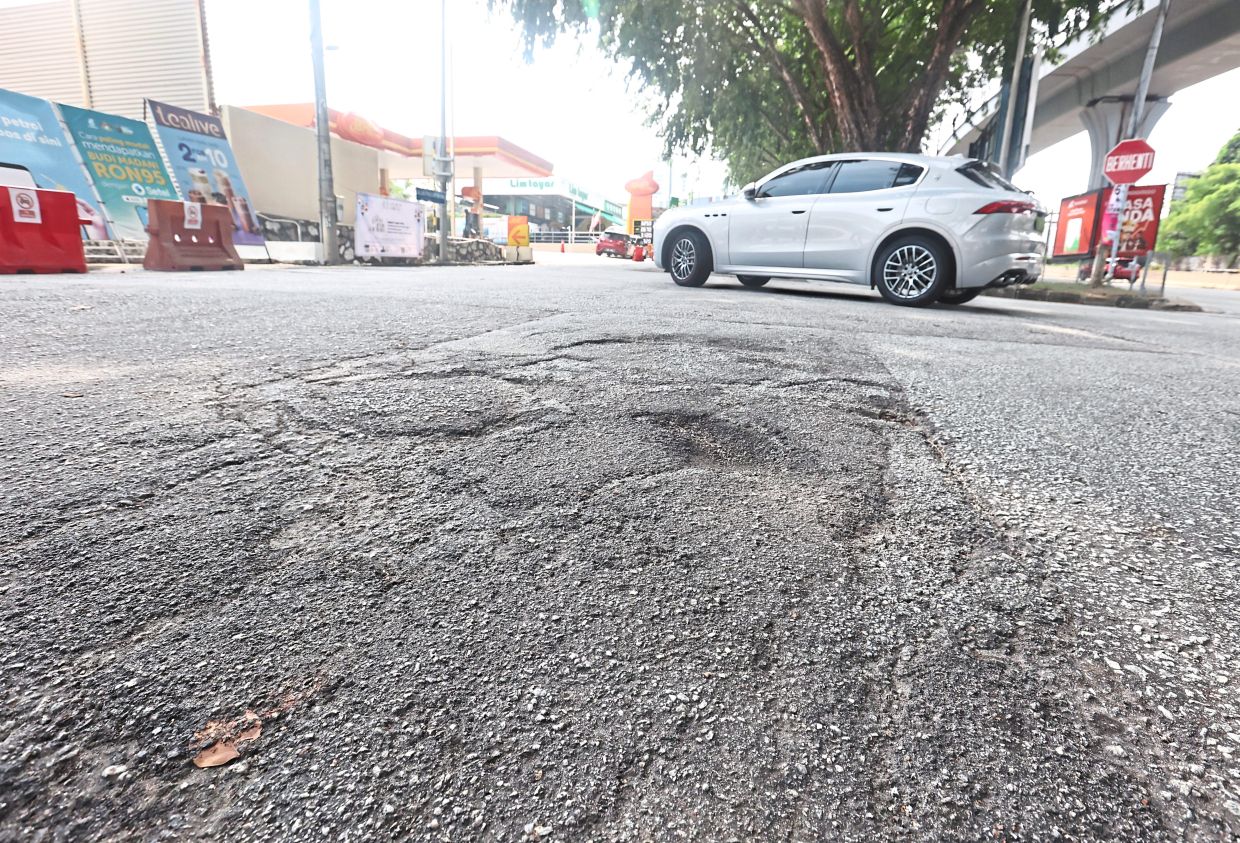
Uneven road surface along Jalan Damansara near the Petronas station junction of Taman Tun Dr Ismail, Kuala Lumpur.
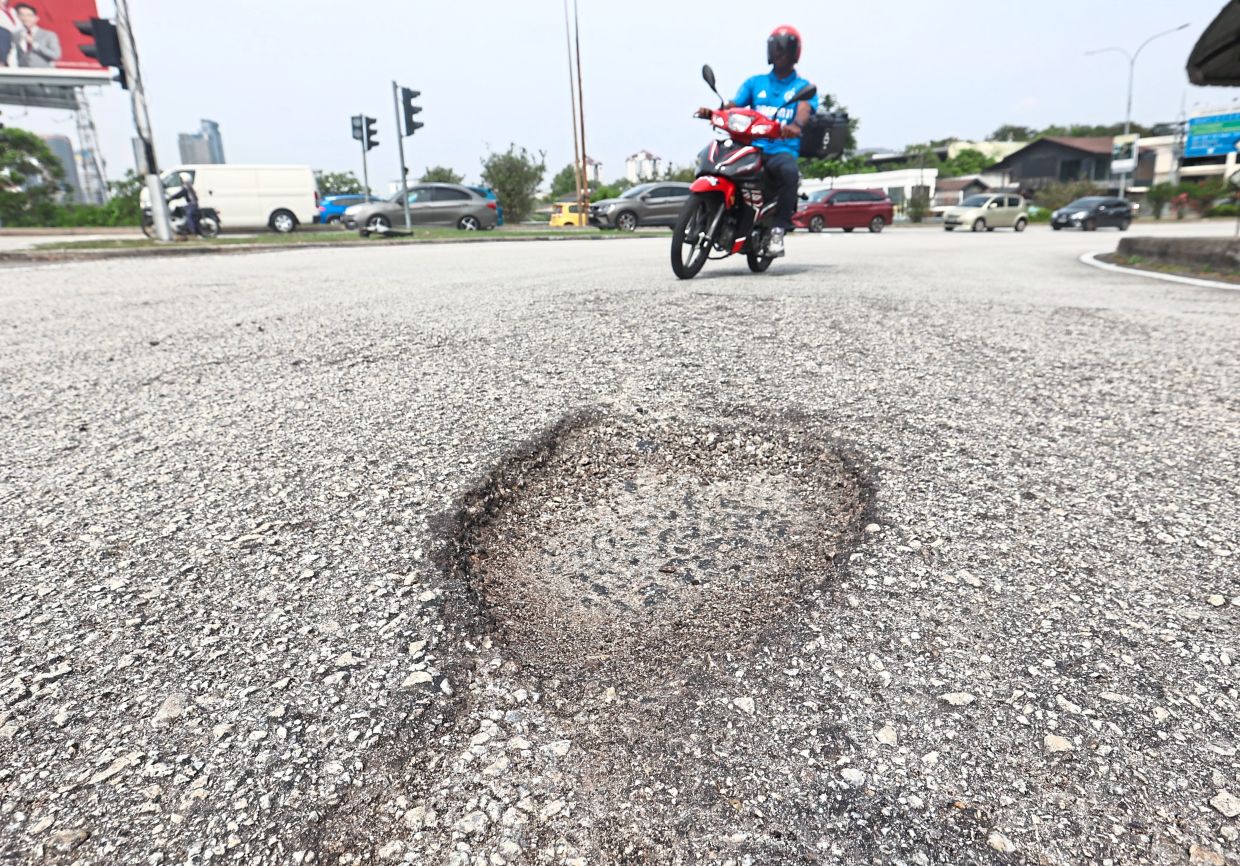
This pothole, near the slip road from University Malaya Medical Centre to the Federal Highway, is a potential hazard to motorcyclists when it is covered by water in heavy rain.