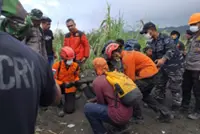
JAKARTA: Early on March 6, a 61-year-old motorcyclist riding along the busy Jalan Lingkar Timur in Sidoarjo, East Java, fell into a large pothole, was run over by a passing truck and died.
Twelve hours later, officials from the city government attended a lavish iftar (breaking fast) event. The Bollywood-themed event at the Graha Unesa convention centre featured elephant sculpture decorations and extravagant costumes.
Sidoarjo regional secretary Fenny Apridawati, who organised the iftar, posted a video of the event on her Instagram account.
The video – now deleted – drew dozens of angry comments from netizens who saw it as an insensitive gesture.
“Seeing officials flaunting their luxury and costumes in magnificent buildings, while Sidoarjo residents have to risk their lives every day crossing streets that resemble pools of water, is truly ironic,” said one commenter, as quoted by local news site Republik Jatim.
Sidoarjo, home to more than two million people, is a satellite city of Surabaya, the second-largest city in Indonesia after Jakarta. The city is known for fishery products such as prawn crackers.
But many of its public facilities are in disrepair and residents have appealed to the local government to take action.
The authorities have been slow to respond.
Tired of waiting, just a few weeks before, in mid-February, a group of local residents took matters into their own hands and pooled together their own money to fix potholes along a local road.
Their action drew the government’s attention.
“This mutual cooperation demonstrates the community’s strong social awareness and sense of ownership of their region,” Sidoarjo regional legislative council member Muhammad Zakaria Dimas Pratama said at the time.
“However, it also signals that the road infrastructure management system still needs a lot of improvement.”
Sidoarjo is not the only place in Indonesia where communities have banded together to fix public facilities when local governments fall short: Such community initiatives are not uncommon sights across the country, especially during the rainy season when weather conditions often cause damage to roads and gutters.
In 2025 alone, local media have reported on such community efforts as far-flung as Lampung in South Sumatra, Nunukan in North Kalimantan, and Taliabu Island in North Maluku.
The Office of the Indonesian Ombudsman, a state agency that oversees the implementation of public services, received more than 23,000 complaints about public services in 2025, the largest share of which were filed against local governments.
In Bekasi, West Java, just outside of Jakarta, a group of five friends calling themselves Generasi Burgeract (Generation Take Action) have made waves on social media for their efforts in cleaning bus stops and filling in potholes across the city.
Syafii Maarif Al-hafiz, 27, one of Generasi Burgeract’s members, said that he and his four friends – Jaka Prasetiyo, 29; Geraldi Weimy Suhestian, 25; Ilham Haristianto, 26; and Cornelia Agustine, 28 – had come up with the idea for the group after one of their regular late-night hangout sessions at the start of 2026.
“One of us had a pregnant colleague who had complained about the condition of one of the bus stops that she had to wait at on her way to work. It was really dirty and full of trash,” he told The Straits Times.
“We had heard a lot of similar complaints before and, of course, we ourselves often hit potholes as we drive through Bekasi. So we agreed to start this group (to improve things ourselves). We see it as a way to criticise the government through action,” he said.
They took to the streets in January and started with a bus stop clean-up. Their video of it gained a lot of social media attention, and they have changed gears from an initial plan to do one activity a month to doing one activity a week, usually at night after they finish work.
“It turns out there’s a lot to do, and the response from the public was very positive, so we decided to step it up,” Syafii told ST.
“So far, we’ve cleaned up four bus stops, and filled in potholes on four roads.”
The group of five friends calling themselves Generasi Burgeract (Generation Take Action) has made waves on social media for their efforts in cleaning bus stops and filling in potholes across the city.
Most recently, on March 7, the group filled in a 10m-long pothole on the Kalimalang route, one of the main roads that Greater Jakarta residents use to “mudik” (return to their home town) ahead of the Eid holiday.
While previous activities had been funded by the group’s own money, this latest venture was supported in part by donations from the public, as well as a free asphalt shipment from a local company.
Syafii said that other local residents have since wanted to join in, but the group has yet to take them up on it due to safety concerns.
“We still don’t have much safety equipment, like road cones. So we’re still thinking about how to mitigate the risks,” he said.
Bekasi Mayor Tri Adhianto has expressed his admiration of Generasi Burgeract’s efforts and praised them for being “energetic young people”.
“It is impossible for all of the city’s issues to be solved by the government alone,” Mr Tri said in January, after Generasi Burgeract’s first bus-stop clean-up video went viral, as quoted by news outlet Kompas.com.
But Indonesian Ombudsman Robert Na Endi Jaweng said that the fact that residents are moved to fix public facilities themselves indicates a form of maladministration by local governments, which should respond more seriously to this phenomenon.
“Regional heads shouldn’t be proud and boast, ‘Wow, our residents are self-sufficient.’ Because that’s the government’s responsibility,” Mr Robert told ST.
“Even if residents do participate, it should be collaborative... not because the government is incapable, but because it’s part of their civic awareness.
“What’s happening isn’t awareness, but rather a form of distrust and criticism of the local government for failing to fulfil its obligations,” he added.
Syafii said that the city government had asked to meet Generasi Burgeract to “show appreciation”, but the group had not yet managed to set a time because of their work schedules.
“Of course, our hope is that the city government can take action themselves because they’re the policymakers,” he said. - The Straits Times/ANN