There are cities that announce themselves with skylines – Kuala Lumpur does it with smoke.
Not the polite, Instagrammable kind. But the real thing: Charcoal coughing into the night, fat dripping, flames licking metal fans, the perfume of turmeric and lemongrass clinging to your shirt long after you’ve gone home.
You don’t see satay first in this city. You smell it. And once you do, you belong to it.
We talk a great deal about nasi lemak, and rightly so, but satay is our shared heartbeat. No race, no postcode, no bank balance.
Banker in Mont Kiara. Mechanic in Balakong. Datuk in Damansara. Grab rider double-parked under a flickering streetlight. All of them standing shoulder to shoulder, waiting for those sticks to land.
That’s not food.
That’s democracy.
And if satay has a capital, it is Kajang.
Kajang did not set out to become famous. It was a tin-mining town, a railway stop, a place you passed through on the old road south. But history – like good marinade – needs time.
In the early 20th century, Javanese migrants brought with them a way of cooking meat over open flame, seasoned deep with coriander, cumin, galangal and palm sugar.
What Kajang did differently – and this is where legend begins – was standardise perfection.
Uniform cuts. Precise fat-to-meat ratio. Relentless charcoal heat. A marinade that leans sweet, but never apologises for it.
The result? A satay that was smaller, tighter, more caramelised than anywhere else in the country – engineered for speed, consistency, and the Malaysian appetite for “another 10, boss.”
Kajang became a pilgrimage. Not because someone declared it so, but because thousands of families drove there on weekends and went home smelling like heaven.
This is how food capitals are born in Malaysia. Not through Michelin stars, but through memory.
And here’s the part we almost don’t notice anymore.
Malaysia Airlines – our flying national theatre – serves satay in Business Class.
Think about that.
At 35,000 feet, somewhere between continents, in a pressurised cabin full of Australians, Japanese executives, London bankers and first-time tourists, what do we present as the opening act?
Not caviar. Not foie gras. Not wagyu. Satay – sticks of grilled meat and a bowl of peanut sauce. A dish born at roadside fires, now plated on fine china above the clouds.
That is not catering. That is a cultural flag planted in the sky.
Foreigners write about it like it’s a novelty – “the famous Malaysian satay service” – but for us it’s so normal we barely look up from our movie screen.
Somewhere over the Bay of Bengal, a flight attendant is fanning smoke from an electric grill in a galley the size of a walk-in wardrobe, and we’re asking for extra sauce like it’s supper at home.
We take this for granted because satay has never left us.
It’s at weddings, carried out in aluminium trays at midnight when everyone is slightly emotional. It’s at Ramadan bazaars, smoke rising into the call to prayer.
It’s at Chinese New Year open houses. It’s at Deepavali gatherings. It’s outside football matches. It’s next to construction sites at 1am feeding men in reflective vests.
Satay is not Malay. Not Indian. Not Chinese.
Satay is Malaysian in the way the PETRONAS Twin Towers are Malaysian – engineered from many hands, speaking in one voice.
And then there is the sauce.
Peanut, yes, but also tamarind, chilli, gula Melaka, toasted rice, sometimes pineapple, sometimes a family secret that will go to the grave.
It is sweet, hot, earthy and dangerously drinkable. Every Malaysian has a preferred viscosity. Every Malaysian believes his or her version is correct.
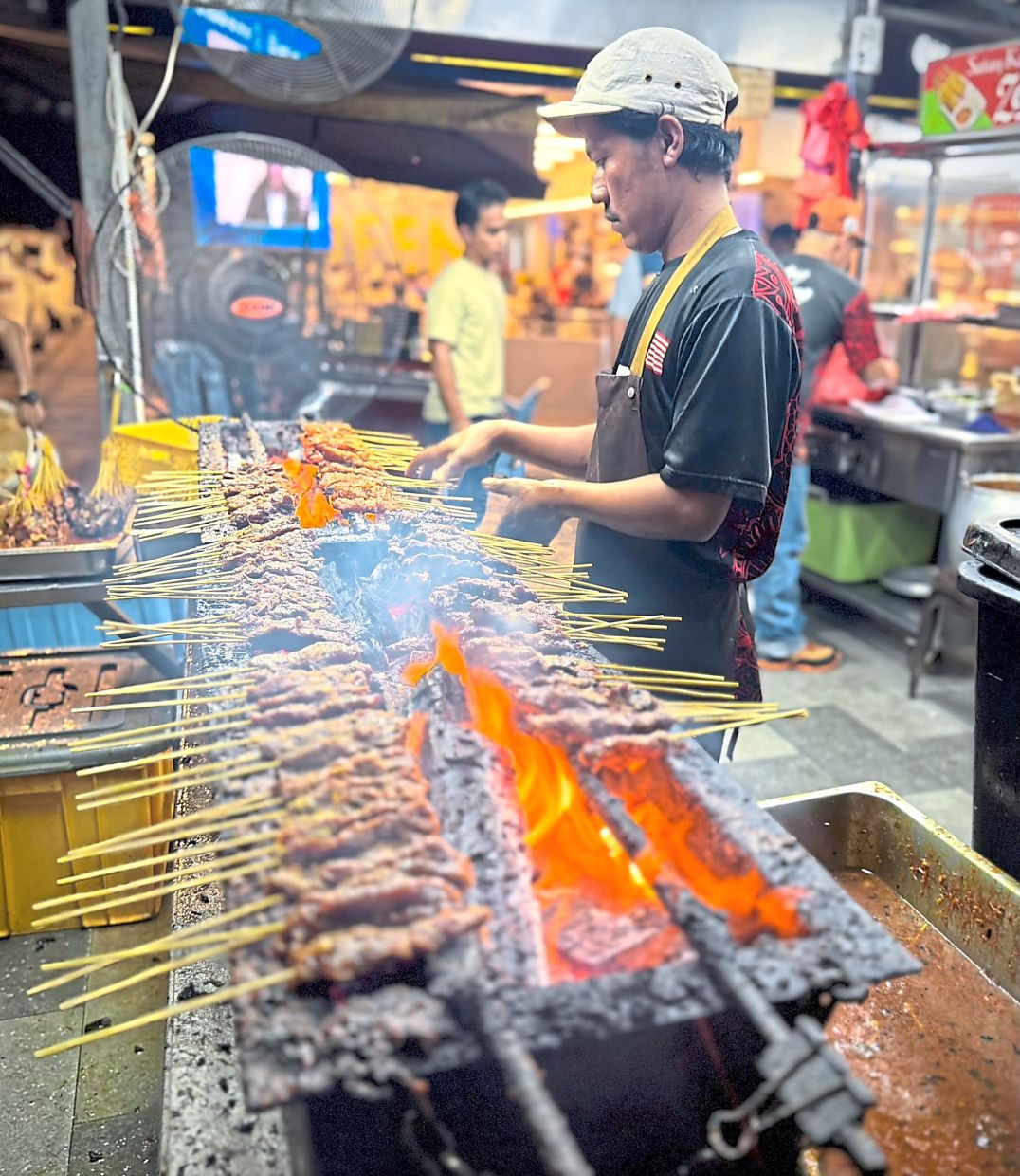
Stand in Kajang on a humid night and watch the grill master work. The fan in one hand, the skewers in the other, the constant turn-turn-turn so nothing burns, everything caramelises. It is choreography. It is jazz. It is the sound of a nation eating.
And the best part? It is still cheap enough to order too much. That – more than anything – is the miracle.
Because in a city now obsessed with omakase counters, imported truffles and tasting menus that require a bank loan, satay remains gloriously, stubbornly accessible. It refuses to become elite. It refuses to behave.
You don’t book satay. You queue for it. You point. You argue about how many.
You eat it too fast and burn your fingers. You wipe the sauce with ketupat like you’re committing a small but necessary crime. You go home smelling of smoke and happiness.
For those of us who live here, who grew up with these flavours so embedded in our DNA that we barely articulate them, satay is not exotic. It is background music.
But step away for long enough – live in another country, eat polite food under polite lighting – and the first bite when you return will hit you like a love letter you didn’t know you’d been waiting for.
Charcoal. Turmeric. Peanut. Sugar. Fire. Kajang didn’t just make satay famous. It made a national language out of skewers and smoke.
And somewhere tonight, on a street corner in KL, under a plastic tarp and a single fluorescent bulb, a man is fanning a grill while a dozen strangers wait in silence for their number to be called.
No one is checking their phone. No one is in a hurry. Because in that moment – with the heat on your face and the smell in your hair – you are exactly where you are supposed to be.
That is satay.
That is us.
The words expressed here are entirely the writer’s own.
Abbi Kanthasamy blends his expertise as an entrepreneur with his passion for photography and travel.