




A Hong Kong homemaker sits alone at a pinball machine at a shopping centre in Sham Shui Po on a weekday morning, engrossed in the game for an hour before picking up her sons from school for lunch.
The 47-year-old mother-of-two, who only identified herself as Mrs Cheung, said she played pinball machines at least twice a week at Dragon Centre, including once on the weekend with her family of four as entertainment.
“We just have fun as a family and use the points we earn from the games to redeem the prizes we want,” she said. “We all enjoy it.”
The family’s favourite pastime reflects a citywide craze for pinball and claw machines, a trend growing so fast that it has prompted authorities to consider tightening regulations to prevent addiction to the games amid a debate over whether they should be viewed as gambling.
The Home and Youth Affairs Bureau earlier this week proposed amending the city’s gambling laws to require an amusements with prize licence for every individual machine, citing addiction risks associated with prize-based games.
The bureau also plans to strengthen licensing requirements by mandating entrance notices and is considering a requirement for addiction warnings to be displayed on all machines.
A pinball machine powered by tiny steel balls requires players to purchase a prepaid card for credits, ranging from HK$10 (US$1.27) for 10 balls to HK$2,000 for 18,000. The card allows unused and earned balls to be withdrawn or banked.
Each round requires a play of five to 99 balls, which activates a random multiplier. Using a plunger to launch the pinball, players aim for lit channels – with varying reward points – hoping to score a windfall.
But the catch is that players must win 50 balls in a single round to yield one point that can go towards a variety of prizes, such as a portable fan for 10 points to a Sony PS5 console for 15,000, among other electric appliances.
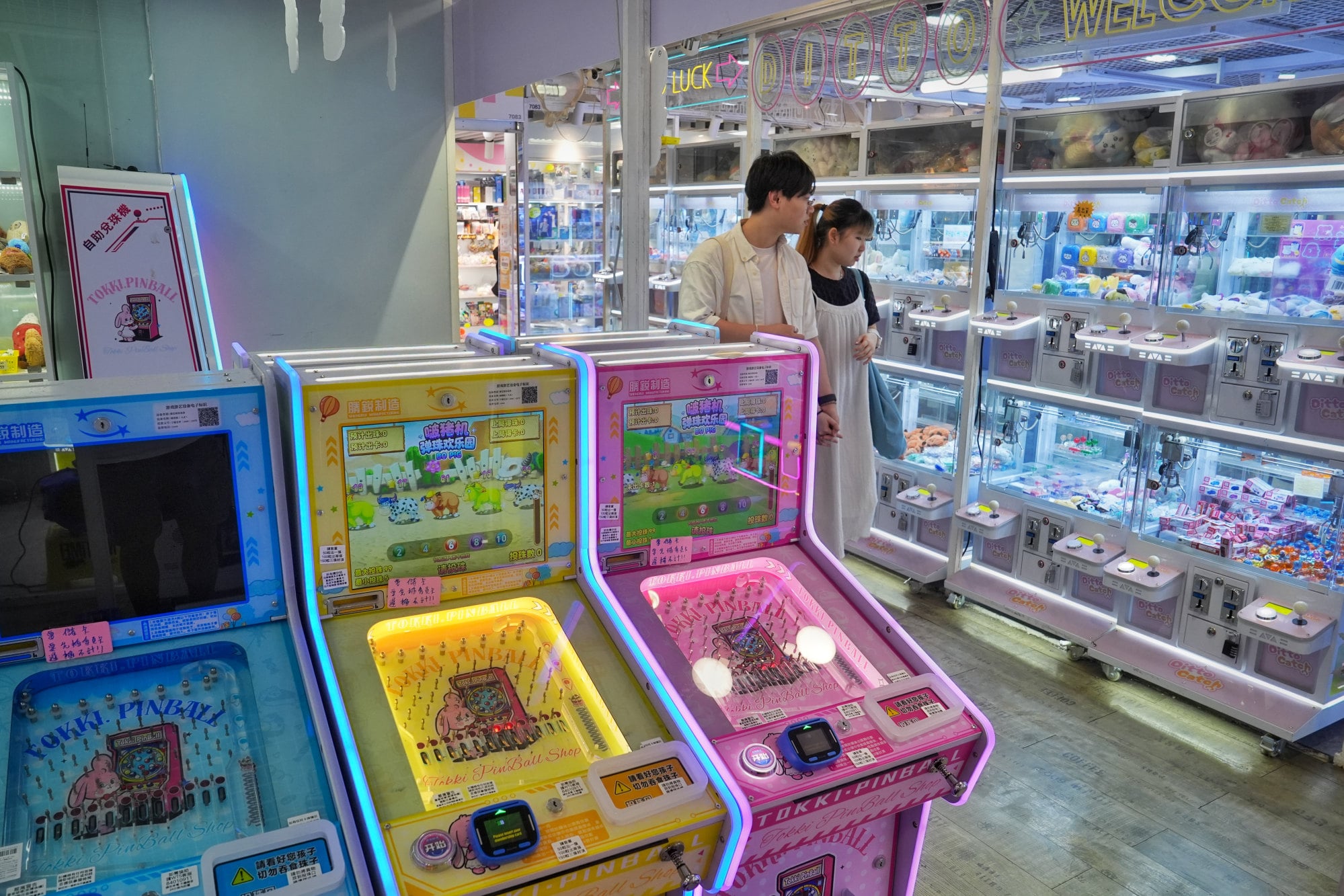
A South China Morning Post reporter tested the game by purchasing 550 balls for HK$100 at one of the three parlours at Dragon Centre. Playing for nearly an hour, the reporter managed to earn six points, with a balance of 400 balls remaining on his card.
The reporter, unable to tolerate the loud music and noise from the machines, left without using the remaining credit and with too few points to redeem any prizes.
But Cheung spent at least an hour at the shop, unbothered by the cacophony – the rhythmic clatter of steel balls cascading through metal pins, the relentless electronic chimes and constant blaring of anime soundtracks.
She said she did not consider the game a form of gambling because it was not a money-in, money-out operation.
“In a casino, the money is gone once you lose, but playing these machines is more like a lucky draw to see if you can redeem items you like,” Cheung said, adding that she limited her monthly spending to HK$500 and simply stopped playing once her card balance ran out.
A pinball parlour operator who only gave his first name, Daniel, told the SCMP that he expected the proposed regulation would cause him to lose at least a third of new customers.
Daniel said he was concerned that tighter regulations would indirectly classify such games as gambling.
“Should the government seek to amend the regulations, I hope they take the time to fully understand the nature of this game, as my experience as an operator shows it is a game of skill rather than one based purely on luck,” he said.
Beyond storefronts, hundreds of claw machines are scattered across various floors of the Dragon Centre mall.
For just HK$5 a turn, people of all ages can try to win prizes ranging from Jellycat plushies to rare Pokemon cards and Labubu figures.
Johnny Law, a 17-year-old secondary school student who spent his lunch break playing claw machines to win a specific plushie, argued that regulations should be applied fairly across the board if the intention was to curb addiction.
“If the government believes these machines lead to addiction, they should also regulate toy blind boxes and in-game purchases in mobile apps. They are way more addictive and uncontrollable,” he said.
“I don’t see claw machines as gambling, but rather as paying for a chance to obtain products that are not easily found in retail stores.”
Law said he spent HK$100 a month on claw machines.
Clinical psychologist Amos Cheung Chuen-yih said that a rational discussion was needed to strike a balance between entertainment and addiction.
“When you have an uncertain probability paired with an uncertain return, it becomes incredibly easy to get hooked,” he said, adding that the thrill of the “near-miss” or the unexpected win triggers a powerful neurological response that drives people to want more.
He noted that individuals who were naturally prone to anxiety or were particularly sensitive to loss were less likely to become addicted.
“But when participants feel they have a stake in the process, it leads to a cognitive bias where they believe they can master or calculate the results. This is exactly what happens in casinos with games like poker,” he explained.
Cheung added that disclosing the probability of winning prizes on such machines, similar to the approach taken in mainland China, could help promote the message of “rational spending”. -- SOUTH CHINA MORNING POST


