
US President Donald Trump’s landmark visit to China comes as the US-Iran war disrupts global energy supplies, fuels economic uncertainty and adds fresh strain to Washington-Beijing ties. In the second instalment of a series examining how rivalry, interdependence and geopolitical crises are reshaping the relationship between the two powers, we weigh the odds of a major deal for Boeing aircraft after nearly a decade without a significant order from Chinese airlines.
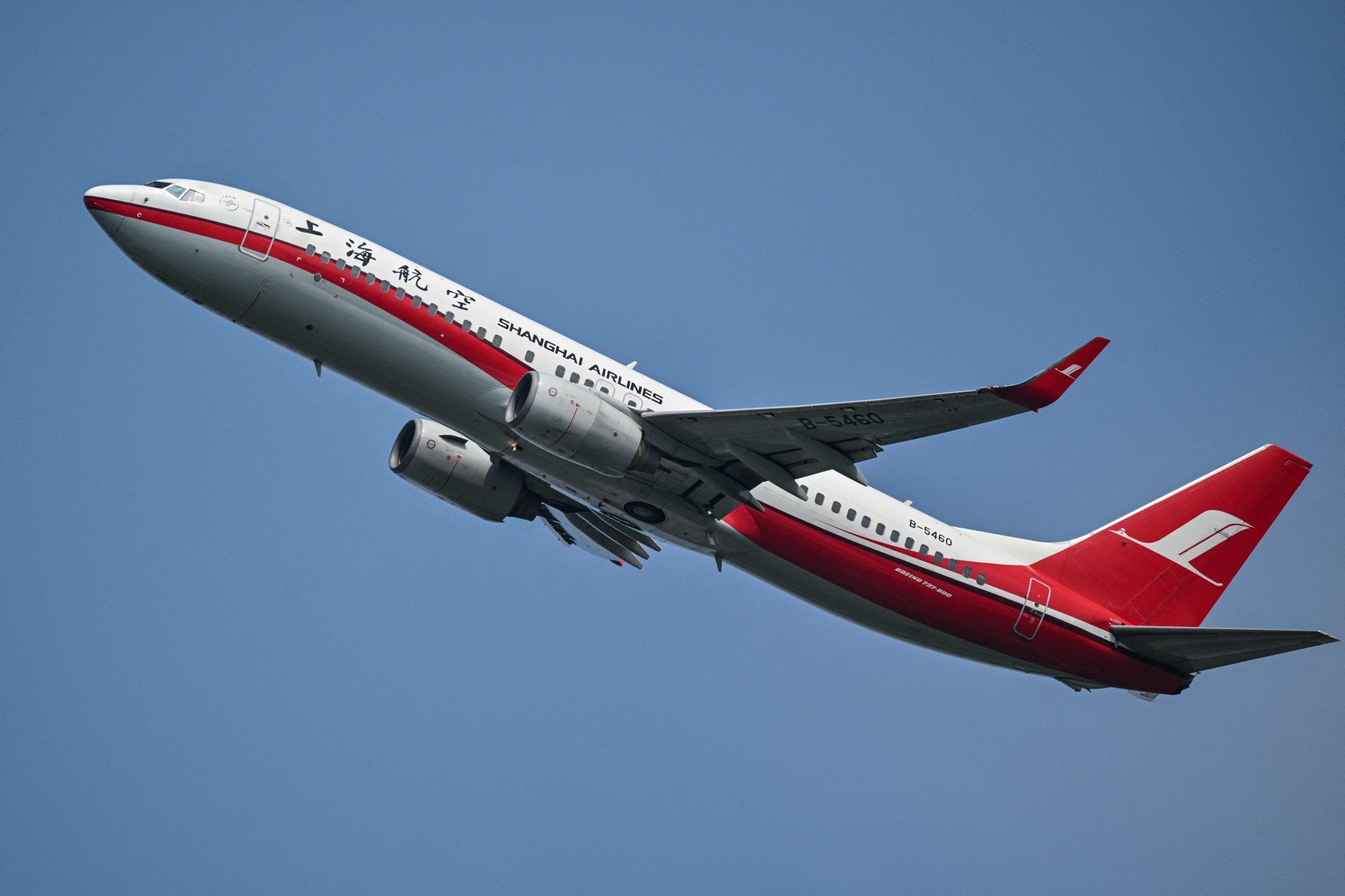
Shanghai Airlines was flying high in 2018.
One year after US President Donald Trump’s first visit to Beijing, the China Eastern Airlines subsidiary had expanded its fleet of Boeing jets to 100 with its first state-of-the-art 787 Dreamliner widebody, signalling ambitions to spread its wings across the globe.
But its expansion was thrown into a tailspin soon after by a perfect storm: Covid-19, safety issues with the US planemaker’s 737 Max series and, more consequentially, cooling ties between Beijing and Washington.
Now, only 87 ageing planes fly with Shanghai Airlines livery. The carrier remains hamstrung by China’s extended pause on major Boeing purchases, a freeze that has lasted nearly a decade.
That turbulence has also found its way home. In North Charleston, South Carolina, the production base for the 787 and a Trump election stronghold, workers reckon with the economic cost of the prolonged purchase drought and dream of a China trade breakthrough.
This month, Trump is scheduled to make his second trip to China, his first since winning a second term. Could it result in a lift for Shanghai Airlines and new deals for the American planemaker?
Trump received a “Boeing gift” on his first visit – a US$37 billion deal to buy 300 of the manufacturer’s aircraft – that later stalled.
Analysts and industry insiders said whether he will iron out a similar deal during his forthcoming visit remains up in the air, but they agree attempts to strike an agreement are being made, with talks being held on both sides of the Pacific.
US outlet Semafor reported on Thursday that Boeing CEO Kelly Ortberg was among the business heavyweights the White House planned to invite on next week’s trip to China. Separate China-based sources told the South China Morning Post that Boeing’s staff in China could be preparing for a visit by “top brass” from the planemaker’s US headquarters, and that some executives may also visit Shanghai.
Some say both countries want to insulate any orders from geopolitical turbulence, with China unlikely to attach too many strings, but there are other variables to consider.
“Signs suggest negotiations are advanced but not yet finalised,” said American business executive Benjamin Kinnas, a former chairman of the American Chamber of Commerce in Shanghai’s financial services committee. A frequent flier with Shanghai Airlines during his time in the city, he now lives near Boeing’s North Charleston plant.
“[This is] typical for orders of this scale that tend to align with high-level political deal-making as much as commercial benefits.”
An American source with knowledge of ongoing talks said the short-term outlook was hazy and that a deal might go down to the wire.
“[A deal] will likely happen, but be a last-minute decision and crunching out of numbers and such,” he said. “The stakes for US commercial interests are too high for Trump to ignore.
“But no May deal is not mayday for Boeing. If May is a missed opportunity, a deal may happen by year’s end, when Trump and [President Xi Jinping] may meet again.”
The source named two intergovernmental forums, the Asia-Pacific Economic Cooperation and Group of 20, as possible venues for a later meeting.
One of the clearest signals yet about the likelihood of a deal came from Washington’s top trade negotiator.
US Trade Representative Jamieson Greer told Bloomberg in March that the US wanted to “sell planes to China”, alongside medical devices, pharmaceuticals and agricultural products, to significantly reduce its bilateral trade deficit by the end of the year.
Leverage or flexibility?
Kinnas said Beijing had previously used aircraft purchases to signal goodwill, and that such deals were “intended to balance trade flows”, especially as Boeing was one of America’s largest exporters.
“There is also the possibility that any order may be treated as Beijing’s leverage, potentially influencing issues such as tariffs or export controls,” he said, while adding that he believed an understanding of mutual benefits would outweigh such considerations, as it had done in 2017.
China did not seek to extract significant, explicit concessions nine years ago, with the Boeing deal framed instead as a move to build rapport with Trump as part of a US$250 billion package.
Kinnas said Beijing could exhibit similar goodwill this month and allow for significant flexibility, a view echoed by a source in China familiar with negotiation arrangements.
The source said China was allowing airlines to talk to Boeing individually, marking a departure from the past practice of bundling jet deals together in bulk negotiations.
“When you are not going to interfere too much, you allow them the autonomy to talk to Boeing on their own,” the source said, adding that could mean new purchases might be spread out.
“Instead of an all-in-one-go deal, like the one in 2017, this time, purchases may be announced by individual carriers, not deliberately timed to coincide with Trump’s visit for diplomatic effect.”
Cameron Johnson, a senior partner at Shanghai-based Tidal Wave Solutions who specialises in supply chains, said such flexibility indicated both countries realised they had other, more powerful cards in trade negotiations than deals for planes.
“Both have bigger leverages: chips, rare earths, export controls ... the Iran war could also be a talking point ... aircraft can be spared,” he said.
Boeing’s business in China was battered after Trump unleashed sweeping “reciprocal tariffs” in April last year, prompting Beijing to retaliate. With tariffs climbing to triple-digit levels, meaning a de facto embargo, company CEO Ortberg admitted that Chinese carriers had rejected deliveries.
The planemaker’s fortunes have revived somewhat since the brokering of a tariff truce in May last year and its reinforcement in October after Trump and Xi met in South Korea.
As the dust of the tariff war settled, stakeholders revived engagement.
In July, the South China Morning Post reported that the Civil Aviation Administration of China (CAAC) had begun surveying airlines’ needs for foreign jets, and CAAC director Song Zhiyong met Boeing senior vice-president Brendan Nelson the same month.
In September, US lawmaker Adam Smith, from Boeing’s home state of Washington, hinted at a deal when he led a rare bipartisan visit to China.
US Ambassador to China David Perdue said the same month that a deal was “very important to the president”, and he confirmed that progress was being made when he addressed a closed-door meeting in Hong Kong in January.
And in December, Chen Chao, director of the Ministry of Commerce’s America and Oceania division, had a meeting with new Boeing China president Landon Loomis. A fluent Mandarin speaker, Loomis is a former adviser to Trump’s previous vice-president Mike Pence.
Pent-up demand, concerns and Comac
China has several operators with Boeing-only fleets and its aviation sector, the world’s second largest, used to account for around a quarter of the company’s global sales.
Shanghai Airlines has both 737s and 787s, with an average service age of more than 10 years, while Shandong Airlines operates 135 of the narrowbody 737s and China United Airlines has 57. Low-cost carrier 9 Air and Donghai Airlines each have more than 20 of the smaller craft.
Many have put off refreshing their old fleets, making a new deal all the more crucial.
As a stopgap measure, Shandong Airlines, a subsidiary of flag carrier Air China, announced plans in March to lease 10 737s, some of them used, in a 2.88 billion yuan (US$421 million) deal with domestic firms.
But independent aviation analyst Brian Yang Bo said that while their demand was tangible, so too were China’s safety concerns.
“These carriers are known for a long-standing preference for Boeing,” he said. “Still, the CAAC and airlines also want strong safety, quality and delivery assurances, especially for the 737, a workhorse model for Chinese operators, so they can move the order forward with conviction.”
Shortly after a second fatal crash of a 737 Max in March 2019, China was among the first countries to ground the aircraft. It was also one of the last to allow the jet back into the air, as Boeing lurched from one crisis to another.
A string of other incidents, from a door plug blowout to fuselage gaps, also dented passengers’ confidence.
A sector-wide supply chain crunch that has delayed Boeing production has further complicated purchase calculations.
“If an airline ordered a new 737 today, they likely wouldn’t see it until the early 2030s ... who has the patience?” Yang asked. “Even if a deal is inked, it’s never an immediate relief for China’s Boeing-only operators and some are reviewing fleet diversification options.”
Those concerns may have led to Beijing delaying the deal-making process.
“While there is no explicit evidence of a formal quid pro quo, China can slow-roll decisions, redirect orders to others or focus on its domestic manufacturing as part of a long-term industrial plan,” Kinnas said.
“It would reflect a mix of supplier diversification and supporting domestic industry, all while taking advantage of the long lead times and backlog at Boeing that give China room to manoeuvre.”
Other than a recent string of big-ticket deals for Airbus planes, Chinese airlines have also ordered hundreds of single-aisle C919 passenger jets – billed as the domestic competitor to Boeing’s 737 series – made by the Commercial Aircraft Corporation of China or Comac, with more than 30 already in domestic service.
Boeing’s Ortberg appealed to Trump late last month to help seal a deal, telling Reuters the planemaker was counting on the US government to help unlock an order from China.
“Without the administration’s support, I don’t think we’ll see any near-term large orders out of China,” he said. “It really is something that would be tied to the effort from the administration.”
Whether those hopes will take flight should become apparent in the days after Trump’s Air Force One – a modified Boeing 747 – touches down in Beijing on Thursday. -- SOUTH CHINA MORNING POST