




WHILST some animals give birth to live young, others lay eggs.
For some species, fertilisation can happen inside the body or outside in the water. Nature is indeed full of surprises.
But is it true that there’s a toad where its young bursts from their mother’s skin?
Verdict:

TRUE
The animal in question is the Surinam toad, scientifically known as Pipa pipa.
Though it might sound unbelievable, this toad's babies actually grow inside the skin on their mother's back in one of the strangest birth methods in the animal kingdom.
The Surinam toad is native to South America, inhabiting slow-moving water sources such as rainforest pools and moist leaf litter throughout eastern Trinidad and Tobago and much of the Amazon Basin, including its namesake country, Suriname.
Reproduction begins with an elaborate mating ritual often described as a "nuptial dance" that can last over 12 hours.
The male grabs the female around the waist in a mating embrace called amplexus, and the pair performs loop-the-loops in the water.
At the top of each loop, the female releases a few eggs, which the male fertilises and positions onto her back.
By the end of this aquatic ballet, dozens of eggs are attached to the female's back.
Within a few days, the eggs become completely engulfed by their mother's skin, forming honeycomb-like depressions directly within the tissue.
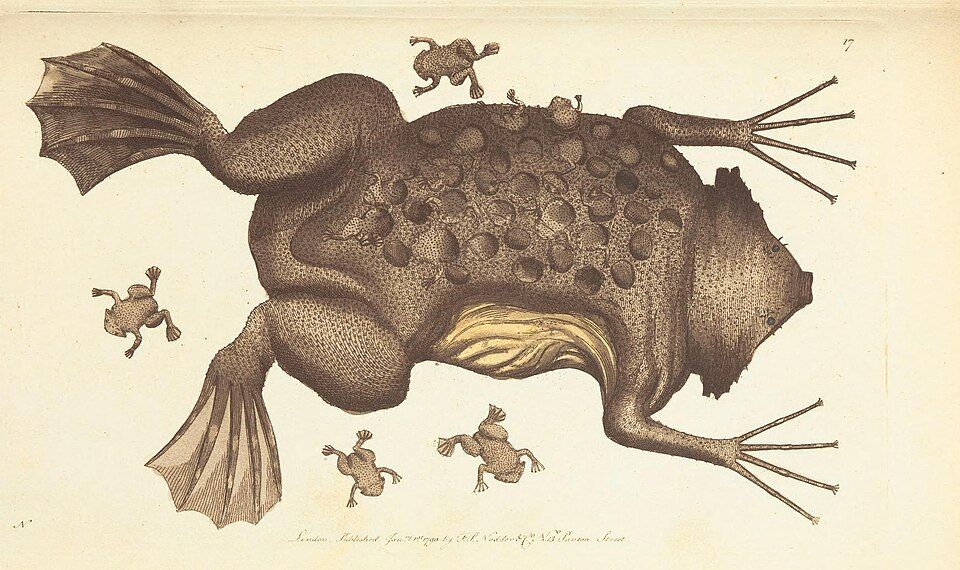
A layer of skin develops over the eggs as a way to protect them as they grow, causing them to disappear from view entirely.
The embryos develop through to the tadpole stage inside these pockets but do not emerge as tadpoles.
Instead, they remain in their chambers until complete development to the fully formed toadlet stage.
This process typically takes between 12 to 20 weeks, or about three to four months.
As the young toads grow, they move around inside their chambers, creating a rippling appearance on the female's back.
Eventually, the tiny toads break out of their chambers and emerge from their mother's back through the holes, fully formed and ready to swim away.
When born, the toadlets are only about 25mm long but look identical to their adult counterparts.
After giving birth, the mother slowly sheds the thin layer of damaged skin and grows a new one for the next breeding season.
Though this back-breaking labour may seem bizarre, it's actually a parental care strategy that keeps the babies safe from predators until they're ready to begin their own lives.
The International Union for Conservation of Nature currently classifies the Surinam toad as "Least Concern" based on a 2014 population assessment, though its habitat faces threats from human encroachment, including logging, farming and ranching.
References:
1. https://www.
2. https://www.
3. https://www.iucnredlist.org/
4. Shaw, G., & Nodder, F. P. (1789). The naturalist's miscellany: or Coloured figures of natural objects; Drawn and described immediately from nature (Vol. 1). Nodder & Co.


