
PETALING JAYA: With growing labour costs and more compliance expenses, micro, small and medium enterprises (MSMEs) are facing a crunch. But some targeted tax relief can help them tide things over.
Such time-bound tax relief could help these enterprises manage rising costs, preserve cash flow and invest in productivity, say business representatives.
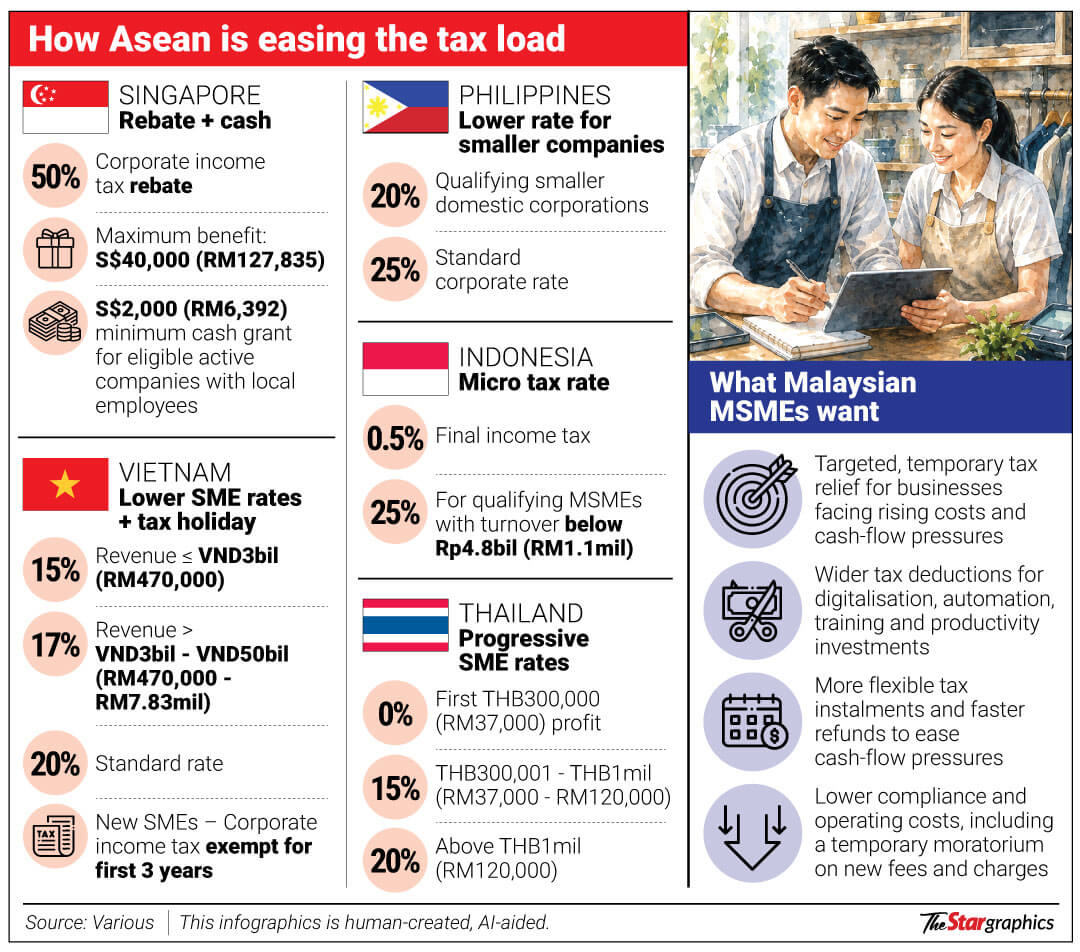
They were responding to a call by Malaysian Employers Federation president Datuk Dr Syed Hussain Syed Husman for targeted and temporary tax relief for MSMEs facing exceptional cost pressures.
He had called on the government to explore innovative solutions like faster and simpler access to financing, and greater use of cash-flow-based lending.
Tax expert Datuk Koong Lin Loong said incentives should be directed at companies investing in digitalisation, automation, workforce training, research and development (R&D) and export expansion.
Koong, who is also Associated Chinese Chambers of Commerce and Industry of Malaysia treasurer-general, said such measures could help businesses cut costs and improve competitiveness.
He proposed allowing double tax deductions for those spending on digitalisation, automation, upskilling and reskilling programmes. Koong said this would be more practical than a grant-based system.
He also called for temporary tax rebates for firms that reinvest in productivity-enhancing activities as well as measures to ease cash-flow constraints.
Koong proposed allowing firms with tax credits to offset them against current tax liabilities under the CP204 tax installment system instead of waiting for refunds.
For businesses unable to settle tax liabilities in full, he said a conditional tax deferment scheme could also be considered.
Small and Medium Enterprises Association president Datuk William Ng said MSMEs are facing a cumulative squeeze on profit margins due to higher labour costs and growing compliance expenses.
Businesses are dealing with costs linked to digital compliance, mandatory e-invoicing, environmental, social and governance requirements within supply chains, as well as increases in local council fees and licensing assessments.
“Government and local authorities should impose a temporary moratorium on new administrative and statutory fee increases.
“Future wage adjustments should be tied to measurable productivity gains and supported by targeted workforce upskilling grants.
“Blanket wage increments also strain smaller businesses.”
On tax measures, Ng proposed expanding the preferential tax brackets for SMEs, with a 15% tax rate on the first RM500,000 of chargeable income and 18% on the next RM500,000.
He said the proposal could provide SMEs with up to RM30,000 in additional retained earnings for working capital.
Ng also called for double tax deductions for expenses related to e-invoicing integration, enterprise software, automation machinery and certified workforce training.
The Inland Revenue Board (LHDN), he said, should speed up tax refunds, which would provide immediate liquidity to businesses.
SME Association of Malaysia president Dr Chin Chee Seong said Malaysia had already introduced various tax incentives, rebates and preferential tax rates for MSMEs, many before the current period of rising business costs.
“However, the present operating environment calls for additional targeted and temporary measures rather than simply relying on existing incentives,” he said.
The government could consider temporary tax relief or additional deductions for MSMEs affected by rising wages, utility bills, rental, compliance and other operating costs, he said.
It could also introduce more flexible tax installment arrangements through LHDN, including allowing eligible MSMEs to reduce or reschedule their estimated tax instalments.
“For MSMEs, every ringgit temporarily retained in the business can be used for wages, inventory, digitalisation, productivity improvements and business expansion,” he said.
When contacted, Deputy Finance Minister Liew Chin Tong said he would look into requests raised by the relevant groups.