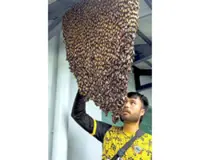
IPOH: What began as a childhood fascination with bees has grown into a mission for beekeeper and rescuer Syafiq Jazli Hasikin to change public perception of bees from pests to vital pollinators.
Syafiq, 34, became fascinated with bees at the age of nine after watching his father, Hasikin Mat Soho, 59, and other experienced beekeepers handle them without protective clothing.
“He initially experienced swelling after being stung but gradually became accustomed to handling bees and eventually began collecting and selling colonies to villagers,” said Hasikin.
Syafiq later learnt about bees through books and practical experience, eventually joining his father in running Madu Pak Long, a business that now also sources wild forest honey and operates bee farms.
However, in recent years, Syafiq’s focus has expanded beyond beekeeping to rescuing bees and educating the public on their importance.
He has been involved in bee rescue for about 10 years, initially helping friends and acquaintances.
Syafiq began posting videos two years ago to raise awareness and encourage people to seek alternatives when bees swarm or build nests in their homes.
His bee rescue service, which has operated around Ipoh since early this year, is provided free of charge.
“The main objective is not simply to rescue bees but to create lasting public understanding. I make videos because I want to create awareness.
“It is about educating the public on their crucial role in the ecosystem,” he said in an interview at his shop here.
“The response has been encouraging. Some people who previously would have immediately killed the bees now contact me for advice, including people from Sabah and Sarawak,” he said.
ASLO READ: Group: Relocate, not destroy
Syafiq said bees generally do not attack unless threatened, adding that fear often stemmed from a lack of understanding.
For rescue operations, Syafiq mainly handles four honey bee species: Apis cerana, Apis florea, Apis dorsata and Apis andreniformis.
Smoke is used to calm the bees and disrupt their alarm communication before the colony is safely relocated.
Only Apis cerana is kept for beekeeping, while the other species are relocated to suitable habitats.
Syafiq said declining bee populations were worrying as bees played an important role in pollination and food production.
Habitat loss caused by development and logging, large-scale agriculture, pesticide use and climate change were among the factors affecting bee populations, he said.
However, he added that another issue that should be addressed was how bees were handled when they entered residential areas.
His father said their relaxed and entertaining approach on social media had also helped make bees less frightening, adding that more people were now seeking help instead of destroying colonies.
“We deliberately do not wear gloves because we want to show people that bees are not dangerous.
“If we went there dressed in protective clothing, people would become even more afraid,” he said.
He said people were now increasingly willing to approach and even hold bees after watching their videos.
Syafiq said his ultimate goal was simple: “I want people to love bees.”