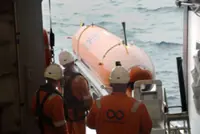
PETALING JAYA: The search for the wreckage of Malaysia Airlines Flight MH370 will continue following the extension of an agreement between the government and Ocean Infinity, says Anthony Loke (pic).
The Transport Minister said the agreement was extended from July 1 this year to June 30, 2027, for Ocean Infinity to resume its search in the southern Indian Ocean.
Loke said the extension maintains all key terms and conditions from the previous agreement, which ran from March 2025 to March this year.
“The decision is a manifestation of the government’s continuous and unwavering commitment to provide closure for the next of kin of the passengers aboard Flight MH370.
“It maintains all key terms and conditions of the existing agreement, including the application of the ‘no find, no fee’ principle,” he said in a statement yesterday.
“Under the principle, Malaysia is not required to make any payment to the company if no aircraft wreckage is found.
“A fee of US$70mil (RM284mil) will be paid to Ocean Infinity if the wreckage is successfully located,” Loke added.
Flight MH370 vanished on March 8, 2014, while travelling from Kuala Lumpur to Beijing , China, with 239 people on board.
Ocean Infinity had on March 25 last year signed a 12-month-long agreement to undertake a 15,000sq km seabed search in the southern Indian Ocean.
The search, which was done in two phases and scanned about 7,500sq km of seabed, concluded in March this year.
Loke said the latest extension would allow the remaining search area of 7,428.54sq km to be fully completed by the company.
“This takes into account new commercial contract commitments received by Ocean Infinity, which require the primary assets of the existing search operation to be temporarily redeployed to another location.
“The redeployment and rescheduling of these assets can only be conducted between November 2026 and April 2027, during the calm sea season, to ensure the safety and effectiveness of the search.”
Meanwhile, Loke said the ministry will implement a telematics system initiative for commercial vehicles in phases from 2026 to 2028 as part of efforts to enhance road safety through a data-driven and smart technology approach.
He said the initiative will begin with a voluntary and advocacy phase for the industry from 2026 to 2027, before expanding to the development of a Commercial Vehicle Driver Database System and centralised telematics data integration the following year.
He said the third phase, proposed for 2028, will consider making telematics systems a mandatory licensing requirement for commercial vehicles, subject to industry readiness and system development.
“However, I want to stress that we are not making it compulsory for any company to adopt telematics systems at this stage.
“Instead, it is something we are encouraging, as we believe that having a telematics system to monitor driver behaviour will help improve road safety,” he said after launching the Telematics Initiative for Commercial Vehicles in Bangi yesterday.
Telematics is a smart technology that integrates Global Positioning System, vehicle sensors and data communication systems to enable real-time monitoring of vehicle operations, allowing parameters such as speed, harsh braking, aggressive acceleration, driving duration and movement patterns to be continuously recorded and analysed.