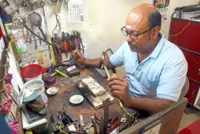
IPOH: In the steady hands of a traditional “pather” (goldsmith), a fading heritage of handmade jewellery continues to survive in a workshop where gold is still shaped by fire, tools, skill and generations of knowledge passed down to family members for seven decades.
For S. Prakash, 46, the craft is more than a livelihood – it is a legacy that began with his grandfather, continued through his father and uncle, and now rests almost entirely on his shoulders.
“This is actually our family business. It has been going on for more than 70 years,” he said when met at his jewellery shop here.
Prakash, who has spent 30 years in the trade, said his fascination with jewellery began when he was a child, watching his father work after school.
“I was around nine or 10 years old. I just watched him and slowly developed an interest. Nobody forced me into it,” he said.
Despite being advised by his father to continue his studies after SPM, Prakash chose a different path, returning to the family trade full-time.
Today, he stands as the sole sibling continuing the craft, while the rest of his family have ventured into other careers.
Inside his shop, every piece tells a story of patience and precision.
From rings and earrings to traditional Indian wedding jewellery such as the thali, Prakash’s work is entirely handcrafted.
“We use machines only for certain processes like melting or drawing the gold, but the actual jewellery making is done entirely by hand,” he explained.
The process begins with small gold bars, usually around 50g, which are melted, shaped, drawn into wire and carefully transformed into intricate designs.
He said depending on complexity, a single piece can take anywhere from an hour to more than a week to complete.
Most of his work, he added, comes in the form of custom-made orders and repairs, a field that has become increasingly challenging with the rise of machine-made jewellery.
Machine-made jewellery is lighter and cheaper because gold prices are high.
“But handmade pieces are stronger. The joints are more durable,” he said.
Despite competition, Prakash, a father of three, believes traditional craftsmanship still holds its value, especially for weddings and cultural ceremonies where authenticity matters.
However, he admits the future of the trade is uncertain. Most goldsmiths in the area come from India.
“I am the only local pather here in Little India.
“Younger generations are increasingly drawn to business or machine-based production rather than labour-intensive craftsmanship.
“Right now, no one is coming to learn. People only ask how long I have been working or whether it is difficult,” he said.
Prakash said even at home, interest is limited, though his seven-year-old daughter occasionally wanders into the workshop, playing with tools and watching him work.
“She likes to sit here when I am around and pretend to mend jewellery. Maybe there is hope,” Prakash said with a smile.
For now, the workshop remains open from 10am to 6.30pm, where heat, fire and gold continue to shape not only jewellery but also a fading tradition.
“I am still learning every day, even after 30 years,” he said.