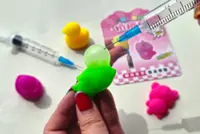
GEORGE TOWN: A jelly-like toy sold with a syringe resembling a real medical device has been banned by the Penang government over safety concerns.
Those caught selling the toy risk having their goods seized, business licences revoked and a compound of RM250 under local council bylaws.
The toy is said to be stress-relieving through squeezing. It features acne-like bubbles that can be “popped” by injecting water with the syringe.
Penang health committee chairman Daniel Gooi said the toy poses multiple risks, particularly because of its resemblance to medical equipment and even carries a “discard after use” label.
He said the design includes a pointed tip similar to a needle, which could cause injury, especially to children.
“These toys come with a syringe meant to mimic a medical device, which is concerning as it can easily be mistaken for a real syringe.
“The pointed end is dangerous and may cause cuts or puncture wounds if mishandled,” he said.
Online tutorials show users injecting air or liquid into the jelly-like material using a syringe. The surface will then swell and form bubble-like protrusions that can be squeezed to burst, mimicking pimple popping.
It comes in various forms, including chickens, as well as designs resembling faces, noses and other figures.
Gooi said the jelly component may be mistaken for candy by young children, increasing the risk of choking or accidental ingestion.
He said the toys are believed to be directly imported and may not have undergone proper safety tests or certification.
“This raises concerns about product safety standards, as there is no assurance the materials used are safe or comply with regulations,” he said.
Penang local government committee chairman H’ng Mooi Lye had earlier said the Penang Island City Council and Seberang Perai City Council would conduct daily spot checks at business premises and night markets to ensure compliance.
He said the ban was necessary following concerns raised by parents, adding that checks at a night market showed the toy was openly sold for RM5 per unit and widely available online.
He added that under the Medical Device Act 2012 (Act 737), such items must be registered with the Medical Device Authority, while manufacturers and importers are required to meet stringent compliance standards.
H’ng said a report had been lodged with the Domestic Trade and Cost of Living Ministry to curb online sales.