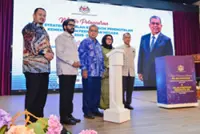
PUTRAJAYA: The government, through the National Unity and National Integration Department (JPNIN), will revive efforts to draft the National Harmony and Reconciliation Commission (SKRN) Bill.
National Unity Minister Datuk Aaron Ago Dagang said the move takes into account current developments and the increasing polemics surrounding unity issues that have, of late, challenged social harmony in the country.
“We are taking renewed steps to revisit the proposed Bill, with a focus on strengthening mechanisms to safeguard harmony and promote reconciliation,” he said in a statement on Tuesday (April 7).
He added that the proposed commission would emphasise preventive and reconciliatory approaches, rather than purely punitive measures.
“This includes early intervention, mediation and constructive resolution of disputes to ensure issues are addressed before they escalate,” he said.
Aaron said the proposal was not new, noting that the National Unity Consultative Council had drafted three Bills in 2015, including one to establish the commission.
However, he said two of the Bills, namely the Racial and Religious Hate Crimes Bill and the National Harmony and Reconciliation Bill, were rejected in 2019 due to overlaps with existing laws and constitutional provisions.
“The proposal to establish the commission was agreed to in principle at the time, but its implementation was deferred due to overlapping jurisdictions with existing agencies such as the Human Rights Commission of Malaysia and the Royal Malaysia Police,” he said.
He added that the government had subsequently decided in April 2020 not to proceed with the proposal.
Aaron said the revived initiative would draw from international best practices, including Singapore’s Maintenance of Religious Harmony Act, as well as models from the Australian Human Rights Commission and Zimbabwe’s National Peace and Reconciliation Commission.
He said the proposed commission is expected to have powers to investigate issues affecting harmony, call relevant parties to provide statements, and issue recommendations to the government and related agencies.
“It will play a role in formal mediation processes and may publish public reports, subject to limitations in the interest of national security,” he said.
Aaron added that JPNIN had begun engagement sessions with stakeholders since early April, involving government agencies, enforcement bodies, non-governmental organisations, political parties and local communities.
“These engagements will continue in an inclusive manner to ensure all relevant perspectives are taken into account,” he said.
He said the ministry also welcomed a proposal by Tan Sri Lee Lam Thye to establish a National Harmony Commission as an independent statutory body aimed at protecting and strengthening ethnic and inter-religious harmony in the country.