
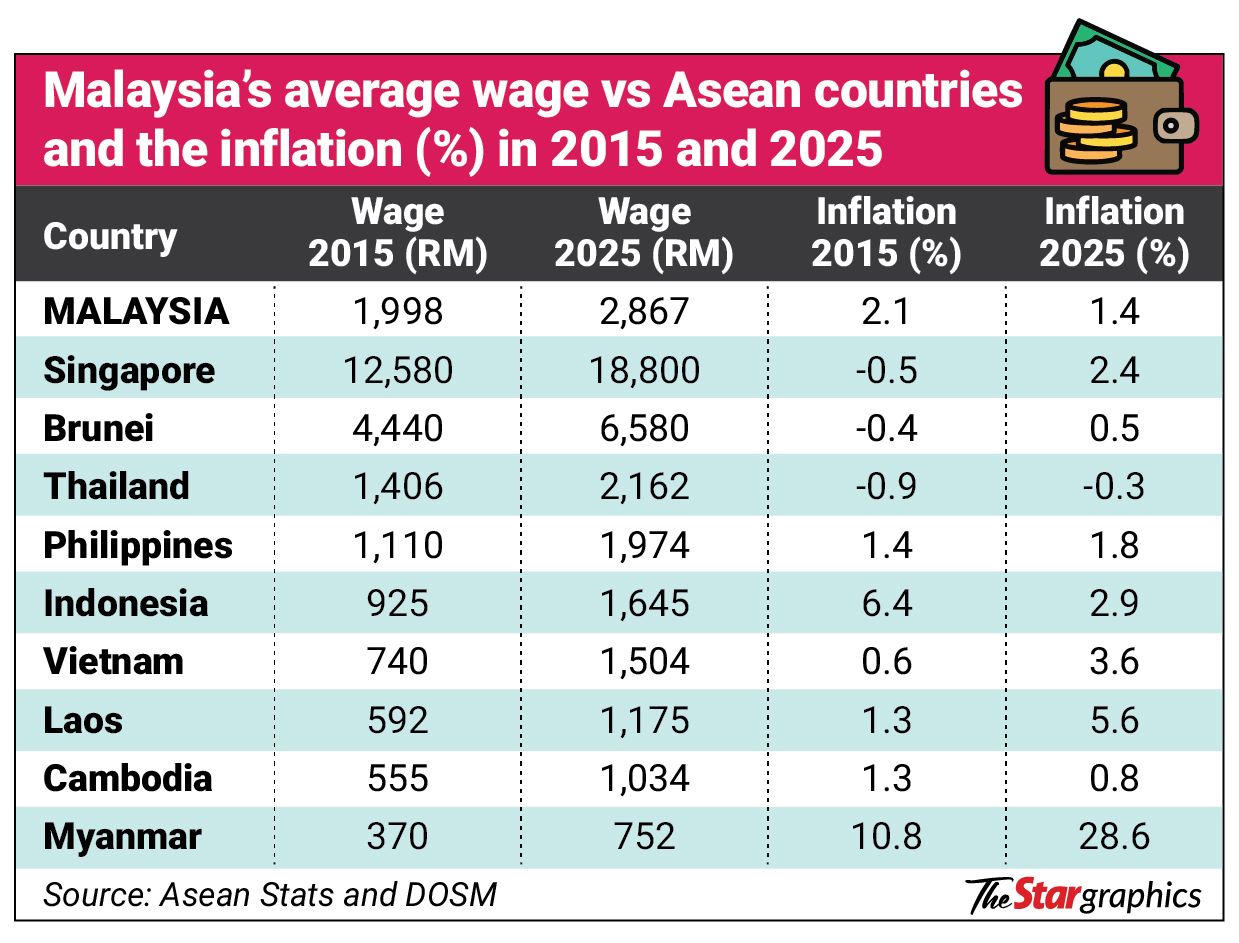
PETALING JAYA: Despite steady increases in nominal wages over the past decade, Malaysians are finding their purchasing power squeezed as inflation continues to erode real income gains.
According to the Statistics Department (DOSM), the median monthly wage in Malaysia rose from around RM2,000 in 2015 to RM2,864 last year.
ALSO READ: More relief and a new tax this year
While this represents a 43% increase over 10 years, the increments have been modest, averaging between 2% and 4% annually.
In contrast, inflation has fluctuated sharply, with spikes in 2017 and 2022 that outpaced wage growth and left households struggling to keep up.
Malaysia’s inflation averaged between 2% and 3% annually, but certain years saw significant surges.
In 2017, inflation climbed to 3.7%, driven largely by rising fuel prices and global commodity costs.
ALSO READ: Tough to stretch the ringgit
The situation repeated in 2022, when inflation hit 3.3% amid supply chain disruptions and higher food prices following the Covid-19 pandemic.
While Malaysia experienced deflation in 2020, with consumer prices falling by 1.2%, this brief respite did little to offset the cumulative impact of earlier spikes.
Inflation eased to 1.4% last year but the impact on household budgets had fully hit by then.
National Association of Human Resources Malaysia president Zarina Ismail said that Malaysia, in its bid to position itself as a developing economy moving towards advanced nation status, must ensure that wage reforms go hand in hand with cost-control mechanisms.
This is to ensure sustainable growth for both businesses and workers, she said.
She said the Progressive Wage Policy requires a necessary balance between employers and employees, particularly as Malaysia grapples with rising living costs and pressure to raise minimum wages.
The policy, she said, allows wages to increase gradually without placing an excessive burden on businesses, especially small and medium enterprises.
“The government’s RM200 top-up under the Progressive Wage Policy has already helped employers absorb part of the cost.
“While RM200 may appear modest, for a company with 40 workers, it can mean an additional RM20,000 a month before allowances, which is significant,” she said.
Zarina acknowledged that current minimum wages remain insufficient for many workers, particularly graduates living in urban centres such as Kuala Lumpur.
“A salary of RM1,700 or RM1,800 is simply not enough for workers who have to settle education loans, transport costs, daily expenses and family responsibilities,” she said.
She said workers should be viewed as long-term assets rather than costs, noting that fair wage progression helps companies retain staff, improve productivity and reduce job-hopping.