AS he slumps into a plush chair, Khaidir (not his real name) immediately turns his gaze to a huge monitor screen attached to his computer.
The 27-year-old has nowhere else to go. Not that he wants to; in fact, he is content spending his days locked in his bedroom – much to the worry of his father, Nazrin, 65, who runs a construction company.
“I do not know what to do with him. He doesn’t want to work or continue his studies. If I ask him to do any of that, he will say he is comfortable the way he is now. I don’t understand him. He has always been this way, especially after he left school.
“He is my son. I cannot throw him out of the house. We are family after all. But Khaidir is of that age where he should be building a career or making a name for himself,” says Nazrin, whose family resides in Shah Alam.
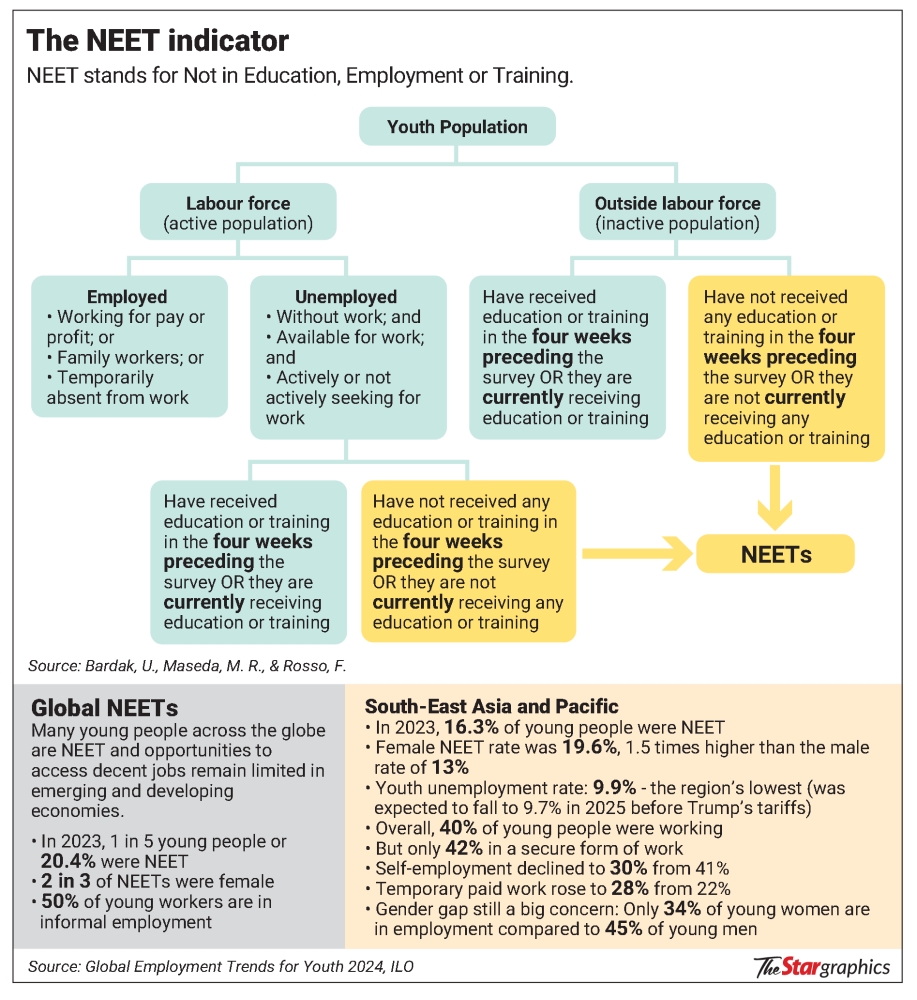
Khaidir is among the country’s youths categorised as NEET (Not in Education, Employment or Training) – a group now in the spotlight as the government works to strengthen Malaysia’s skilled workforce.
Statistically, the presence of NEETs remains a concern in ongoing economic efforts despite the lack of comprehensive data.
Studies show that Malaysia’s NEET rate for youths aged 15–24 stands at 13.6%. Based on Statistics Department (DOSM) records, there are about 6.84 million youth aged between 15 to 24 in the country since November, out of the country’s total population of 34.2 million.
And according to DOSM’s Third Quarter 2025 Labour Force Statistics data, published last month, the unemployment rate for youth aged 15 to 24 years was at 10.1% in September, registering 296,900 unemployed youth. Early this year, Higher Education Minister Datuk Seri Dr Zambry Abdul Kadir had already shared that more than half a million SPM graduates from 2020 to 2023 did not pursue tertiary education. It is not clear how many now are in vocational training, self-employment or gig work.
Understanding NEETs and their needs
So what will it take to entice NEET youths into the workforce? Experts say that while programmes to pull them in are important, an equally crucial task is understanding the factors that led them to disengage in the first place.
Young people who become NEETs rarely arrive at this point abruptly; instead, their withdrawal from school, work, or formal institutions reflects long developmental patterns that often begin in early childhood, says consultant psychiatrist Dr Tesini M. Paramannantha Veloo.
“Across cases I notice a consistent constellation of early experiences, family dynamics and unaddressed neurodevelopmental needs that shape how these individuals learn to cope, relate and survive the real world,” she says.
Dr Tesini, who is also a senior lecturer at IMU University, notes that many NEET individuals show early signs of neurodevelopmental differences – emotional and cognitive rigidity, attention issues, intellectual impairment, poor emotional regulation, impulsivity and lack of resilience. When unrecognised, these contribute to chronic difficulties in school.
“Over the years, such difficulties can produce a deeply internalised sense of inadequacy, leading the child to disengage long before adulthood.”
Unstable family environments further shape this trajectory, she says.
“A substantial proportion come from homes marked by emotional inconsistency, parental mental illness, substance use, or high- conflict relationships. When families are overwhelmed by their own crises, children receive fragmented emotional attunement.
“Some grow up with an absent or abusive father and an overburdened, anxious, or dominant mother – a pattern that clinically gives rise to hypervigilant, sensitive, and approval-seeking children.”
Such children often become adults who fear criticism, struggle to tolerate distress and withdraw to protect themselves.
Universiti Putra Malaysia’s Institute of Social Science Studies director Prof Dr Haslinda Abdullah says the “NEET” label itself can create a stigma that frames young people as lazy, unmotivated or irresponsible – even though many face barriers such as poverty, caregiving responsibilities, or limited transport and digital access.
She highlights a study showing that over 30% of NEET youths report feeling ashamed of their status, while more than 40% experience anxiety, low confidence or social withdrawal due to repeated job rejection or family pressure.
“As a result, some NEET youth begin to internalise these negative perceptions – or as we say, make them a self-fulfilling prophecy – lowering their ambitions and reducing engagement in job-seeking or training.
“What is vital in this context is that the narrative must shift away from blaming youth and towards recognising the structural challenges they face.
“The issue calls for better mental health support, greater access to vocational pathways, and more nuanced language that reflects the realities of young people navigating hardship rather than labelling them as disengaged.”
No one-NEET-fits-all answer
While the number of NEETs in Malaysia is comparatively lower than the global figure, the gender difference is a concern, says Prof Haslinda: young women in the country seem to be disproportionately affected (17.7% of youth aged 15-24).
“Data from 2022 show the male NEET rate at 9.91%, but female rates are higher, and women make up over 65% of the total NEET population due to involvement in household chores and strong institutional barriers that limit women’s participation in the labour market.”
When asked how factors differ between urban and rural youth, she stresses there is no “one size fits all” explanation.
“Urban youths struggle with high living costs, intense job competition, and limited digital tools during online learning.
“Rural youths, meanwhile, face limited access to training centres, fewer job opportunities, poor digital infrastructure, and stronger family responsibilities.”

She adds that youths from B40 (lower income) households are most affected due to intertwined financial, social and health factors.
“Many industries have openings in manufacturing, logistics, IT and digital services; however, NEET youth lack technical training, hands-on experience, or digital literacy.”
Rural youths face even bigger hurdles, with fewer vocational schools and training programmes available to them.
Cultural attitudes also play a role – many young people avoid vocational training due to the stigma that it is a “low-class” profession associated with 3D (dirty, dangerous, difficult) jobs.
“Long-term unemployment can also lead to emotional stress, making it even harder for youth to return to school or work. This will later lead to mental health issues.”
From NEET to neat’o?
Under the 13th Malaysia Plan 2026-2030 (13MP), the government is positioning technical and vocational education and training (TVET) as Malaysia’s main youth employability engine. Enrolment is rising, job outcomes are strong, and there is a systemic shift away from traditional academic pathways.
The policy thrust on TVET aims to absorb potential NEET youth into training and employment, transforming a risk group into a talent pool. TVET enrolment is expected to reach 70% by the end of the 13MP in 2030.
The Malaysian Employers Federation has voiced its support through enhanced industrial exposure, career coaching, youth-employer matching platforms, and transition programmes specifically for NEET youths.
However, the government and employers can only go so far. This raises another question: What other approaches work best to re-engage NEET individuals, and how does one navigate their resistance or mistrust of institutional reintegration?

Dr Tesini says the work begins with understanding why school or work once felt overwhelming, unsafe, or impossible.
“What we see on the outside is only the tip of the iceberg. Many NEET youths struggle with issues that are poorly recognised – such as attention difficulties, learning challenges, anxiety, depression, autism traits, trauma, or family stress. If we don’t attend to these root causes, asking them to ‘just try harder’ only deepens their shame.
“Once their underlying difficulties are supported, they start feeling more capable and confident.”
She adds that schools, counsellors, mental health professionals, social services, government agencies, employers and NGOs all have roles to play – no single professional can address family conflict, poverty, housing instability, learning difficulties and emotional trauma alone.
“Effective reintegration requires coordinated support – a safety net of adults and systems working together.”
Identifying early risk factors is critical, she stresses.
“School refusal, chronic avoidance, risky behaviours or persistent anxiety in children and adolescents should never be dismissed as ‘a phase’.
“Early intervention reduces the likelihood of long-term NEET outcomes. Young people who struggle academically should be offered skills-based pathways, hands-on learning and alternative routes that play to their strengths rather than highlighting their weaknesses.”
Help for the NEET-y
UNDER MP13 (2026-2030), the government has intensified efforts to address the challenges faced by NEET youths.
Recognising youth’s potential as drivers of future growth, the plan builds on the progress made and prioritises education pathways, youth empowerment and employment opportunities.
> Education and skills development:
- TVET (Technical and Vocational Education and Training) enrolment among SPM leavers rose to 53.6% in 2024, from 31.3% in 2020.
- Academic performance still lags behind global standards (Pisa & TIMSS scores).
- Only one local university made it into the QS Top 100 rankings.
> Youth wellbeing and empowerment:
- Youth Index score increased to 73.59 in 2024, reflecting better quality of life.
- Affordable housing expanded, with over 179,000 units completed.
- Infrastructure upgrades (roads, water, electricity, telecom) support youth in rural areas .
> Employment and income:
- Graduate employability improved to 89.8% in 2023.
- Labour force participation rose to 70.6%, unemployment dropped to 3.2%.
- Skills mismatch remains high at 36.1%, showing the need for better job alignment.
- Minimum wage raised to RM1,700, with RM3,100 monthly wage commitment by GLIC/GLC for 153,000 workers.
- Average household income rose to RM9,155 in 2024.