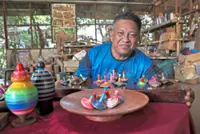
BEHIND the hum of a wood lathe in a modest workshop in Kampung Tenang, Segamat in Johor, a craftsman patiently shapes spinning tops, determined to preserve the traditional toy and prevent it from fading into obscurity.
For 55-year-old Muhammad Yunus Ismail, spinning the gasing (a local top) is not just a traditional pastime but a symbol of Malaysia’s cultural identity that deserves to be retained for future generations.
Its significance is reflected in its inclusion among the traditional motifs featured on Malaysian coins, along with the keris (dagger), wau (kite), tepak sirih (betel nut container), congkak (a traditional game) and rebana ubi (a traditional drum).
Muhammad Yunus began his journey in the handicraft industry in 2007 by producing decorative items and landscape features from driftwood, before turning to top-making – a skill inherited from his father.
“To me, the gasing holds deep sentimental value because my father was an avid top player.
“We still have an active gasing arena here in Kampung Tenang.
“It is among the 10 or so gasing arenas still operating in Malaysia.
“That is why I want this heritage to remain alive and be appreciated by future generations,” he told Bernama.
Muhammad Yunus said his decision to breathe new life into the traditional toy was the best move he has taken to ensure it remains relevant today.
Over the past seven years, he has undertaken extensive research and development to create a range of recreational spinning tops that are easier to play and designed to appeal to younger generations.
Unlike the traditional gasing, which requires a string and considerable skill to spin, his creations can be launched by hand on a specially designed board or playing surface.
They are also smaller in size and feature bright, colourful and modern designs.
“Beginners often struggle to master the string, so I created a version that is easier to play while still retaining the identity and essence of the traditional gasing.
“I want children to enjoy playing it too,” said Muhammad Yunus.
Every spinning top is crafted using only two types of local timber, cengal and merbau, both chosen for their heritage value, the father-of-six said.
In addition to discovering the gasing, he wants tourists to also appreciate the uniqueness of Malaysia’s local wood through the products they take home.
Muhammad Yunus’ innovative tops gained recognition when he emerged champion at the Johor-level Creative Arts Competition 2018, reinforcing his confidence in producing handicrafts that embody the identity of both Johor and Malaysia.
With a production capacity of only 30 to 50 units a day, Muhammad Yunus has had to turn down orders for tens of thousands of units because his top-making process still relies largely on manual craftsmanship.
He hopes to one day acquire semi-automated machinery and improve his product packaging to boost production capacity and expand into wider markets.
For Muhammad Yunus, true success is measured not by sales alone, but by seeing the legacy passed to him by his father continues to be recognised, played and cherished by future generations.