
IF THE Malaysian ecosystem is one big, beautiful tapestry made of interwoven lines, what happens when some of those threads disappear?
Using puppetry, art and good old-fashioned sit-down discussions, “Project Riwayat, Katha 1: Voices of the Vanishing” explored the ecological and cultural impact of Malaysia’s disappearing wildlife.
Project co-producers and artists Bright Ong and Christine Das focused on seven of Malaysia’s endangered animals, highlighting how losing our local wildlife could also mean losing the cultural traditions and stories they inspired.
The seven species highlighted were the helmeted hornbill, Irrawaddy dolphin, Malayan tiger, Bornean banteng, Sunda pangolin, Malayan tapir and Raffles’ banded langur.
The exhibition was made up of two separate components; puppetry performances by Bright and embroidery work by Christine.
Over three weekends in May at the Hin Bus Depot in Penang, the creators aimed to remind society that “as species vanish, so do the stories, dances and crafts they once inspired.”
Riding the waves
A subtle change in atmosphere spread through the weekend crowd at George Town’s popular creative arts hub.
As the live band’s upbeat music paused, the clear sound of waves filled the air. Then,
out of the blue, dorsal fins appeared. A mother ‘dolphin’ and her two calves made their way through the crowd.
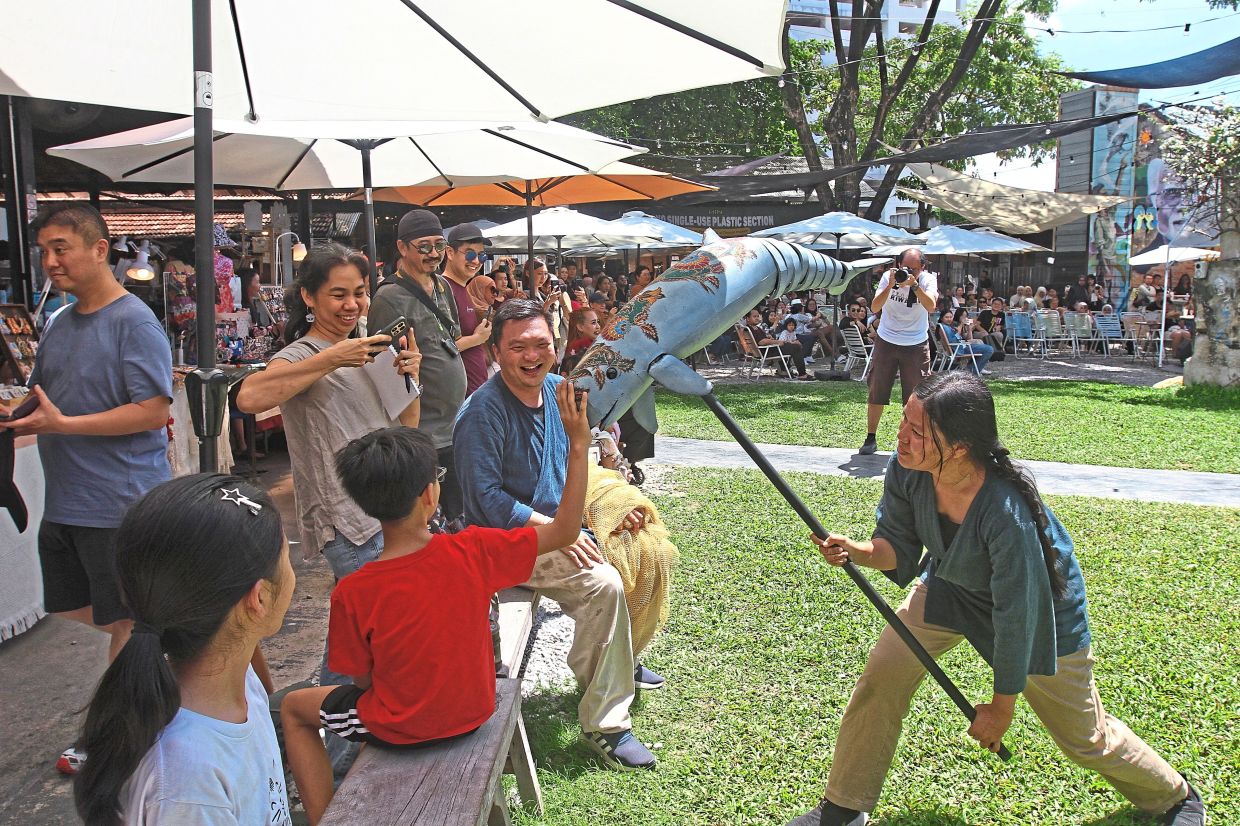
Hoisted on sticks and masterfully handled by three puppeteers, the dolphins were incredibly agile. The bottom halves of their bodies flipped and weaved through the air.
But soon, the mood turned ominous and the animals moved frantically as they sensed danger. Tragedy struck when one of the calves became tangled in a yellow fishing net. Fortunately, help was nearby as small children from the crowd stepped in to save it.
Directed by Bright, the ‘Wildlife Encounters’ puppetry performance featured separate shows for the Irrawaddy dolphin and the helmeted hornbill.
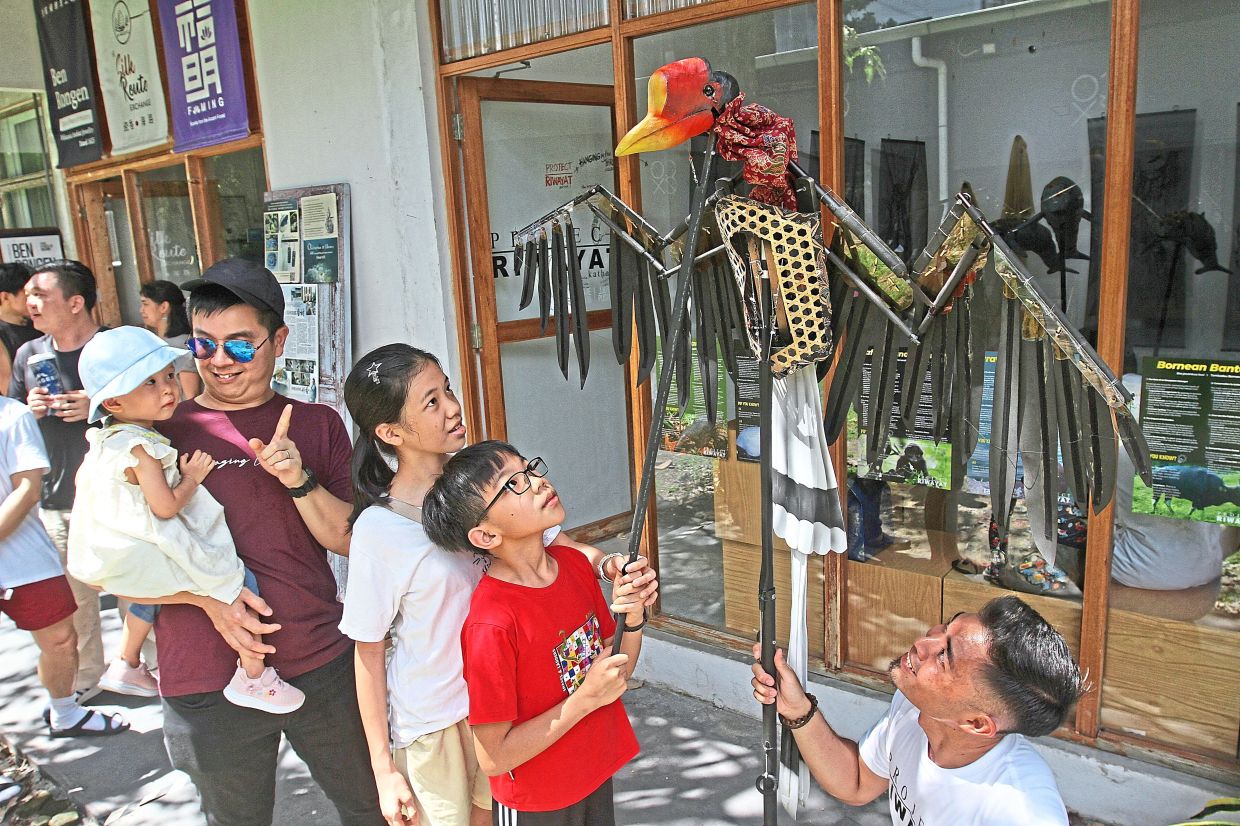
The shows ran 20 times on rotation throughout the exhibition.
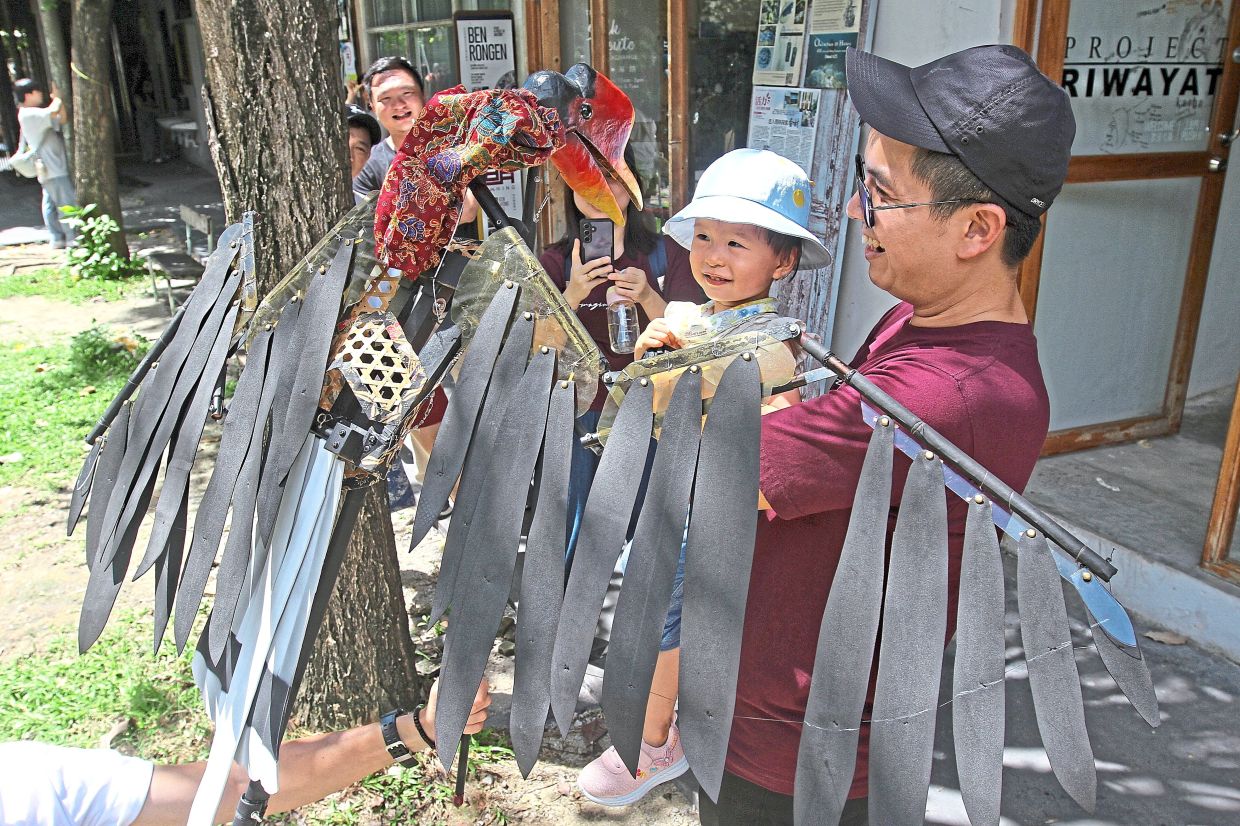
“While the dolphin puppets are smaller than real life, the birds were built at a one-to-one scale.
“The bird is a two-man puppet; by using simple weight and counter balance mechanisms, we can change its body from being at rest, to flight mode, to diving mode,” Bright said during one of the discussions.
The dolphin puppets were created using EVA foam, aluminium rods and spring wire, adorned with batik cut-outs.
Bright said the birds were created using fishing lines and swivels, upcycled fishing rods, carbon fibre blades, brassware from office supplies, and bamboo.
“Every single item used to build the puppets came from local industries, both old and new,” said the former actor who spent over a month on the build.
Aside from Johor-born Bright, a four-person team of puppeteers brought the animals to life.
The cast included Alfred Loh from Selangor, Maisyarah Mazlan from Perak, Marcus Lim from Penang and Lim Yun Xin from Terengganu.
“Everyone performs with a puppet differently, as the personality of the puppeteer comes through,” said Bright.
He said Project Riwayat aimed to highlight the plight of threatened native animals in a voice that was true to local culture.
After years of working abroad, he returned home realising he had stories to tell and that “we, as a country and region, have our own unique stories to share”.
“I want to find our own South-East Asian voice. Here, we celebrate diversity; it is very fragmented and kecoh or ‘messy’, but that is the beauty I want to celebrate with my puppets,” he said.
Threads and shadows
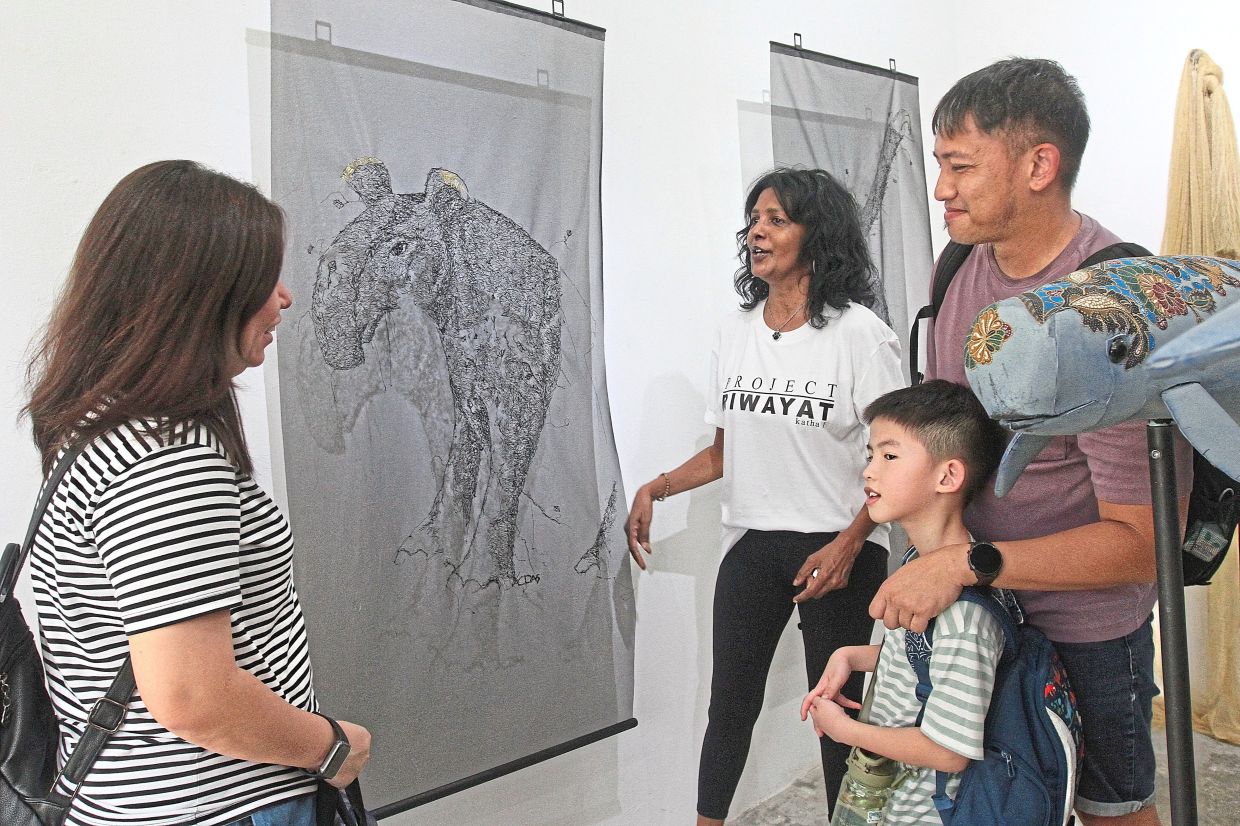
On a translucent grey mesh, glittering gold thread stood out against stark black lines. Behind it, the shadows of five animals shimmered softly.
The displays were part of Christine’s ‘Hanging by a Thread’ exhibition at COEX@Kilang Besi, located within the Hin Bus Depot.
Her black-thread depictions of the Malayan tiger, Bornean banteng, Sunda pangolin, Malayan tapir and Raffles’ banded langur explored the threat of extinction through textile.
“Looking at a saree, I realised that cutting just a few threads causes the entire piece to unravel.
“To me, that symbolises the ecosystem. Nature is perfect until it is disturbed.
“If you remove one species, everything falls apart.
“That unraveling is ‘chaos’, and I wanted this exhibition to put that on display,” said Christine.
Overcoming her dislike of sewing, the Penang painter used gold saree thread to spotlight key features of each animal such as the angular horns of the banteng (a wild cattle species with white ‘stockings’) and the half-crescent eye markings of the banded langur.
“Only the Malayan tiger has golden tears. Of the seven species we a
“Since it is our national icon, this is the saddest reality for Malaysia,” she said.
Aside from sewing, Christine did something else she usually avoids; she let others touch her unfinished work.
“The Malayan tapir was the only incomplete piece I brought to the gallery.
“I originally planned to sit in the space and let the crowd watch me work,” she said.
That plan quickly evolved into a collaborative ‘sew-in’ as Christine realised that letting
visitors participate would demonstrate both the patience required for the craft, and the collective effort needed for wildlife conservation.
“It was very moving to watch them. People were worried at first that they would ruin it. But after a stitch or two, they got completely absorbed.
“Together, the public brought the tapir to life,” she added.
Noting that Project Riwayat was aimed at capturing the stories of the endangered animals, Christine said the quiet atmosphere of the exhibition space was symbolic of the slide into extinction.
“When species disappear, they disappear very quietly. There isn’t going to be a loud announcement.
“Suddenly, we find out that they have gone,” she said.
Windows to the soul
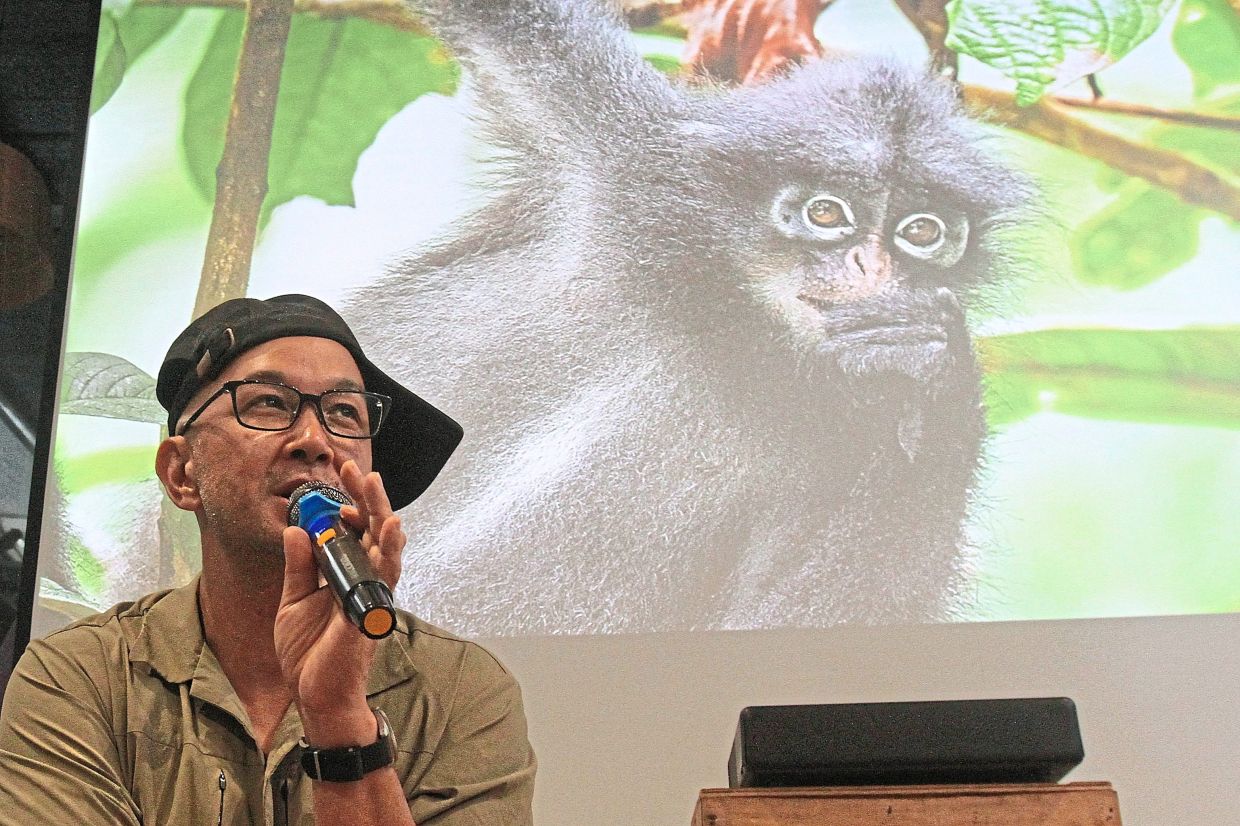
Monkeys may act aggressively to humans (and vice-versa), but wildlife photographer Peter Ong is more interested in how both can stare at the sky.
“It turns out that human beings are not the only ones able to stare at the sky in wonder.
“Chimpanzees also look at the sky and at waterfalls and derive pleasure from the experience.
“It is an incredible thing; the ability of primates to be fascinated and mesmerised, as well as to have the cognisance and attention span to maintain engagement,” Peter said during “Monkey Business’, one of the talks in the Project Riwayat line-up.
“When you mention nature and primates, the first place that flashes across everyone’s mind is Borneo and its orang utan and proboscis monkey.
“While these are not found in Peninsular Malaysia, we have others that are as wonderful,” Peter said when leading the audience through photographs he had taken of 12 primate species found in Peninsular Malaysia.
This included the critically endangered Raffles’ banded
langur, the stump-tailed macaque, nicknamed Mr Red Face due to its vivid colour, and the secretive and adorable Sunda slow loris.
“The Sunda slow loris comes out at night. Everyone thinks it is a sloth but it is not – sloths are only found in the Americas.
“In Asia, we have the lorises. They are nocturnal and have big, beautiful eyes that glisten in the night,” Peter said, adding that contrary to its cute features, the Sunda slow loris has the distinction of being one of the world’s rare venomous mammals.
“When you look at a primate and they return your gaze, there is a remarkable intelligence behind their eyes, which is unmistakable.
“They look into you with intention; it is not a dismissal. When primates are intrigued and when there is a curiosity, it sparks in their eyes.
“That is the first way you can tell that someone or something is alive, when you see the thought process happening behind the gaze,” Peter stated.
He said that with a biology so similar to humans, it was no wonder that primates were often used for medical trials and experiments.
“The southern pig-tailed macaque has eyes so similar to humans that most experiments for eye medicines and surgeries are conducted on them.
“The longevity and health that we enjoy as the human race, we owe to our primate cousins,” he said.
Project Riwayat was funded under Hasanah Foundation’s ArtsFAS grant programme and was supported by the Penang Art District.