
MALAYSIA’S parking operators claim they are set up to fail due to inconsistent policies, vague guidelines, and political interference.
They face sudden contract changes, frequent fine discounts, and erratic enforcement, which impose financial burdens while ratepayers complain about inadequate services.
Operators are not entirely blameless though, as industry insiders admit that some concessionaires lack experience and fail to meet contract requirements.
Despite the introduction of smart parking apps and car-free zones, congestion and complaints persist.
Kuala Lumpur City Hall (DBKL) illustrates these issues, having suffered years of poor management and revenue loss.
It finally appointed a new parking operator in September 2015, and clear rules, proper enforcement methods and structured system brought more than RM1mil a month in revenue.
However, a 2018 government change led to policy interference, including clamping and towing, forcing operators to absorb losses and face blame for unmet obligations.
Discounts of 50% to 70% on fines are criticised for encouraging delayed payments.
“Motorists wait for discounts, draining revenue and undermining enforcement,” said an insider.
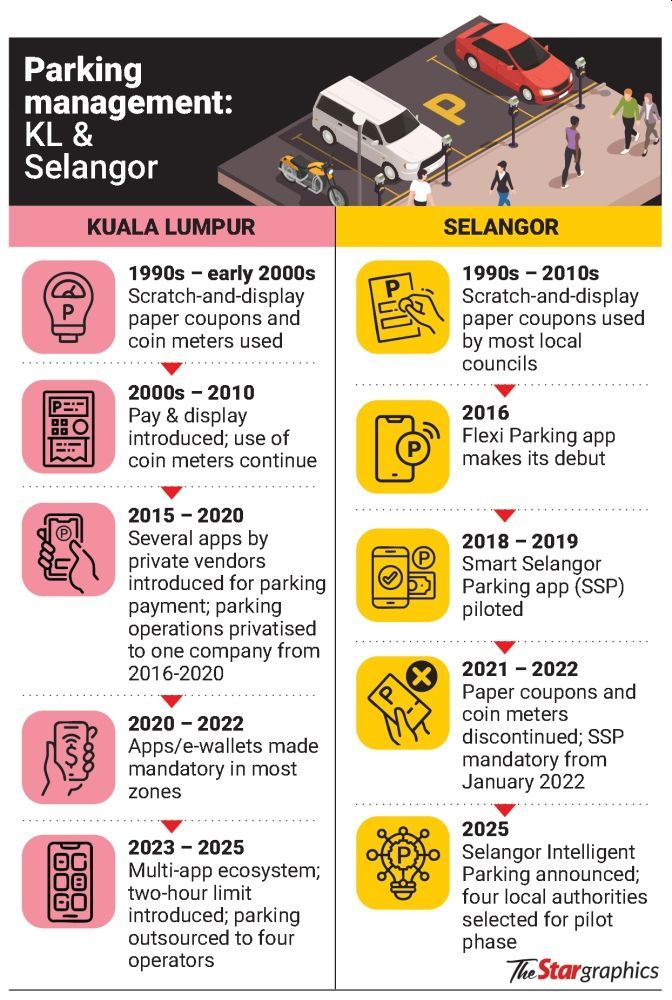
DBKL took over the management of 59,000 parking bays in October 2024, engaging on contract four operators to scan vehicles for parking compliance, with enforcement by City Hall officers.
However, revenue from parking fees and compounds has not met expectations.
Melaka faced similar issues, with four local councils managing 35,000 to 40,000 parking bays in the state.
In the city, Melaka Historic City Council (MBMB) appointed a company in 2021 to manage parking, but by August 2024, the company was terminated for poor performance and unpaid dues.
MBMB now manages parking directly via its app, while the company’s legal challenge over contract termination continues.
Over in Selangor, the state’s parking system has seen numerous changes, with rules amended repeatedly since 1998, creating confusion for motorists and enforcement teams.
The plan to centralise the system was initially welcomed, but the Selangor Intelligent Parking (SIP) system rollout has faced controversy.
Several concessionaires raised concerns about the tender process’ transparency.
“We attended a briefing on Oct 2, 2024, with clear criteria, yet a newly formed company won the contract,” said one operator.
The SIP project is managed by Rantaian Mesra Sdn Bhd − a subsidiary of Menteri Besar Incorporated (MBI) − alongside Selmax Sdn Bhd, to oversee bays under Subang Jaya, Shah Alam and Selayang councils.
Revenue is now split 50% to the concessionaire, 40% to councils, and 10% to MBI, a significant reduction from previous collections.
Critics argue that allowing MBI’s subsidiary to win the tender undermined public trust.
“It is like being both referee and player,” one concessionaire noted.
Petaling Jaya City Council (MBPJ) rejected the SIP proposal twice, citing lower projected revenue, and negotiations continue.
One operator questions, “Why accept a plan reducing council revenue?”
StarMetro contacted ITMax System Bhd, which owns 70% of Selmax, for an interview but they declined for the moment. — By BAVANI M, AIDA AHMAD and SHALINI RAVINDRAN