
As spring unfolds in China’s Guizhou Province, a 125.8sq km ancient azalea forest in the Baili azalea scenic area in Bijie City stretches across the mountains like a vibrant ribbon, with more than 40 varieties in full bloom drawing visitors from home and abroad.
Cynthia Tan, a tourist from Malaysia, recently took a direct charter flight from Kuala Lumpur to Guizhou to experience this sea of flowers.
“The spring in this garden is amazing. Here we can see so many beautiful flowers. It’s a special experience for Malaysians,” Tan said.
According to Song Jiqiong, head of the ticketing department at the scenic area, in just one week at the end of March, the scenic area received over 180,000 visitors, an increase of about 200% compared to 2025.
The scenic area has also introduced an extended ticket validity policy this year, allowing visitors to enter the park for free within five days after purchasing a single ticket.
Perched on a hill in Dujuan Village within the Gamu management area of the Baili azalea scenic area, an ancient azalea – carefully enclosed by a wooden fence – rises several metres high with an 80cm trunk and a dense canopy of blossoms. Known as the “king of azaleas”, it is over 1,200 years old.
“The unique climate, soil and other natural conditions are ideal for azaleas,” said Luo Dan, an official with the area.
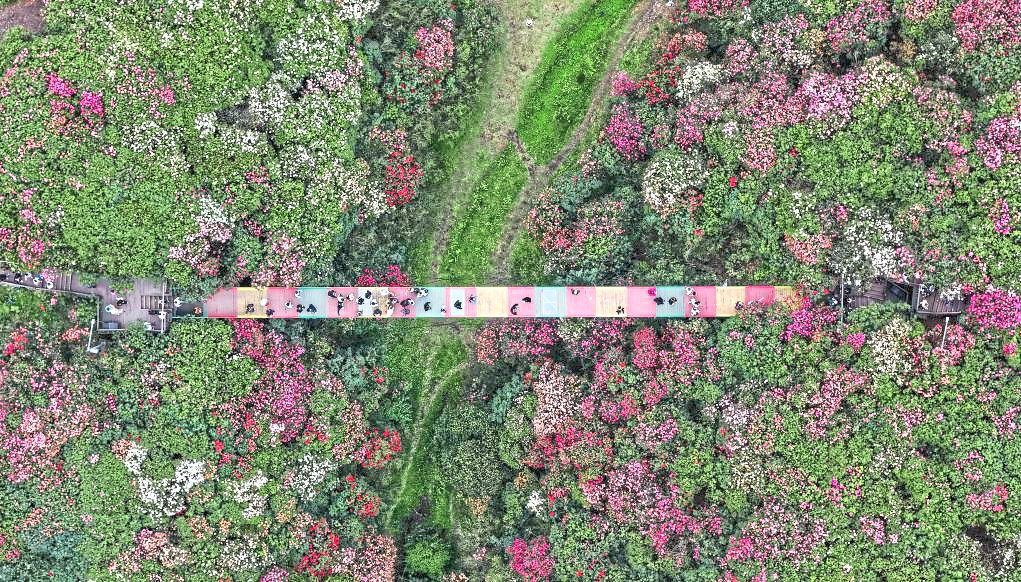
Since the Baili azalea provincial nature reserve was established in 2007, local authorities have strengthened the protection of the ecosystem, natural landscapes and rare plants and animals, preserving sufficient ecological space for this azalea forest belt.
Thanks to long-term conservation efforts, this primitive azalea forest belt, which contains many ancient trees over a hundred years old, has become one of the world’s largest, most species-rich and best-preserved primitive azalea forests to date.
Though the azalea bloom lasts just over two months, the flower economy of the area has long moved beyond sightseeing, offering visitors the chance to hike among the blossoms, explore a heritage market, enjoy live performances and even take a helicopter tour over the sea of flowers.
Local authorities have launched over 100 cultural, sports and tourism events, including torch festivals and trail running, alongside offerings such as summer retreats, hot spring wellness experiences and study tours.
To help visitors “take the beauty home”, a local company has come up with a way to artificially propagate the flowers so they are able to bloom during off-season. The company has successfully bred more than 110 varieties of alpine rhododendrons.
The influx of tourists has boosted local businesses. In the scenic area, 50-year-old Huang Tianqing and her husband spent many years as migrant workers in coastal regions.
Seeing the opportunities brought by the development of tourism in their hometown, they renovated their old house in 2019 and opened a homestay featuring 30 guest rooms and a dining area that can accommodate up to 200 people.
“We serve authentic local farmhouse dishes that are very popular with tourists from other regions. Last year, we made over 1mil yuan (RM578,818) in revenue, and our family’s life has become more prosperous,” Huang said. – Xinhua