
Across airports, digital billboards and tourist hotspots nationwide, the grinning faces of "Wira" and "Manja", the official mascots for Visit Malaysia 2026 (VM2026), enthusiastically welcome the world.
Yet, more than a thousand kilometres away in the dense rainforests of Sabah, the real-life inspirations for these characters face a far grimmer reality as they struggle to survive against shrinking habitats, poaching and the illegal pet trade.
The world's smallest bear species, classified as "Vulnerable" on the International Union for Conservation of Nature's (IUCN) Red List, faces steep decline across South-East Asia, with experts warning that habitat fragmentation in Borneo and Sumatra will accelerate its disappearance.
For Bornean Sun Bear Conservation Centre (BSBCC) founder and chief executive officer Dr Wong Siew Te, the VM2026 mascot campaign represents a long-overdue victory for a species he calls the "forgotten bear", compared to the Malayan tiger and orangutan that often dominate conservation headlines.
"Its scientific name is Helarctos Malayanus. 'Hela' in Latin means sun, 'arctos' means bear, 'Malayanus' means Malaya. It has an identity as something Malaysian. This is not a Sumatran rhinoceros or anything, this is Malayan, like the Malayan tiger," Wong said in an interview in BSBCC in Sandakan.
The 57-year-old Penang-born wildlife biologist explained that as a species entirely dependent on forests, sun bears require vast and undisturbed habitats, something that is becoming increasingly difficult to maintain across South-East Asia.
"In recent decades, the human population has increased rapidly, especially in developing countries in Southeast Asia. When the population increases, we need more areas for housing and agriculture such as palm oil and rubber plantations.
"As a result, we are forced to compete and encroach on the habitats of wildlife, including sun bears. So, is the population of these bears increasing? No. The fact is, our forest areas are decreasing every year," he said, describing his conservation work as a lifetime project.
Wong explained that forest clearance triggers a violent cycle, pushing displaced bears into human conflict, rendering them vulnerable to poachers who target adults for their parts and capture cubs for the illegal wildlife trade.
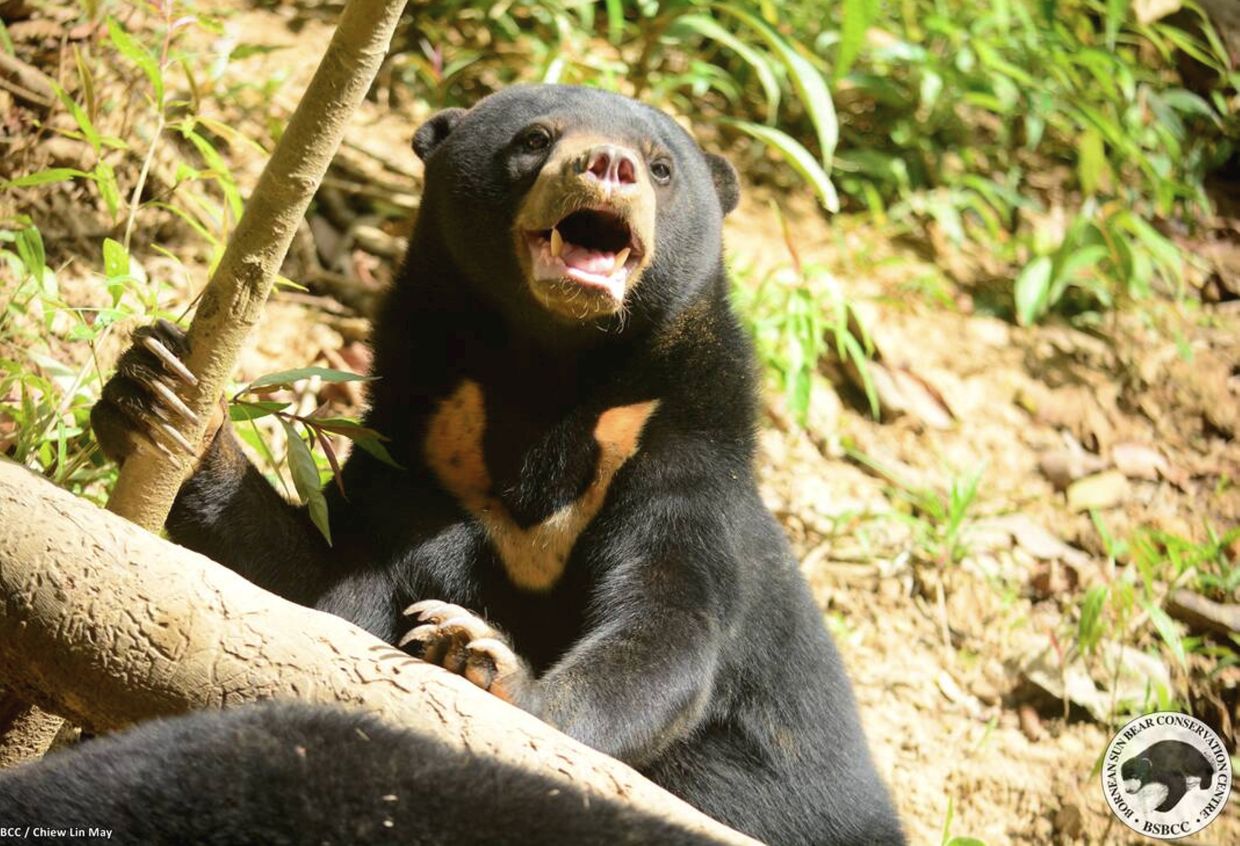
He revealed this dark trade often involves poachers slaughtering protective mother bears to snatch their cubs for the exotic pet market – a reality exemplified by Amaco, a rescued sun bear who languished in a small cage on an oil palm plantation in Lahad Datu for 18 years.
Wong shared that Amaco's years in captivity left the animal so deeply traumatised that it lost all natural survival instincts, eventually preferring the safety of a concrete floor to the forest it once feared, meaning it could never be returned to the wild.
With official estimates suggesting only 300 to 500 sun bears remain in Peninsular Malaysia, Wong views the VM2026 campaign as a critical awareness opportunity.
"Since this honey bear is used as a mascot for Visit Malaysia 2026, the government is very active in promoting it to the public. This helps me as a conservationist to raise awareness because in conservation work, you must know the species first. That is the first step," he said.
With the species finally in the national spotlight, Wong is pushing for tangible solutions, including massive wildlife corridors and integrating conservation into the national school curriculum, while lauding the Sabah state government's commitment to protect 30 per cent of its land mass as forest by 2025.
While the Bornean Sun Bear Action Plan for Sabah highlights the urgent need for forest connectivity to ensure safe migration and breeding, Wong stressed that conservation must also address the human element by providing local communities with alternative livelihoods through nature-based tourism to deter poaching.
Despite the grim challenges, he remains hopeful, driven by profound victories such as the centre's "soft release" programme in the Tabin Wildlife Reserve, where he recently observed a rehabilitated bear named Tenom slowly re-adapting to the wild and spending days foraging in the jungle without returning to the enclosure.
"He is ready anytime he doesn't want to come back anymore. One day, he will be able to be 100 per cent independent," Wong said, describing the exhaustive rehabilitation process as incredibly rewarding. – Bernama