Anne Doull is busy in winter. Together with her parents Margaret and Addie, she owns 650 sheep in the north-west of Mainland, the main island of Orkney in Scotland, and also has a regular job as an engineer.
Her family was honoured in 2024 to become patrons of Shetland Wool Week, an annual handicraft gathering held for the past 16 years that is among the highlights of the region.
Knitters and crafters from all over the world come to the isles on the northern tip of Britain – and many come especially for Wool Week.
Though it is tough to reach, people come nonetheless in order to learn techniques and patterns and exchange ideas with like-minded people. And, of course, to see the Shetland Islands.
Every year, the patron designs the pattern for the official hat for the event. Of course, no one has to wear it or knit it. But most people do. Anne has designed a hat with a Fair Isle pattern and sheep heads, and pre-knitted it in several colour combinations.
Fair Isle is also the name of the southernmost part of the inhabited Shetland Islands, where this special knitting technique was invented by fishermen’s wives centuries ago.
But those who grab their needles and venture to try Fair Isle patterns are not beginners to the craft. After all, in some cases, the colours change with every stitch to create the pattern on the outside.
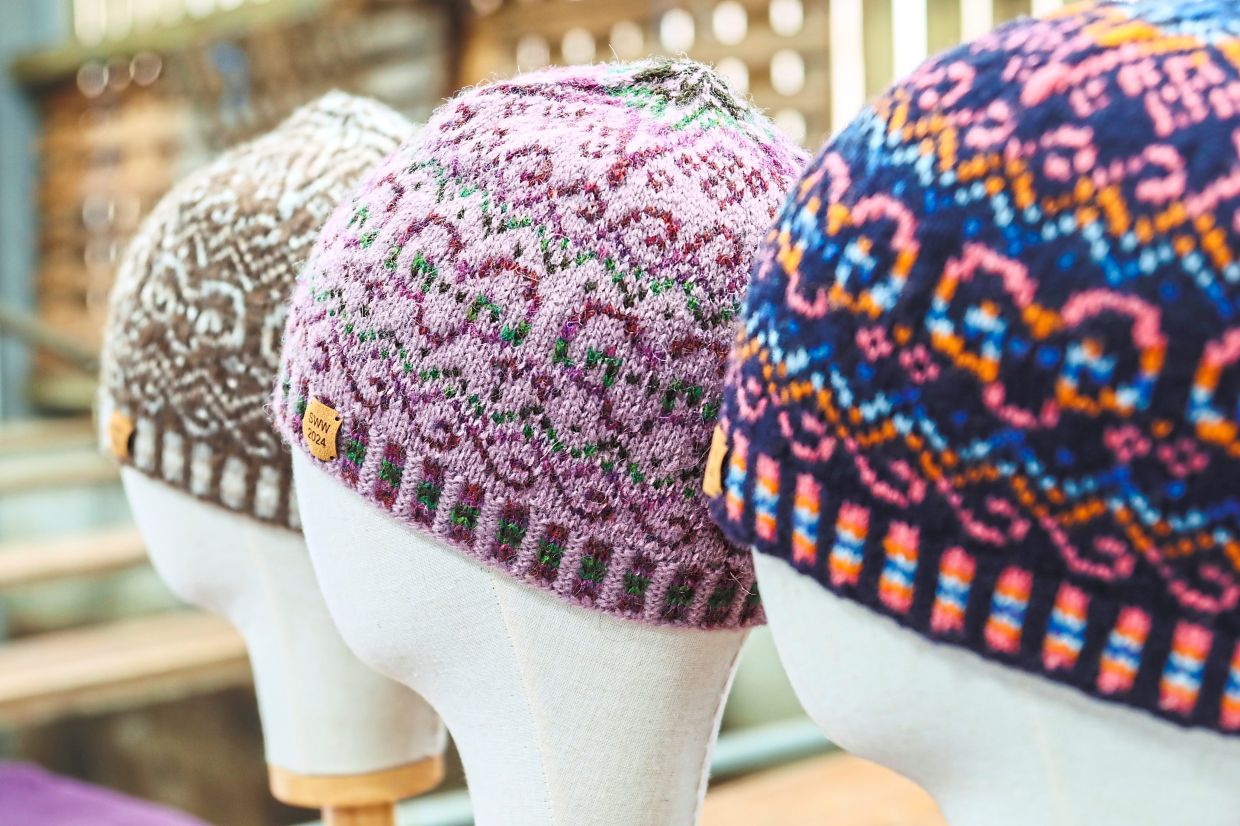
On the inside, the threads are pulled through to create a hat with several layers of wool. Warm and insulating, this is just right for the often changeable weather in northern Scotland.
It’s not just hats and gloves that are knitted this way. Anne and Margaret show off jumpers and cardigans that are also made using patterns that have often been passed down through the family. All handmade, of course.
Addie loves his Fair Isle jumpers. “Nothing is warmer or more durable,” he says, whether out in the fields, in the barn or at home. This is of course also due to the quality of the wool produced by the sheep here.
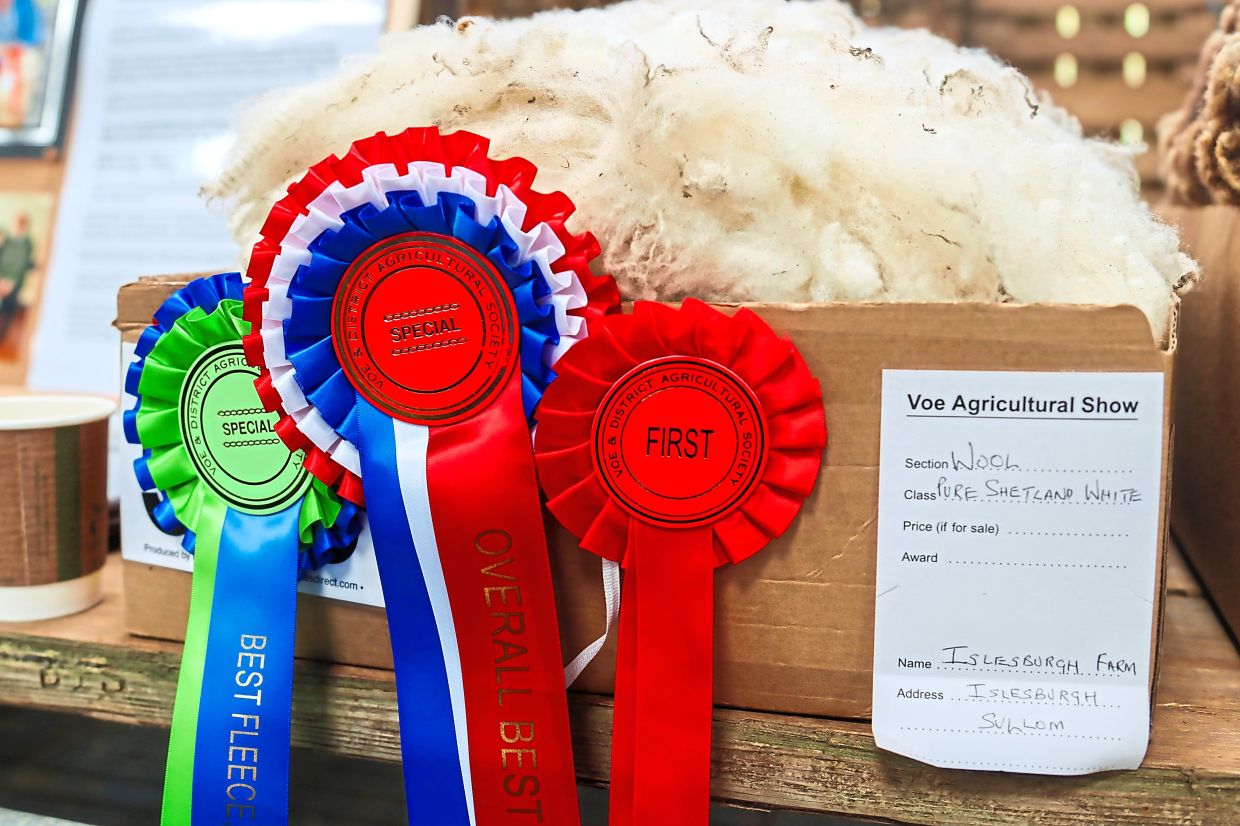
He demonstrates this with a sheepskin: how does the wool feel? What is the quality of the fibres? Is the structure uniform? All of this is also tested at competitions, to which the island’s sheep farmers bring their skins.
The Doulls regularly receive awards.
Eleven different breeds of sheep live on the islands, and more than 30 different shades can be produced from the coat colours. “Producers now also offer shades that are reminiscent of the colours on the island: the sunset, for example, dark blue, pink, orange and yellow,” says Anne.
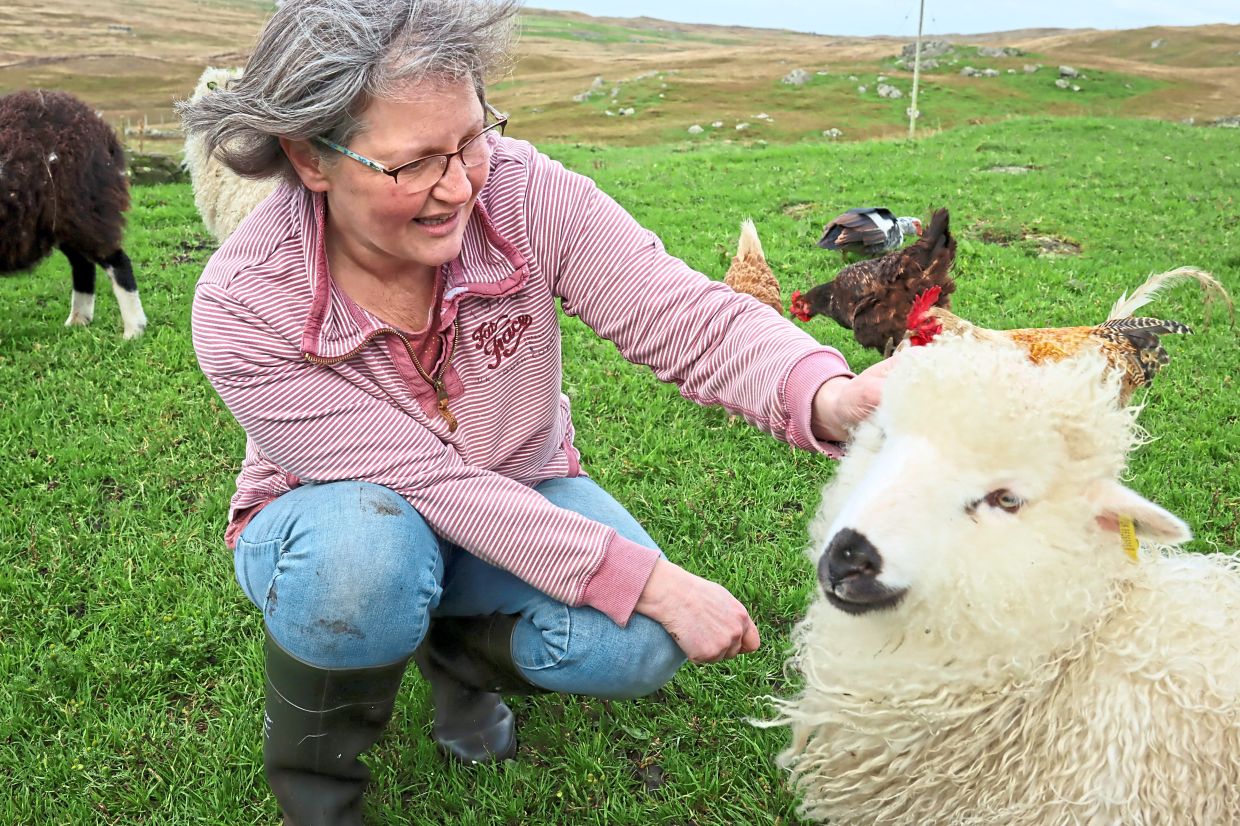
Becky Pritchard is one of those who dyes and sells her own wool. She runs her Silly Sheep Fibre Company in Walls, in the far west of the main island. Around 50 sheep, a few ducks, geese and chickens live on her fields.
Becky either uses the natural coat colours for her wool or dyes small quantities by hand. She sees that her wool has many fans, especially in the last quarter of the year and during Wool Week in Lerwick.
That’s when she starts packing the popular Advent calendars that she sells every year.
The long winters
Janni Beichert from Hanover, Germany, didn’t come here for the wool from Walls when she knitted the hat based on Anne’s pattern. She came to the islands with her friends Elke Bothe and Vanessa Jakel from northern Germany. To knit, relax and explore the Shetlands.
There are 100 islands in total, 16 of which are inhabited – located between the Orkneys, Faroe Islands and Norway. All three rave about what they have seen, even if it was in the rain, wind and the little sunshine that occasionally breaks through the clouds in autumn.
There are green hills, rugged cliffs, small lakes and lochs, and beaches with turquoise sea water. There are winding roads, almost all single lane, with bays to let oncoming traffic pass.
And with a bit of luck, you can see the Northern Lights as early as the beginning of October, when the sky is clear.
It’s completely different up here, lonely but special like nowhere else. And it is easy to imagine how people knit all winter long when it’s stormy, wet and dark outside. How they spin wool for domestic use and the older women teach the younger ones the complicated Fair Isle patterns. Or lace knitting.
The women of Shetland were once famous for both, as visitors to the Shetland Museum and Archives in Lerwick can learn.
A cultural treasure
Queen Victoria owned a stole, French fashion magazines reported on the lace that was handmade on a remote archipelago, and it was even available in shops in New York, United States.
The islanders sold the thick warm jumpers and cardigans throughout the kingdom and to fishermen who stopped at the islands on the border between the North Atlantic and the North Sea.
It was mainly the women from Unst, the northern-most tip of Britain, who knitted the lace from very fine wool. This is a real science, even for those who are experienced. A small group meets up regularly at the Heritage Centre on the northernmost of the larger islands in the archipelago. In a side room of the building, which from the outside resembles a primary school, they knit, chat and pass on their knowledge.
They also analyse mistakes in patterns or technique.
Minnie Mouatt and the others can take some of the credit for ensuring that the cultural heritage of lace knitting has not been forgotten – there was a danger of that happening. But now there are a few younger women who use their needles to create the delicate patterns.
Wool Week
While people visit year-round, a highlight for many is the annual Wool Week in autumn. It sees organised trips to Unst, plus numerous other tours to visit shepherdesses and spinners, wool producers and designers. And there are lots of workshops on spinning, knitting, weaving, felting – everything you can do with wool.
The Shetland Museum and Archives in the main town of Lerwick is the hub for Wool Week and all are welcome to come with their crafts and any questions they might have. In a kind of living room, people sit on cosy sofas, needles clacking, with balls of wool lying around on the ground.
On one wall there is a large world map with numerous flags that show how wool enthusiasts have come to the north of Scotland even from Hawaii in the US, South Africa, New Zealand and Japan.
Elke, one of three friends who came from northern Germany, is a minority in the area as she can’t knit. Yet, anyway. Nevertheless, she was determined to go on this trip. No question.
She is fascinated by something else, without which no knitter could take up their needles and start out on a pattern. “I could sit there for hours watching someone make wool on a spinning wheel.” – VERENA WOLFF/dpa