
The warnings are impossible to miss – posted at Santa Lucia train station, St Mark’s Square, and every Venetian water bus (vaporetto) stop, spelled out in multiple languages: “Attenzione borseggiatori”. “Attention pickpockets”. “Beware pickpockets”. And of course, “Achtung Taschendiebe”.
Yet, despite the warnings, wallets still disappear from trouser pockets or handbags. This happens to dozens of tourists in Venice, Italy every day.
Pickpocketing in Venice, a city with fewer than 50,000 residents, rivals that of major metropolises.
Especially in peak tourist season, when up to 150,000 visitors pour in daily, the city becomes a lucrative hunting ground for thieves.
In the city’s narrow streets, the culprits range from petty pickpockets to organised gangs – men, women and even children – many arriving from outside Venice as day visitors.
The issue of stolen wallets is not new in Venice.
As early as 1961, the local newspaper Il Gazzettino lamented that there was not a day without thieves.
However, with more and more tourists coming to the historic city, the problem has worsened to the point that Mayor Luigi Brugnaro has now issued a plea for help to the national government and parliament in Rome – a step proud Venetians, with their history spanning over 1,500 years – are reluctant to take.
A visit to the police station opposite St Mark’s Basilica gives an idea of the scale of the problem. There, a room contains 15 black bags filled with handbags and wallets – just the items re- covered over the past six weeks.
Typically, thieves discard the stolen items after taking the cash and credit cards. They show little interest in identification documents, which are often found on pavements, in letterboxes, gardens, or even in the canals.
The baby pickpockets
Organised crime is often behind the thefts.
Most perpetrators come from the mainland, from cities like Milan, and are brought to Venice for their criminal activities, sometimes in minibuses.
Increasingly, children as young as 12 or 13 are being caught – making them just under the age of criminal responsibility, which is 14 in Italy.
They are referred to as “baby borseggiatori” or baby pickpockets. In Italian, the term sounds almost harmless. Most of these children are released from the police station on the same day, often within hours.
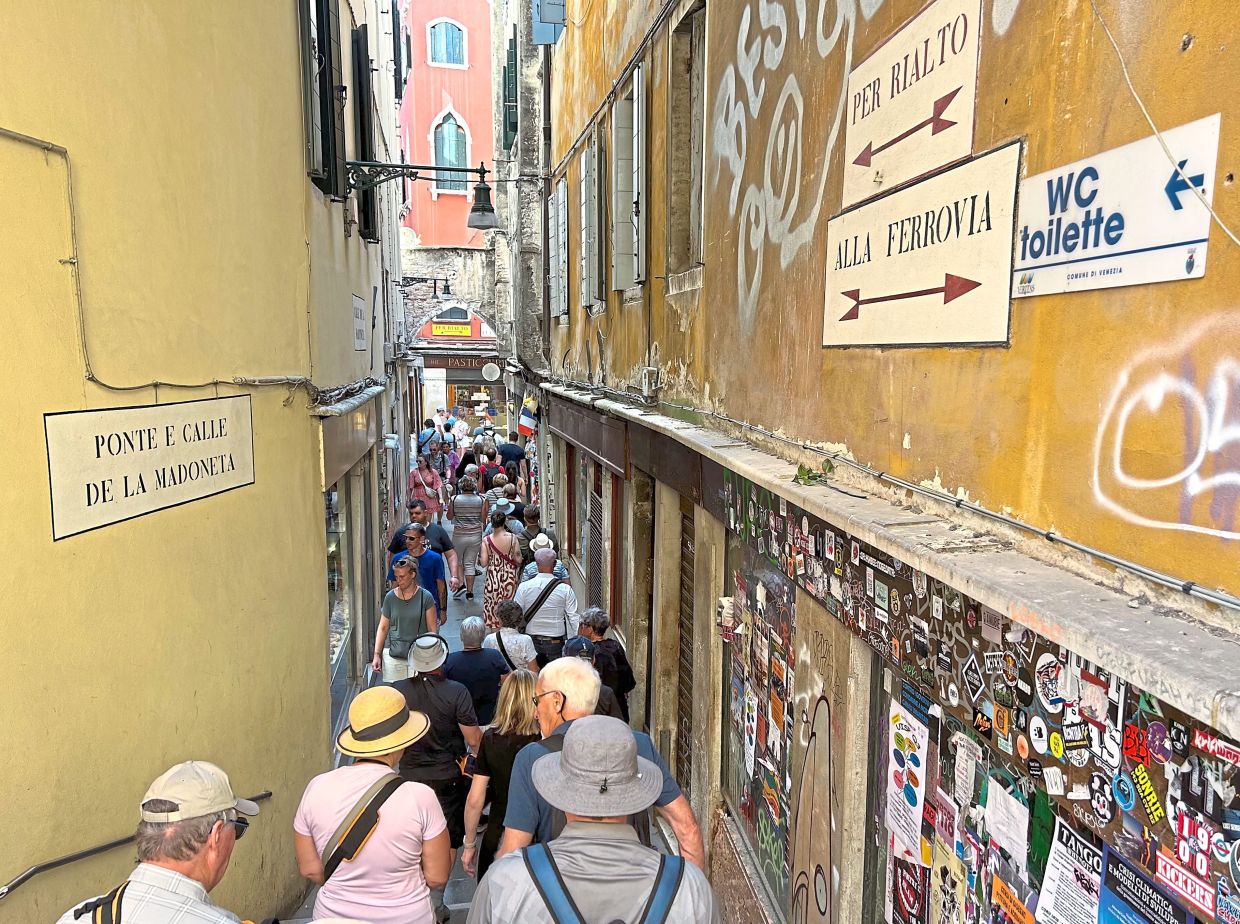
Particularly dangerous areas include Santa Lucia, where trains from the mainland arrive, the bus station at Piazzale Roma, the gondola and boat docks, and the narrow streets between the Rialto Bridge and St Mark’s Square.
In these spots, the crowds can be so dense it’s hard to move – perfect conditions for pickpockets.
Although the city has installed more than 850 surveillance cameras, with footage monitored around the clock from a control room on one of the islands, the police often arrive too late.
Adding to the frustration is that even when thieves are caught they face little risk of imprisonment. Police Chief Marco Agostini recently complained in the daily newspaper Corriere Della Sera about a “large bubble of impunity”.
“Pickpocketing can only be prosecuted if a complaint is filed. And if the victim does not appear in court, the complaint is considered dropped.”
Most victims are foreigners, many of whom leave the city the same day. As a result, trials are rare. Currently, only four people are in prison in Venice for pickpocketing.
In a nationwide appeal, Brugnaro has called on politicians in Rome to tighten the laws. He wants to reverse a reform passed some time ago, which stipulates that many minor offences are only prosecuted at the request of the victim.
So far, however, only minor changes have been made, and nothing has changed regarding pickpocketing.
“We must not get used to such crimes becoming part of everyday life,” the mayor said. – CHRISTOPH SATOR/dpa