China's nine-day spring festival holiday, the longest on record, is doing more than unleashing pent-up travel demand. It is revealing a clear shift among young travellers.
Increasingly, they are bypassing traditional hometown reunions and crowded attractions in favour of smaller cities and towns, where festive traditions feel more vivid and local life more tangible.
Leading this shift are the post-1980s (1980-1989) and post-1990s (1990-1999) cohorts. According to travel platform Tuniu, they account for 64% of all travellers, making them both the principal spenders and the chief planners of family trips.
“The festive atmosphere has become one of the main drivers of China’s domestic travel market during the Chinese New Year,” said Sun Yunlei, director of online travel platform Mafengwo’s destination research institute. Destinations steeped in folk traditions and cultural heritage are especially popular, reflecting travellers’ desire for both cultural experiences and a festive holiday ambiance, she noted.
Fuzhou exemplifies this trend, entering the top five for spring festival hotel bookings for the first time on travel platform Qunar, with reservations soaring by over 80%. A key draw is the “youshen”, or “parade of the gods”, a local folk ritual that offers travellers a vivid glimpse of living festive traditions.
Meanwhile, hotel bookings in Guangdong’s Chaoshan region jumped over 70% year-on-year during the spring festival.
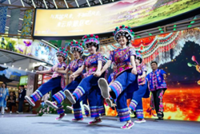
Shantou, a charming “festive small city” in the region, attracts visitors with its vibrant folk traditions. From the unique Yingge dance to its renowned tea culture and local beef dishes, it’s turning into one of this year’s surprise travel hotspots.
For Lexie, a post-1990s resident of Shanghai, the shift is deeply personal. This spring festival, she is swapping the quiet, grey chill of Shanghai for a family road trip along the southern coast, visiting Shantou, Chaozhou, Quanzhou, and Fuzhou.
Looking for that rich, lived-in festive vibe that metropolises often miss, Lexie has focused her itinerary on two main adventures: diving into the Yingge dance and savouring local eats in Shantou, as well as soaking in the historic, poetic street view and the ambient charm she described as “half worldly hustle, half celestial peace” of Quanzhou.
Industry observers said that such a shift has also sparked a nationwide cultural heritage fever during the holiday. Searches for folk events, from lantern shows to temple fairs, have jumped 117% year-on-year on online travel service provider Fliggy.
Meanwhile, interest in intangible cultural heritage experiences, including museum visits, craft workshops and live performances, has risen more than 60%.
Localities have responded accordingly. Guangdong, Fujian and Sichuan are leveraging their unique customs to draw in visitors. In Sichuan, events like the lantern festival in Zigong, the Sanxingdui New Year ceremonies, and the hot springs at Mount Emei have catapulted Chengdu into one of the top four domestic flight destinations.
Hotels near the lantern displays are nearly all booked out, and prices have shot up, more than doubling in some cases.
Chinese-style theme parks are another stage for immersive celebration. Visitor interest in Unique Henan: Land of Dramas, a gigantic immersive theatre complex in the central city of Zhengzhou, and an amusement park themed on Journey To The West in Huai’an, east China’s Jiangsu Province, more than doubled during the holiday.
Experiencing an authentic Chinese New Year celebration has also become a growing trend among international travellers. Data from Fliggy shows that in the past two weeks, foreign bookings for domestic flights during the holiday have quadrupled year-on-year, with Shanghai, Guangzhou, Hong Kong, Beijing, and Chengdu topping the list of preferred entry points.
“Even smaller cities are now welcoming more foreign visitors,” noted Yang Han, a researcher at Qunar’s Big Data Research Institute, citing destinations from Jining and Rizhao in Shandong, to Linzhi in southwest China’s Xizang Autonomous Region and Yibin in Sichuan, all seeing inbound travellers over the holiday period. – Xinhua