To a stranger, these might be little more than family photographs and school trophies and medals placed in a cupboard.
But to artist Puah Chin Kok’s mother, they meant the world.
He had an inkling just how much, so when she was recuperating from an illness in his home in Kuala Lumpur, he took photographs of the old family home in Sekinchan in Selangor, and selected two to hang on the wall in the room she stayed in.
One of the photographs showed an altar engraved with the phrase "Jin Yu Man Tang" (overflowing riches) in the middle of the family’s living room, with a few ancestral tablets and miniatures of the deities that his parents prayed to, with trophies and medals received by Puah and his six siblings on display.
The other photograph is of their graduation photographs on the wall.
“I wanted my mother to feel at home. I hoped that the photos could offer her comfort, which she seemed to appreciate. Throughout the period of her recuperation, she liked to look at the two photos, and would praise them saying that they looked ‘Jin Sui’ (they are beautiful).
"So in retrospect, the pieces bring back nostalgia for her as well as her life’s work in raising me and my siblings. Today, I take comfort in knowing that my mother was proud of her children’s achievements which she had so lovingly enshrined alongside the family’s collective memory as a tribute to the generations before us,” says Puah, 54, who primarily works with photography (and installation art) as a creative medium.

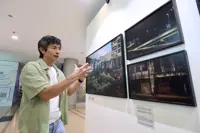
These two photographs are featured in Puah’s photography exhibition Family Pride at Studio Setiawangsa in Kuala Lumpur.
Another eight photographs, depicting similar displays in the homes of friends and relatives, round up this project which started out as a remembrance for his mum, but ended up being so much more.
“The medals and trophies that are visible across all pieces put a big emphasis on pride. I was startled by how remarkably similar they were to the photos that my mother had praised, which opened up my eyes to serendipitous stories about the things that matter most in our eyes.
"Many parents in Chinese families want their children to become successful, to become great. They want their children to be the best so that their children can live a fulfilling and comfortable life. Although methods to achieve this vary between families, I think all Chinese parents share the same sentiment. Communicating with other families to help them express the stories they shared with me, has only strengthened this idea,” he says.

Puah points out that trophies and medals might seem like an inconspicuous waste of space to some people, but they are almost never thrown away by parents.
“They acknowledge the hard work of not one, but many people, all collected together for a display of sheer persistence, serving as the easiest way to symbolise, glorify and show their achievements. This is a culture that can be seen in many families throughout Malaysia,” he says.
Family Pride, curated by Liew Kung Yu, is supported by Cendana’s Visual Arts Showcase Funding Programme 2020 (Cycle 1).
It highlights the stories of a generation that endured hardship and despite all odds, made huge sacrifices for their children to help them succeed in life.
To Puah, it is a reminder about the sacrifices of his mother’s generation and a tribute to their tremendous efforts.

The photographs in this exhibition are familiar scenes that are relatable across generations, even if perspectives differ.
“I do hope for an overall positive response from visitors. I would like children from my generation to understand the lengths that their parents went through to make them successful. I want our appreciation to be known to my mother’s generation, to know that their efforts are not in vain. I also hope I succeed in paying tribute to the hard work of my parents’ generation - the first reason that started it all,” he says.
This exhibition is a rather personal undertaking for Puah, as it directly links to his mother who has since passed away.
He recalls that like many typical Chinese parents, she was never particularly effusive in her praise for her children while they were growing up - at least, not in front of them.
“However, she would talk about her children’s success to her friends, our neighbours, anyone - just not us. She even told my dad to do the same. I was never clear about what her intentions were or what this was supposed to achieve, but my guess would be to help us stay grounded, humble, and continue to work on being a better person than yesterday,” he says.

In Family Pride, he pays tribute to his mother, noting that the love and commitment she put into raising her children, as well as her pride and achievements, have taught him a great lesson about perseverance and undying motherly love.
“My mother did not go to school, but in my heart, she became the most successful mum. When she passed away, in accordance with her wishes, we bought her a primary school uniform as a fulfillment of her dearest wish to complete the education she was denied in life.
"In her absence, this series of photos give me comfort and help me to remember the person she was. It also allows me to follow in her footsteps, to understand the regrets she carried, and why she felt such a strong need for her children to receive a good education.
“I sometimes contemplate whether she would enjoy these pieces, but without a doubt, I think she would. Not only had she complimented the first two pieces of the exhibition, but I think she would be proud of my work because it not only pays homage to the bond between us, but to the bonds between many others. My mum would have been happy and very proud about that,” he concludes.
‘Family Pride’ is on at Studio Setiawangsa, 30-3, Jalan Setiawangsa 10, Taman Setiawangsa in KL, till Feb 15. Opening hours: 2pm to 9pm, by appointment (closed for Chinese New Year from Jan 31-Feb 3). For more here.
Already a subscriber? Log in
Get 20% OFF The Star Digital Access
Cancel anytime. Ad-free. Unlimited access with perks.