



Most steakhouses in the Klang Valley tend to be dominated by the holy trinity of premium beef cuts – striploin, tenderloin and rib eye.
Very few venture outside this gilded category of cattle and even fewer are skilled at treating and cooking secondary cuts of beef.
And yet, chef Yenni Law and her partner-in-crime chef Shelly Saw decided to go quite literally against the grain at their hallmark non-halal Petaling Jaya restaurant, Meat Feds.
“I started studying all these secondary cuts of beef in 2017 and dabbling and experimenting and then I got deeper and deeper into it.
“Originally, the aim was to put a lot of steaks on the menu and then subsequently, Shelly and I put in more effort to study more and more secondary cuts to turn them into special steaks. So we kept doing R&D through a lot of butchery work.
“Even now, we dedicate 10 man-hours a week to processing (butchering) these cuts. After processing, we cut them into singular steaks and vacuum pack them to keep them fresh, then we sell them on the menu,” says Law.
Law and her team at Meat Feds recently bagged a Malaysia Book of Records nod for having the highest number of secondary cuts of steak on a restaurant menu, clocking in at 20 different secondary cuts – the most of any restaurant in Malaysia, according to the research team at the Malaysia Book of Records.
“We normally try and verify on-site. In this case, they had to send us evidence of every single cut at their outlet, so they had to send us videos and photographic proof taken at their outlet and detail each cut.
“We also did a general survey to look at other restaurants, and actually nobody else does this. Even if they do, they only serve one or two secondary cuts, not 20,” says Jwan Cheah, the chief executive officer of Malaysia Book of Records.
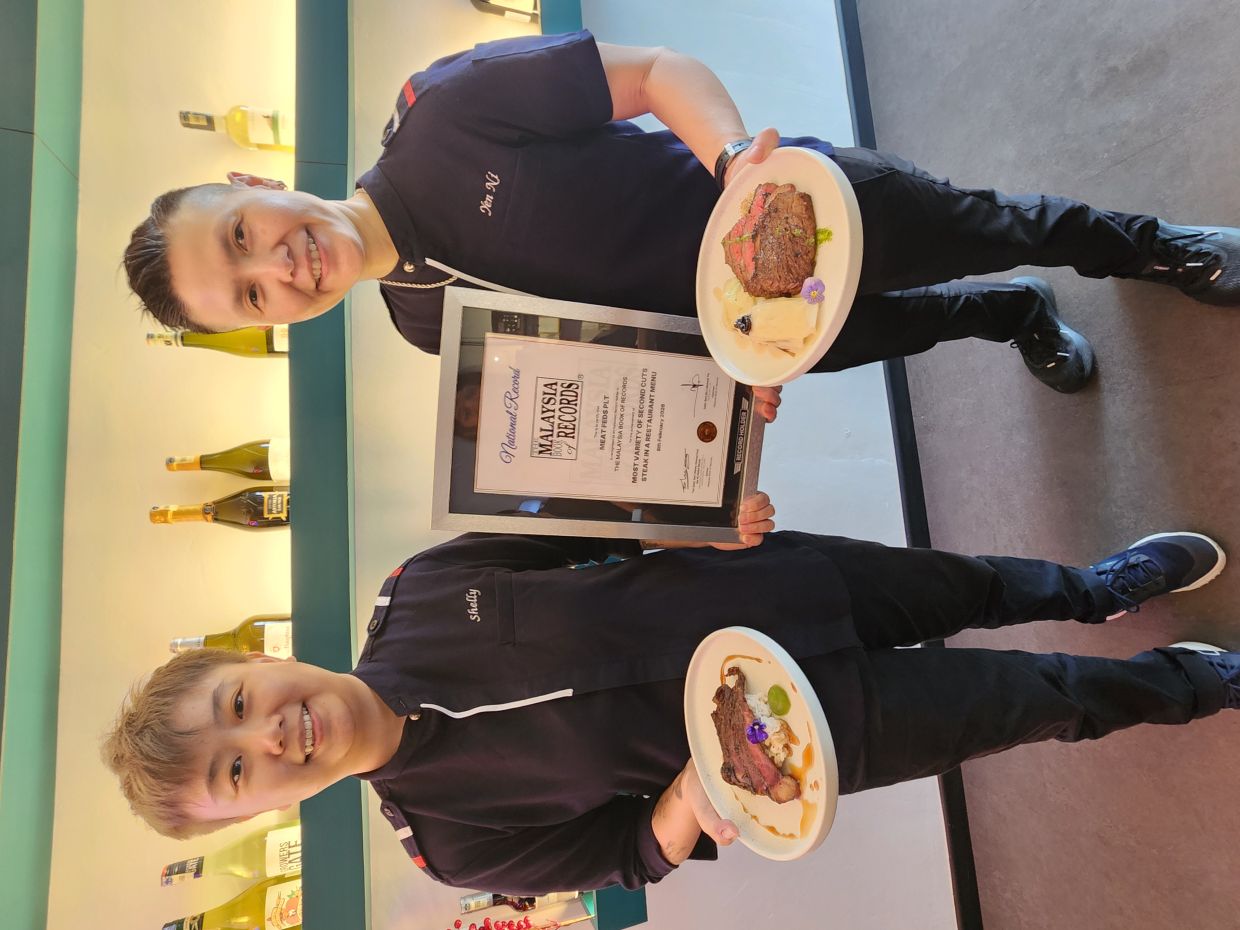
These 20 secondary cuts include: flat iron (derived from the beef shoulder), flank (a lean cut from the abdominal muscles), rump (from the hindquarters of the cow), hanging tender (a cut from the diaphragm), outside skirt (from the diaphragm muscle), inside skirt (from the cow’s plate primal), chuck primal (from the shoulder and neck region) and picanha (sourced from the top rump cap) – to name a few. The beef is typically sourced from Australian Angus, Australian wagyu and Japanese wagyu cattle.
For reference, prime cuts of beef only make up less than 20% of a cow’s utilisation, while secondary cuts take up approximately 80% of a cow’s utilisation.
Unlike most restaurateurs who repurpose secondary cuts of beef into thin slices of meat used in shabu-shabu or even turned into stews and braises, Law is adamant about turning these cuts into steaks so that people can truly appreciate the flavour and texture of the meat in its au naturel state.
“You could have the same cattle, like Australian wagyu, but different parts of the cattle taste different. There are also different textures and different grains. A flank steak, for example, can be very grainy but also very tender and a picanha steak can be very beefy and buttery and creamy at the same time, while a short rib steak is often bursting with juices.
“And yet, most people who buy secondary cuts just buy them and cook them in a stew, but they are wasted in the sense of the enjoyment of the meat. Anything that you cook for a long time or pressure-cook or slow-roast, you are really going to cook it until it is overcooked and that would break down the tendons and sinew, but you don’t get to enjoy it as fork-tender – you don’t enjoy the juices or the char – so I want people to enjoy it as a steak. That is why we are dedicated to doing this,” says Law.
Interestingly, although Law and Saw won the award for having the most secondary cuts of beef on a restaurant menu, Law has applied the same principle to other proteins like lamb and pork and has various secondary cuts of both at her restaurant.
Law says she feels that she is probably a rarity simply because most restaurateurs and chefs are unwilling to put in the hours and recruit a team dedicated to butchering secondary cuts of meat.
“These types of cuts are very intimidating to do. A lot of restaurants won’t invest in this because there is very high wastage (yield loss can be up to 50%), so they feel it’s not worth it to have these cuts on the menu.
“And a lot of chefs shy away from doing this because it’s just so much work and processing and that’s before you’ve even cooked it. Which is why this is our blue ocean (untapped market space), because a lot of people don’t want to do it.
“So we are not competing with anyone else – we’re in our own category and we’re willing to put in the hard work because we want to give these secondary cuts main character energy,” says Law.

