L’Oréal reduces material use, promotes circular design
An Yves Saint Laurent (YSL) perfume bottle stands empty, and a refill bottle is set upon its opening.
With an effortless twist, vibrant liquid flows into the original bottle, sending a stream of bubbles rising through the refill bottle.
A gentle gurgling of the flowing fragrance accompanies the seamless refill, as the original bottle gradually fills once more, ready to be enjoyed again.
With L’Oréal’s Join the Refill Movement, every refill turns beauty rituals into a thoughtful gesture for the planet.
Globally, 28 products from 18 brands under L’Oréal are refillable, with refill pouches, canisters and bottles to replenish the original products when they run low.
In Malaysia, seven brands across three divisions – Kiehl’s, Lancôme, La Roche-Posay, Kérastase, Armani, YSL Beauty and L’Oréal Professionnel – are participating in the campaign, spanning luxury fragrance, professional haircare, dermatological skincare and everyday beauty.
“The consumers are ready to adopt,” said L’Oréal Malaysia and Singapore country manager Tomas Hruska. “It’s our job to make it easy for them.”
Packaging innovation
The refill options are far more than simply packaging products in refill containers and calling it a day.
Considerable thought has gone into ensuring they are both safe and easy to use, while some of the original packaging have to be redesigned to accommodate the refill system.
The thoughtful engineering behind the refill systems is reflected in the spill-free dispensing, airless pods and custom-fit nozzles.
Most importantly, the refill packs embody the same sense of luxury and aesthetics of the brands.
“We don’t want our consumers to feel like they are sacrificing luxury for sustainability,” Hruska said.
“Our iconic fragrance and skincare bottles are emotional objects of craftsmanship. By offering elegant refill systems, we transform the act of refilling into a sophisticated new beauty ritual, proving that true luxury and environmental wisdom go hand in hand.”
Combining performance and environmental responsibility is just as critical.
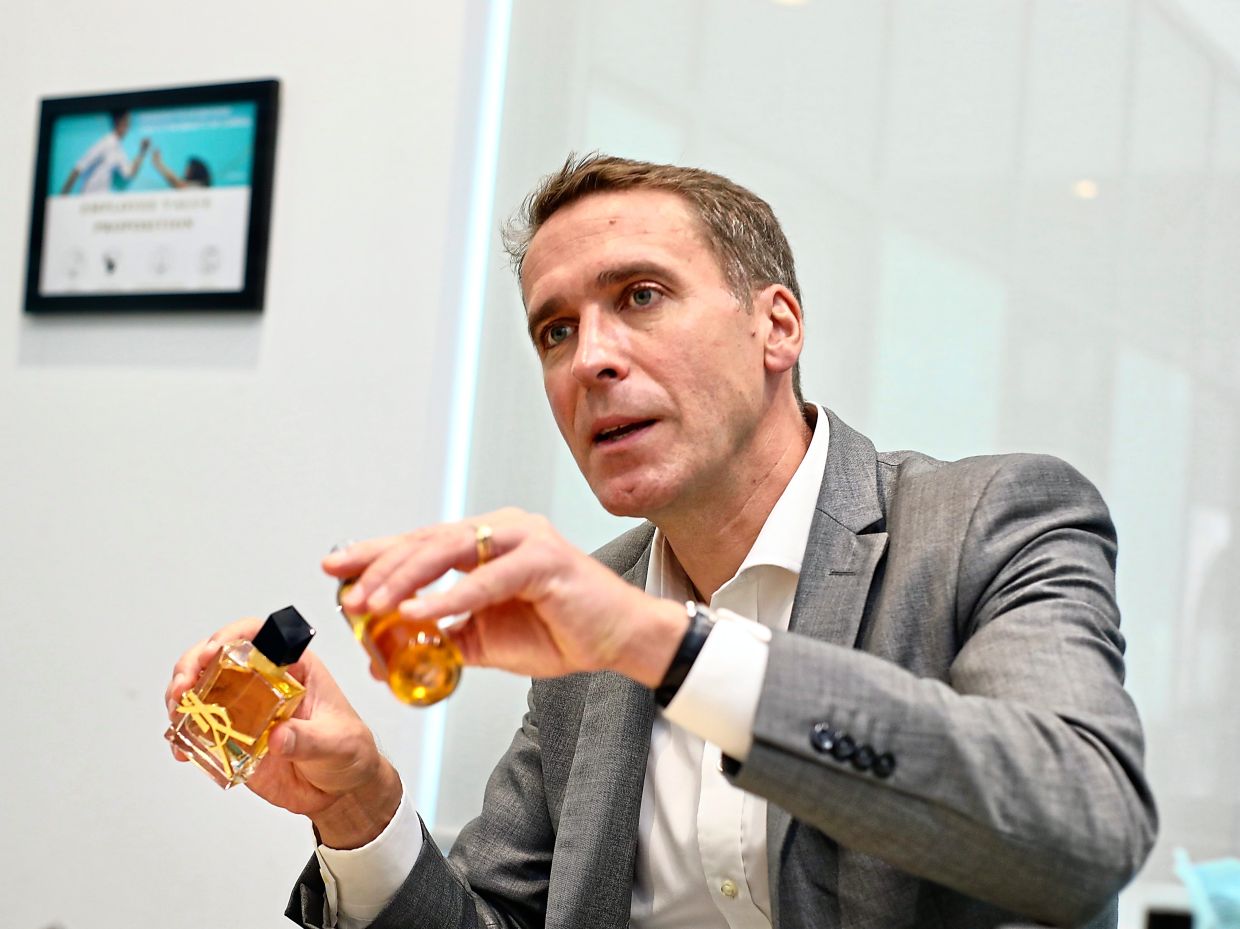
“We have to make refilling convenient, clean and mess-free, while guaranteeing the product’s performance and quality,” he added.
Wherever possible, the refill packaging is also made of recycled materials. The amount of material saved varies across products and their refill formats.
For instance, refilling a Kiehl’s Ultra Facial Cream 50ml jar three times reduces plastic use by 94%. When consumers purchase a 150ml refill instead of rebuying two 60ml YSL MYSLF Eau de Parfum, they save 58% of glass, 100% of metal, 43% of plastic and 26% of cardboard.
Collectively, these products contribute to the goals under L’Oréal for the Future, which are to reduce virgin plastic in product packaging by 50%, reduce overall packaging intensity by 20% and to source 50% of packaging materials from recycled or bio-based origins by 2030.
To date, the group has achieved a 37% reduction in virgin plastic use, reduced packaging intensity by 12%, and sourced 44% of packaging materials from recycled or bio-based sources.
Malaysian consumers are ready
L’Oréal’s refillable options first hit shelves three years ago, with global sales of refills growing by 34% in 2025 compared to 2024.
In Malaysia, L’Oréal’s rollout of refillable offerings began with Kiehl’s. The refill packs are prominently displayed alongside the main products, maximising visibility.
Today, the brand remains the most successful in terms of refill sales by weight of business.
Last year, the Join the Refill movement in Malaysia drew consumers’ attention to fragrances, offering greater value for those who invest in a bottle of quality perfume and continue to refill it.
Refills are not more expensive, Hruska said, challenging a misconception that sustainability costs money.
“Our data shows that while 68% of consumers want to buy refills for the planet, an overwhelming 87% will buy them if they see a clear cost saving.
“That is why we make the price gap both real and highly visible. When you buy a refill, you aren’t paying for the glass, the heavy caps or the outer box – you are only paying for the high-performance formula.”
Since consumers are ready to embrace refillable options, the only task remaining for the group is to build awareness and bring the products closer to customers.
Hruska said he looks forward to scaling the refillable range in the coming years and working with retail partners to optimise visibility, as a global survey shows that 42% of consumers were unaware refillable options existed, and 43% could not find them on shelf even when they were looking.
“These are retail infrastructure and visibility problems as much as they are awareness problems, and solving them requires working closely with retail partners to improve signage, shelf placement and the presence of refill options on platforms like Shopee and Lazada, not just in physical stores.”
Hruska shared that he has two key performance indicators: the weight of business from refill pack sales, as well as the percentage of refillable products within a brand.
“Once you unlock the three steps – awareness, ease of use and value for money – the adoption is significant.
“Malaysia is ready for it. It shows that in this part of the world, people are prepared and waiting for companies to help them. It is our job to provide and educate consumers, and the good news is that they are willing to adopt,” Hruska said.
Commitment to circular design
L’Oréal’s commitment goes beyond the current refillable range.
It has launched the L’AcceleratOR programme to support the development of next-generation packaging materials, including seaweed-based packaging, bio-plastics derived from sugarcane and recyclable paper bottles.
This initiative, in collaboration with Cambridge Institute of Sustainability Leadership, represents L’Oréal’s longer-term commitment to circular design.
“This will help us identify, pilot and scale the solutions needed to address the continued challenges facing our industry, from sustainable ingredients and packaging materials to low-impact manufacturing processes,” Hruska shared.
The €100mil (RM466.5mil) investment over five years will allow the group to scout, identify, pilot and scale breakthrough technologies addressing critical solution gaps within the industry in support of its sustainability transformation.
In the first cohort, which began in January, almost half of the startups and small and medium enterprises (SMEs) are focused on developing future packaging and materials.
Among them, a Swedish company is creating fibre-based caps and lids as alternatives to plastic packaging tops, while another Swedish firm specialises in low-carbon, paper-based packaging processes.
An Estonian company is turning natural wood into high-end shock-absorbing protective packaging.
“We look forward to the participation from Malaysian small and medium enterprises or entrepreneurs in the next round,” Hruska said.
L’Oréal’s refillable products are now available at Sephora, Watsons and Guardian, on Lazada, and across L’Oréal’s own online platforms.