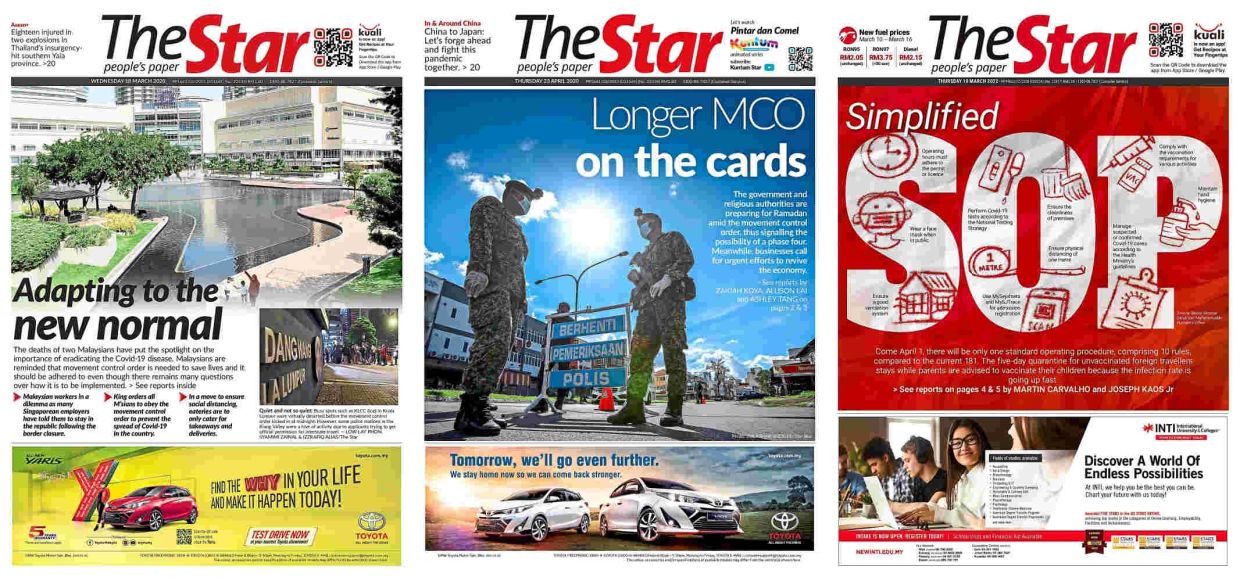
Iconic covers: March 18, 2020, April 23, 2020 & March 10, 2022
THE virus hit the country in January, and the first deaths came on March 17, 2020, one in Johor and the other in Sarawak.
The very next day, the country went into lockdown. Covid-19 had come to Malaysia – and was just as deadly here as it was everywhere else on the planet.
The world came to a standstill. Millions died. In Malaysia alone, the virus infected more than five million people and killed over 37,000.
Countries went into lockdowns, isolated the sick, scrambled for personal protective equipment and raced to develop vaccines, while hospitals and morgues struggled to cope with the death toll.
Malaysia recorded its first cases on Jan 25, 2020, before the Movement Control Order (MCO) was imposed on March 18. The MCO would continue through several phases before transitioning into the endemic phase in April 2022.

Much of the country was forced to stay indoors. Students took lessons online, while employees worked from home.
But not frontline journalists. They continued working, armed with masks and hand sanitisers, as well as physical distancing rules to protect themselves from an unseen enemy.
It was the biggest story the planet had seen in more than a century, and journalists had to deliver even when every day at work meant another day of exposure to the deadly virus.
They only received their vaccines in 2021, which meant they had to work an entire year in high-risk situations without a vaccine.
The pandemic also transformed newsroom operations and how journalists worked.
Star Media Group chief content officer Datin Paduka Esther Ng recalled that, at night, only the content department’s two floors at the 17-storey Menara Star remained lit, while the surrounding area remained pitch black.
Such was the journalists’ commitment to keeping the public informed.
Joseph Kaos Jr, then a reporter with The Star’s Putrajaya bureau, crossed state and district boundaries almost daily to cover Covid-19 press conferences by then Health director-general Tan Sri Noor Hisham Abdullah.
“Journalists were classified as essential workers, which meant we were allowed to travel for work despite the movement restrictions. I was living in Kuala Lumpur at the time, so travelling to Putrajaya meant crossing state and district boundaries through Selangor.
“We had to show our media passes at police roadblocks to be allowed through,” he said.
“While much of the country was staying home – almost on holiday – during the initial lockdown, it was business as usual for journalists. We still had to go out, cover developments and keep the public informed,” he added.
Of course, there were always concerns about personal safety and the risk of infecting loved ones.
“My family was worried too.
“While they stayed home, I had to travel outside regularly for work. The biggest concern wasn’t just getting infected, but the possibility of bringing the virus home and exposing my family to it,” he said.
He stressed the importance of following standard operating procedures (SOPs), including wearing masks, maintaining physical distance and practising good hygiene.
“In fact, I did not get infected by Covid-19 throughout the lockdown, it was only after lockdowns were lifted that I tested Covid-19 positive,” he added.
The experience also reinforced the responsibility journalists carry during a public health emergency.
“As reporters, we were among those receiving the latest developments directly from the authorities, but our responsibility went beyond simply reporting what was announced.
“We had to make sure the public understood what those announcements meant for them, whether it involved movement restrictions, vaccination programmes, or changes to government SOPs,” he said.
Accurate reporting was crucial as misinformation spread quickly online. Mainstream media had to play an important role in providing reliable information.
Although Joseph has since left journalism, he considers the experience one of the most valuable of his media career.
It wasn’t just the lockdown. Some places, where Coviod-19 clusters were found, faced enhanced movement control orders (EMCO), which saw people being placed behind barbed-wire barricades.
The Star’s technical producer Andrew Tan remembers covering EMCOs at the Selangor Mansion and Malayan Mansion buildings along Jalan Masjid India in Kuala Lumpur.
“Looking at those barricades, it really hit me that this could happen to any apartment block, including ours. Living under those restrictions would be incredibly tough for those with children and the elderly,” he said.
“But I felt confident I would be all right on site as long as I followed safety precautions. The real anxiety wasn’t about being there, it was the fear of potentially exposing my family and colleagues after returning from a high risk lockdown zone,” he said.
As the only editor-in-chief in The Star’s history to lead the newsroom through a pandemic of this scale, Ng faced the challenge of keeping staff safe while ensuring that one of the thickest newspapers in the country went to print every single day.
The pandemic taught the newsroom how to manage content and their workforce daily through online mediums.
Although most employees worked remotely, print production still required some staff to be physically present, particularly sub-editors in the content department and production staff at the printing plant in Bukit Jelutong, Shah Alam.
With only 20% of staff allowed in the office, Ng visited the floors under her care almost daily to ensure compliance with restrictions.
She also sent staff home when numbers grew too high, as a single infection could force an entire floor or even the building to close. Several alert systems were put in place as part of the Covid-19 restrictions.
Despite limited assignments, largely confined to health and security press conferences, and occasional prime ministerial addresses, Ng said the team continued producing exclusive reports.
“I’m very proud to say that all the desks stepped up, because without assignments and scheduled events, everything was our own story and follow-up.
“Nobody came to me to say they were scared but I could see from their faces that they were very worried,” she said.
The pandemic also gave birth to new forms of storytelling, which Ng describes as “ACBC”, After Covid-Before Covid.
Among them was the award-winning StarPlus team which produced data driven interactive reports, and The Star Online’s fact-checking section, True or Not, which went on to win the gold award at the WAN-Ifra Digital Media Awards 2025.
Ng said that as fake news proliferated during the crisis, journalists worked to verify information and debunk false claims.
She also described how the newspaper’s front page had transformed and since become more focused on infographics.
The newsroom’s former Hall of Shame, which highlighted stories journalists had missed, was also transformed into a Hall of Fame showcasing iconic front pages, including many from the Covid-19 period.