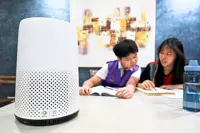
PETALING JAYA: Demand for air purifiers is surging as consumers seek to safeguard indoor air quality amid the haze situation.
Samantha, an electrical appliance store manager in Kelana Jaya, said she has sold about 40 units this month.
“Our two most popular models, priced between RM1,299 and RM1,599, sold out within the first week.
“I have ordered extra stock as demand keeps growing due to the haze,” she said.
A sales assistant at a nearby home appliance outlet noted that stocks are limited, with new shipments for certain models delayed by two to three weeks.
“More first-time buyers are coming in due to the haze. Our top-tier RM4,700 model has sold out for the month,” she said, noting that entry-level units start at around RM400.
She added that their staff would guide first-time buyers on room coverage.
“Many assume one small unit covers an entire house,” she said.
“We advise them to check the Clean Air Delivery Rate to match the device to their room size.”
Universiti Malaysia Terengganu air quality expert Assoc Prof Dr Samsuri Abdullah said air purifiers help filter fine particles that seep indoors.
“While haze indices track outdoor air quality, fine particulates like PM2.5 enter homes through windows, doors and ventilation vents.
“If budget permits, an air purifier removes these particles and protects respiratory health when homes are shut tight,” he said.
Assoc Prof Samsuri advised buyers to check filtration specifications, recommending high-efficiency particulate air filters to capture PM2.5 particles effectively.
“You should also monitor the outdoor air quality index, and when conditions are good, open your doors or windows slightly to allow some airflow,” he added.
Prof Dr Zailina Hashim of the Malaysian Environmental Health Practitioners Association said consumers should not rely solely on an air purifier to maintain good indoor air quality.
“If you always leave your windows open or use a small air purifier in a large space such as the living room, it may not be as effective,” she said.
Prof Zailina advised consumers to minimise other sources of indoor air pollution such as cigarette smoke or incense while ensuring the purifier is placed in an area where air can circulate freely.
“Instead of using one unit for an entire home, maybe they can place the device in the room where they spend the most time,” she added.