
KUALA LUMPUR: Small and medium-sized enterprises (SMEs) want the government to ensure any GST-style tax reform does not tie up the working capital needed to pay workers, suppliers and other day-to-day expenses.
They are calling for faster refunds, tax liabilities linked to actual cash received and higher registration thresholds, while warning against compliance requirements that could force smaller firms to spend heavily on accounting systems and manpower.
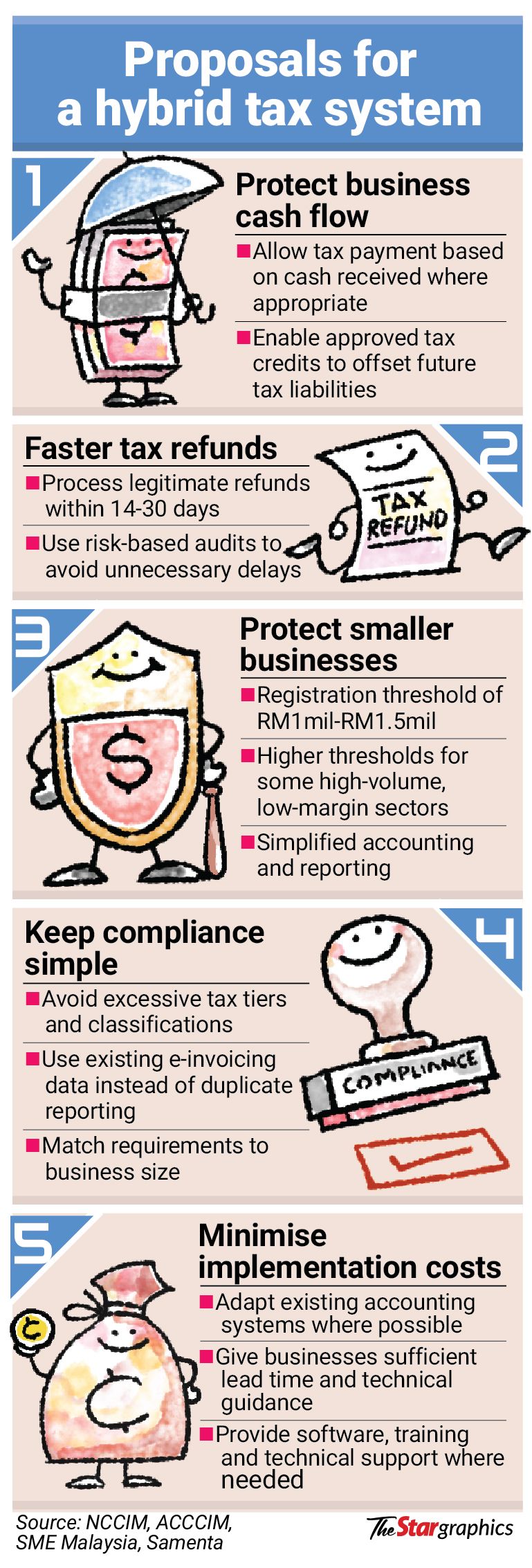
The groups supported allowing businesses to recover tax paid on genuine business inputs but warned that the system would be of little benefit if SMEs had to spend more on compliance or wait too long to get their money back.
Small and Medium Enterprises Association (Samenta) president Datuk William Ng said the government should avoid repeating the complexity of the previous GST regime, particularly multiple tax tiers and classifications that could create confusion and inadvertent non-compliance among smaller businesses.
“Given that most businesses have already implemented e-invoicing, we must also make sure any new features do not require businesses to duplicate transaction data that is already captured by LHDN,” he said in an interview yesterday.
Ng proposed a RM1.2mil annual revenue threshold for mandatory registration, saying the previous RM500,000 threshold was outdated given inflation and higher operating costs.
“The primary failure of the 2015 GST era was delayed input tax refunds that crippled cash flows,” he said.
The Associated Chinese Chambers of Commerce and Industry of Malaysia (ACCCIM) treasurer-general and SME committee chairman Datuk Koong Lin Loong said improving business cash flow should be a priority as the tax system is reformed.
“Timely refunds are important because money paid to the government could otherwise remain tied up when businesses need it for their operations,” he added.
SME Association of Malaysia president Dr Chin Chee Seong similarly called for cash-based accounting for SMEs, saying businesses should not have to pay tax before receiving payment from customers, particularly when they routinely extend credit for 30 or 60 days.
“Businesses are traders and employers, they should not act as default bank financiers for tax authorities,” he said.
Chin proposed a minimum RM1mil annual taxable-turnover threshold, with higher thresholds considered for high-volume, low-margin sectors.
He also called for a 30-day standard for straightforward, low-risk refund claims, with risk-based audits handled separately so legitimate claims were not held up indefinitely.
Yayasan Nishana chairman Nivas Ragavan, whose organisation focuses on safeguarding and empowering micro-SMEs, said businesses also needed greater certainty when adapting to another tax system change.
“We could draw on some of the accounting and tax expertise built up during the 2015 GST implementation, but technology and business systems had since changed.
“We have gone through SST, GST and then SST again, while businesses have repeatedly had to spend money changing their systems and processes,” he said.
Nivas said sufficient transition time and clear technical guidelines were needed, with businesses allowed to adapt existing systems where possible instead of incurring another major implementation cost.
“For businesses, especially SMEs, cash flow is survival. A profitable company can still fail if its working capital is trapped in the tax system,” he said.