
Govt urged to engage with relevant groups for feedback
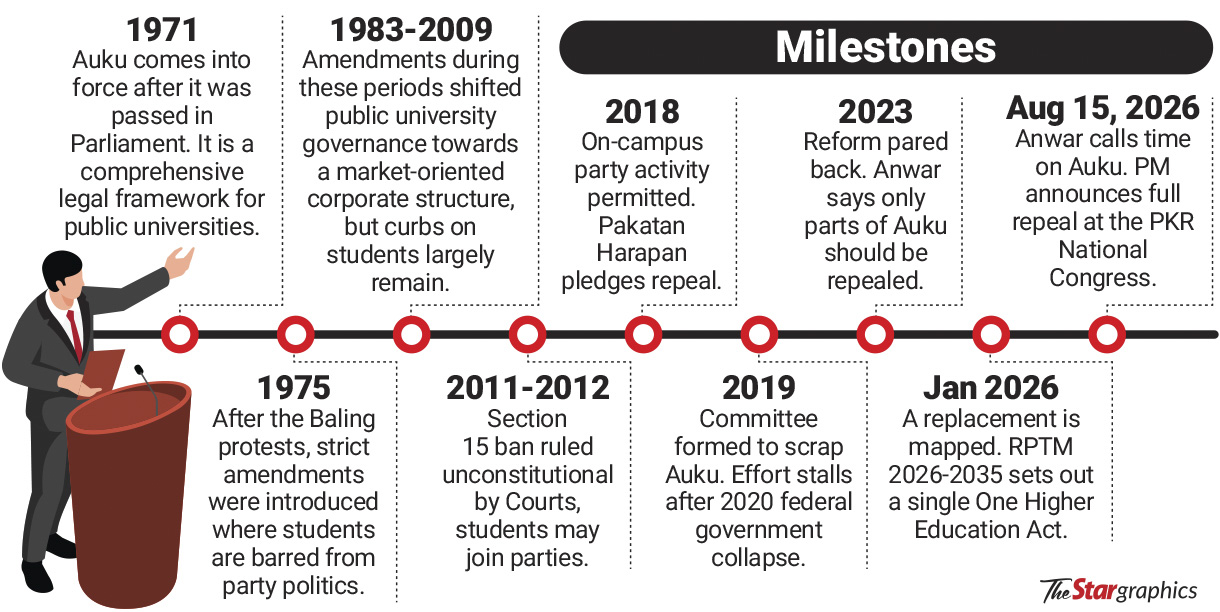
PETALING JAYA: Student groups, academics and youth leaders have hailed the proposed repeal of the Universities and University Colleges Act 1971 (Auku) as a major victory for students.
They also urge the government to set a clear timeline for scrapping the decades-old law.
Universiti Malaya Association of New Youth (Umany) said the announcement was the result of years of struggle by the student movement and should not be viewed as a gift or favour granted by any government.
“Umany urges the government to immediately announce a clear timeline for the repeal of Auku, outline the legislative process involved and present a comprehensive framework to replace the existing system,” it said in a statement yesterday.
The group said student organisations, academics, university staff and civil society groups must have meaningful opportunities to participate in the process, rather than leaving the future of students and universities to be decided behind closed doors by the bureaucracy.
The Secretariat to Abolish Auku, which had staged a protest outside Parliament on this matter, also welcomed the Prime Minister’s announcement, calling it a major victory for students who had campaigned against the Act.
The secretariat also called for a clear timeline, warning it would take further action if no concrete steps were taken within a month.
It also called for its key demands to be fulfilled, including the repeal of the Disciplinary Act (Act 174), a review and amendments to the UiTM Act (Act 173), and the establishment of a technical committee on the repeal of Auku and guidelines for the post-Auku framework.
Universiti Utara Malaysia academic Prof Mohd Azizuddin Mohd Sani said the repeal had already been outlined in the Malaysia Higher Education Plan (RPTM) 2026-2035.
He said the bigger issue was the patchwork of laws governing different institutions, with a single comprehensive Act needed to bring them under one framework.
“Right now, we have so many Acts. I think we need just one Act that covers everything, with all these laws embedded into it,” he said.
Mohd Azizuddin said the announcement should prompt academics to prepare and provide feedback as the government drafts the new law.
He urged the government to engage academics and other stakeholders, including students, agencies and universities’ partners, but cautioned against appointing foreign consultants to draft the legislation.
Adom Teh, head of the Youth Generation Network Bureau of Muda, said the repeal must be followed by concrete legislative action and broader reforms to protect student freedom.
He added that the repeal should be brought to Parliament and passed as soon as possible.
Teh said repealing Auku alone would not be enough if students continued to face pressure or action under other laws.
He said the use of Section 233 of the Communications and Multimedia Act 1998 against students for expressing their views, criticisms or positions should also be addressed.
Meanwhile, two former students, whose court fight first broke the law’s ban on campus politics, said the government must give a firm commitment.
In a joint statement, Muhammad Hilman Idham and Woon King Chai pointed out that Pakatan Harapan’s manifestos for the 14th and 15th General Elections pledged to repeal Auku.
“Scrapping one provision is not the same as fixing the system.
“What is genuinely at stake in the replacement is the machinery; how a public university is constituted, who appoints its board and vice-chancellor, how it raises revenue and on what terms it admits students,” they said.
Muhammad Hilman and Woon were among four Universiti Kebangsaan Malaysia students whose 2010 charge under Section 15(5)(a) led to the 2011 Court of Appeal ruling that declared the provision unconstitutional.