
CHINESE humanoid robotics firm AgiBot Innovation has pledged a potential investment of up to RM1bil in Malaysia by 2035, along with the creation of 5,000 job opportunities.
This came following a meeting between AgiBot founder, chairman and chief executive officer Deng Taihua and Prime Minister Datuk Seri Anwar Ibrahim in Hangzhou, China last week.
The meeting was among several that Anwar held with senior management from five Chinese industry giants – AgiBot, ZTE Corporation, Alibaba Group, Geely Automobile Holdings and Huawei Technologies – during a three-day working visit to Shanghai and Hangzhou.
“Our discussions centred on exploring new investment opportunities and strategic collaborations in high-impact sectors, including humanoid robotics, digital infrastructure, artificial intelligence (AI), EV technology and e-commerce,” Anwar said in a post on his social media.
The investment commitment builds on AgiBot’s existing collaborations in the country, such as its partnership with i-City, which began with the AI World Experience Centre in the township and has since expanded into the development of domestic robots for AI Living @ i-City.
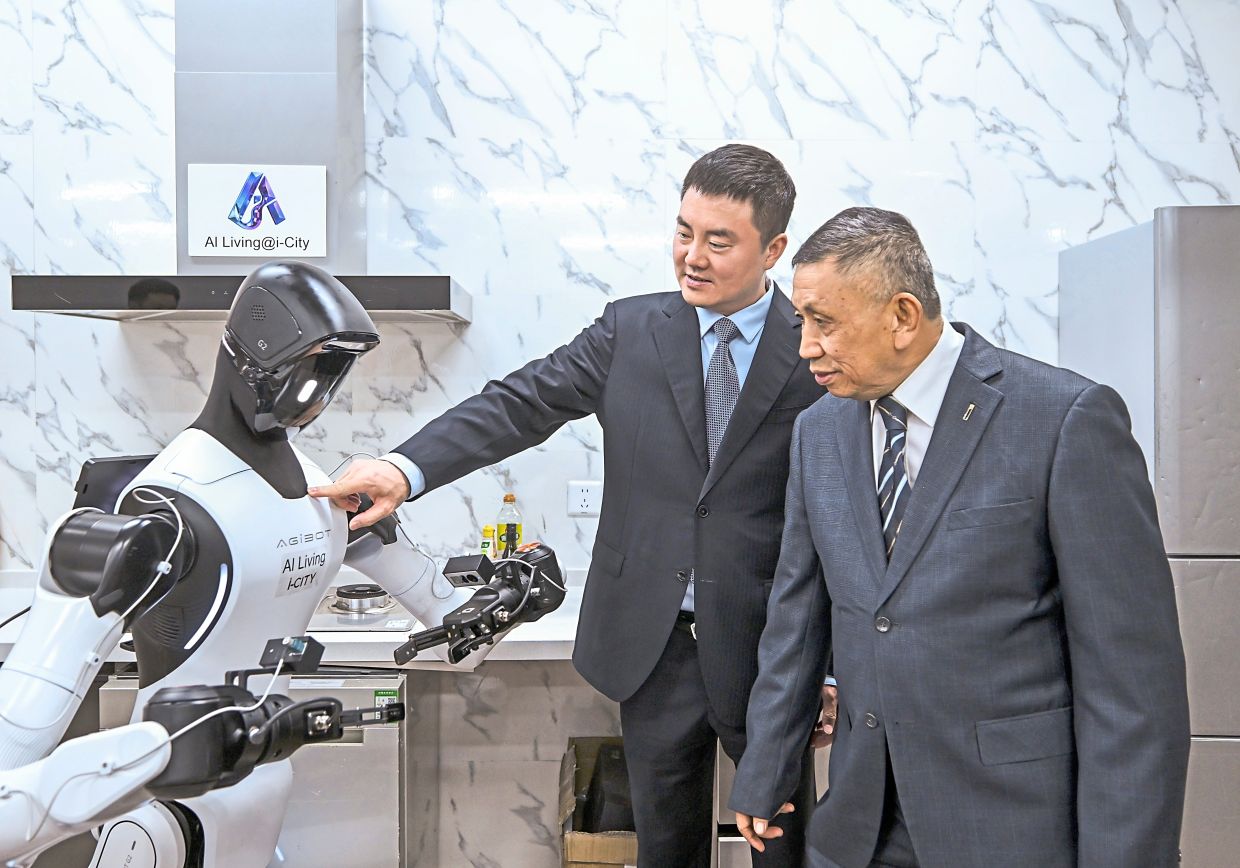
The collaboration moved into its next phase when Deng hosted i-City founder and chairman Tan Sri Lim Kim Hong at AgiBot’s AI Living Lab in Shanghai to review the progress on how humanoid robots could move beyond industrial and commercial applications into the home.
That is the problem AgiBot and i-City are working on at AI Living @ i-City, a 500-home development billed as the world’s first AI residence, scheduled for completion in 2030.
“The starting point is the person, not the robot.
“A home may last for decades, and the needs of the person living in it will change during that time,” said Deng.
“Our collaboration with i-City allows us to explore how embodied intelligence can serve those changing needs – whether it is convenience when people are younger or wellness, mobility, assistance and care as they grow older.”
Rather than building around today’s technology, the development is being designed in anticipation of new generations of AI, robotics, wellness technology and intelligent appliances and services, enabling progressive integration as these technologies are introduced.
Humanoid robotics is moving fast, and the project is not being tied to any single generation of hardware or software, but is built to absorb whatever comes next.
Earlier this year, more than 100 Agibot humanoid robots were deployed at i-City’s AI World Experience Centre in Shah Alam, allowing visitors to observe and interact with embodied intelligence across a range of applications.
AgiBot’s AI Living Lab is the next stage, testing how domestic robots could work inside an actual home and how those applications need to change to suit residents’ lifestyles.
Deng said that this is what makes the project important for the company’s push into domestic robots.
“The opportunity for us is to understand how the technology within the home can evolve alongside the people who live there, so that embodied intelligence continues to become more useful as needs change.”
With AgiBot now also signalling a broader investment commitment in Malaysia, the AI Living @ i-City partnership sits within what appears to be a wider push by the company to deepen its presence in the country beyond a single showcase project.
FIRDAUS & Associates, which is leading the marketing and sales for AI Living @ i-City, has appointed three of Malaysia’s top property agencies to work alongside it in bringing the new residential concept to market.
Its group executive chairman Datuk Firdaus Musa said the appointment reflects a different problem than filling showrooms with agents, as selling the development now entails changing buyer perception.
“People will still care about location, price and the quality of the property. But AI Living @ i-City introduces another question as the conversation moves from ‘What does this property have?’ to ‘What could this home do for you?’,” he said.
Firdaus, who is a former International Real Estate Federation (Fiabci) Malaysia president, noted that the question has no single answer, as it differs by buyer and their needs.
There is also a time horizon that most property pitches do not have to address.
While a building may stand for decades, AI and robotics will not stay still for that long.
AI Living @ i-City’s AI-ready homes are intended to integrate new technologies rather than being fixed to what is available at launch.
“You could be buying a home at one stage of your life and asking very different things of it 10 or 20 years later. That begins to change how we think about the value of a home,” said Firdaus.
That shift is forcing a change in how the four agencies sell the development.
Instead of running through a specifications sheet, agents are being retrained to lead with how a home fits the buyer’s everyday life – whether that’s a working couple, a family with children, someone living alone or a family caring for elderly parents.
The pitch has moved from specification-based selling to needs-based, experiential selling.
Firdaus said the underlying proposition rests on what he calls the 4Cs – Care, Comfort, Convenience and Community.
“Can technology help care for the people in the home? Can it make the home more comfortable? Can it make everyday activities more convenient? And can it help residents connect better with the wider community? For me, that is when AI becomes meaningful,” he said.
He was also careful to separate the AI proposition from the fundamentals buyers already look for.
AI Living @ i-City sits within the established i-City integrated development in Shah Alam, with its existing infrastructure and surrounding commercial, retail, office and residential ecosystem – and Firdaus said buyers are not being asked to buy AI in isolation.
“Technology changes quickly, so the real value is not simply having today’s latest gadget. It is having a residence that is AI-ready and capable of evolving with tomorrow’s technology.
“I believe that future-readiness, combined with the 4Cs, can increasingly become a recognised attribute of property value.”
He added that investors may weigh AI-enabled features as part of tenant preference and future marketability, though he would be cautious about promising higher rental yields on the AI label alone.
“The interesting question for us is not simply who likes AI, but which AI applications solve a genuine need for each group of buyers. That is where I believe the real potential of AI Living lies,” he said.
That question of genuine need is why the four agencies are currently undertaking a market survey to gauge buyer interest and preferences, which will help shape how the development is positioned across different buyer segments.
“We don’t have to pretend to have all the answers today. But if the home is changing, the way we engage the homebuyer has to change as well,” he said.
“AI Living @ i-City gives us the opportunity to develop that approach together, starting with the people who ultimately decide whether this new category succeeds: the homebuyers.”