
PETALING JAYA: Government-backed financing guarantees under the Syarikat Jaminan Pembiayaan Perniagaan (SJPP) have emerged as an important lifeline, helping businesses secure loans, maintain cash flow and pursue expansion plans, say industry players and economists.
They say the scheme has played a significant role in bridging financing gaps, particularly for smaller businesses that may struggle to meet conventional banking requirements.
This has become increasingly important as businesses face higher wage bills, rental costs, utilities and compliance expenses, including the rollout of e-Invoicing, said SME Association of Malaysia national president Chin Chee Seong.
“The government guarantee gives banks greater confidence to lend, allowing more SMEs to obtain financing even if they have limited collateral,” he said.
“This helps businesses maintain cash flow, continue operating and invest for future growth. Without such support, many SMEs would have to postpone expansion or delay important business plans.”
The SJPP, set up in 2009, is wholly owned by the Minister of Finance (Incorporated). Its role is to manage and administer government guarantee schemes to help SMEs.

In April, Prime Minister Datuk Seri Anwar Ibrahim said the SJPP is one of the key instruments in supporting SME resilience. He said that more than 50,000 businesses had been provided with financing guarantees of about RM50bil between 2023 and 2025.
Chin noted that government-backed guarantees can have a broader economic impact by enabling businesses to invest in machinery, automation and digitalisation while creating employment opportunities.
“SMEs account for more than 97% of businesses in Malaysia. Supporting SMEs through financing is not just helping individual companies; it is an investment in Malaysia’s economy and future growth,” he said.
According to Chin, sectors that have benefited include manufacturing, retail, wholesale, logistics, food and beverage, tourism, services and technology-based businesses.
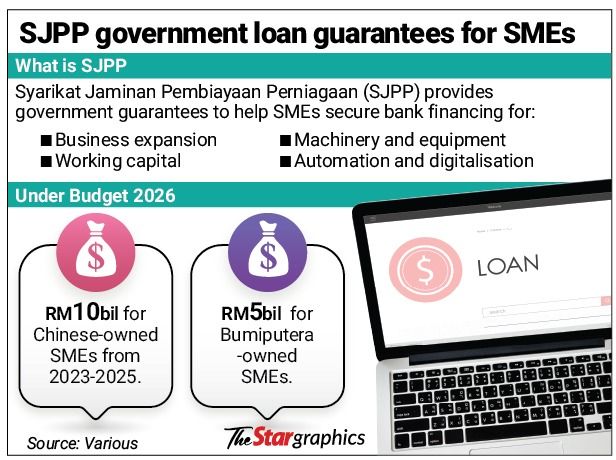
Most SMEs utilise the financing for working capital, machinery upgrades, automation, digitalisation initiatives and expansion into new markets.
Despite the support for the scheme, he said improvements are needed to maximise its reach.
“The most common complaint among SMEs is the lengthy approval process, which can delay expansion plans and create cash flow pressures.
“Faster approvals, simpler applications and wider access will enable more SMEs to grow, create jobs and contribute even more to the Malaysian economy,” he said.
Universiti Teknologi Mara senior lecturer in economics and financial studies Dr Mohamad Idham Md Razak said government guarantees help address financing constraints that often prevent SMEs from growing.
He said easier access to financing allows businesses to invest, improve productivity and strengthen their competitiveness.
However, he cautioned that access alone is not enough.
“The application process should be simplified, especially for micro and small businesses, while awareness programmes should be expanded as many SMEs are still unaware of the financing schemes available,” he said.

SME owner Datuk Irwin Cheong said demand for financing remains high, particularly among SMEs looking to fund new expansion plans, inventory purchases and operational costs.
“About 70% to 80% of SMEs seeking financing require it for expansion, increasing inventory or managing higher operating costs,” he said.
While government-backed financing provides additional support, Cheong noted banks still conduct their usual credit assessments before approving loans.
“We hope the government can further assist SMEs, especially smaller players, by enabling easier access to financial aid and encouraging less restrictive approval requirements,” he added.
Another SME owner, Ng Kee Peng, said one key advantage of SJPP-backed financing is that businesses do not need to provide substantial collateral.
“The evaluation process is still there because both the bank and SJPP assess the application.
“However, the good part is that SMEs generally do not need to provide additional security apart from a personal guarantee,” he said.