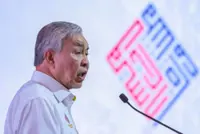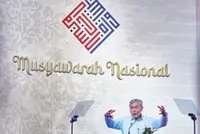
KUALA LUMPUR: Deputy Prime Minister Datuk Seri Dr Ahmad Zahid Hamidi says the Musyawarah Nasional (National Discourse) will be registered as a non-governmental organisation (NGO) but stressed that it would not be a political group or owned by any group or individual.
The founder of Musyawarah Nasional said the platform should serve as a long-term, shared and inclusive mechanism to advance the Malay and Islamic agenda as well as national unity in a more structured manner.
"The permanent secretary of Musyawarah Nasional must immediately take steps to register it as an NGO under the Registrar of Societies (RoS).
"It should not be established as a coalition of political parties, but as an NGO that brings together the collective thinking of the Malay-Muslim community in this country," he said when closing the Musyawarah Nasional themed “Malay Concerns: What Are the Solutions?” here on Sunday (May 10).
Meanwhile, the Rural and Regional Development Minister assured that all resolutions and proposals raised at the Musyawarah Nasional would not be left as mere rhetoric or archived documents, but would instead be closely monitored through to implementation.
Ahmad Zahid said he would personally ensure that all agreed resolutions are translated into follow-up actions involving the relevant ministries and government agencies.
"I do not want these resolutions to end up being passed to ministries and departments only to be set aside. I will personally bring these proposals to the Cabinet, and all Malay-Muslim ministers in the government must play their role to ensure this agenda is implemented," he said.
He added that a permanent secretariat under the Musyawarah Nasional would also be established to monitor implementation of all proposals, as well as to ensure that five key pillars - religion, politics, economy, education and social development - are discussed on a regular basis.
He said chairpersons of each pillar would also be tasked with holding follow-up meetings at least once every two months to refine the implementation of the Malay, Islamic and national unity agenda.
Among the resolutions raised was the need to strengthen the Malay and bumiputra economy in a more bold and structured manner to improve living standards and lift the community out of the low-income group.
"Aid remains important, but it is not a long-term strategy. The real strategy lies in skills development, access to high-income jobs, capital, markets and mastery of future sectors," he said.
According to Ahmad Zahid, institutions such as Majlis Amanah Rakyat (Mara), the Bumiputra Agenda Steering Unit (Teraju), government-linked companies (GLCs) and government-linked investment companies (GLICs) must be given a clearer mandate as engines of bumiputra development.
He said Malaysia must also produce more bumiputra entrepreneurs and industry players in strategic sectors such as technical and vocational education and training (TVET), artificial intelligence (AI), the digital economy, renewable energy, the halal industry, modern agriculture and high technology. - Bernama