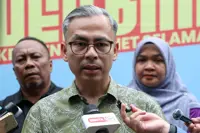
PUTRAJAYA: The Finance Ministry has been directed to immediately examine the process of targeting diesel subsidies using a mechanism similar to that implemented for Budi 95, says Datuk Fahmi Fadzil.
The Communications Minister, who is also government spokesman, said the Finance Ministry has been asked to present this at either the upcoming National Economic Action Council (NEAC) meeting or the next Cabinet meeting in the coming week.
“The next step is to review the targeted subsidy mechanism, where we will begin examining the best approach to shift how subsidies are delivered - for example, from the current cash transfer model like Budi Individu and Budi Diesel, to a mechanism similar to Budi 95.
"We expect that when the time comes, this will help Malaysians, especially those driving vehicles like the four-wheel drives (4WD). The method would be simpler, more efficient, and more effective, based on how Budi95 is currently implemented.
“For the fisheries sector, for example, discussions have taken place at the council level, and the Agriculture and Food Security Ministry is currently reviewing a slightly different mechanism that could be implemented, subject to further discussions, including with the Malaysian Fisheries Development Authority,” said Fahmi, responding to a question on whether the government was aware of a report that diessel smugglers had shifted orperations to using local fishermen.
Fahmi also said that the Cabinet had agreed for Malaysia to upgrade its biodiesel mandate from B10 to B15, with an intermediate B12 phase.
“This transition will not involve any additional cost to the government and will use the existing biodiesel blending infrastructure.
“It has been decided that the biodiesel blending rate will increase from B10 to B15, starting with a B12 blend," said Fahmi.
B15 refers to a fuel mix of 15% palm methyl ester and 85% petroleum diesel.
Fahmi said that the Plantation and Commodities Minister informed the Cabinet that the existing infrastructure for B20 biodiesel is currently available throughout the state of Sarawak except in Bintulu, and is also available in Labuan and Langkawi.
“The government will examine further steps, and the Economy Minister will conduct a visit to the premises to inspect the base materials for biodiesel blending this Saturday (April 18),” Fahmi said.
Biodiesel blending mandates are policies requiring a specific percentage of renewable fuel – typically palm oil-based methyl ester – to be mixed into fossil diesel. The mandate levels represent the percentage of biodiesel in the fuel mix.
Fahmi explained that such a move would strengthen national energy security during global oil shocks and support palm oil prices.
He also said that Prime Minister Datuk Seri Anwar Ibrahim had ordered a firm stance on fuel leakages, smuggling and misappropriation.
He said that petrol stations at the Malaysia-Thai border selling a suspiciously high volume of fuel would be monitored closely.
"Among several measures taken by the government, the first is to deploy security forces, particularly the Royal Malaysia Police, at more than 100 out of 150 petrol stations identified as high-risk, especially those located in border areas, to ensure that activities or actions believed to involve smuggling or misappropriation can be curbed.
“In the National Economic Action Council meeting on April 14, it was noted that one of the stations’ fuel sales were significantly higher than all other stations nationwide - especially when compared to the population within its surrounding area.
“So one of the immediate steps is to station police personnel at stations identified as high-risk," he said.
Fahmi also reiterated that new prices for fuel products sold in Malaysia are announced every Wednesday at around 6pm or 7pm.
“Any information or dissemination detected before that day and time, which is not issued through the official Finance Ministry channels, is likely to be false,” said Fahmi.