PETALING JAYA: Malaysia’s electric vehicle (EV) market is on a record-breaking run, but a widening geographical divide in public charging infrastructure is raising fresh alarm bells from the Malaysian Automotive Association (MAA).
EV sales surged 118% to 5,633 units in March, up from 2,579 units in the same month last year.
But MAA president Mohd Shamsor Mohd Zain said that the rapid growth has raised concerns about the EV-to-charger ratio, with charging infrastructure remaining heavily concentrated in the Klang Valley.
“This has created some level of disparity across regions as adoption continues to expand.
“If not addressed early, this could affect user experience and confidence, especially as EV adoption continues to grow,” he said in an interview.
Latest data from the Energy Commission substantiates this concern, as there are currently 5,619 charging bays nationwide, comprising 1,898 direct current (DC) fast chargers and 3,721 alternating current (AC) chargers.
These public chargers operate under an Electric Vehicle Charging System (EVCS) framework, with operators required to obtain a licence from the Energy Commission to ensure commercial stations comply with strict national safety standards.
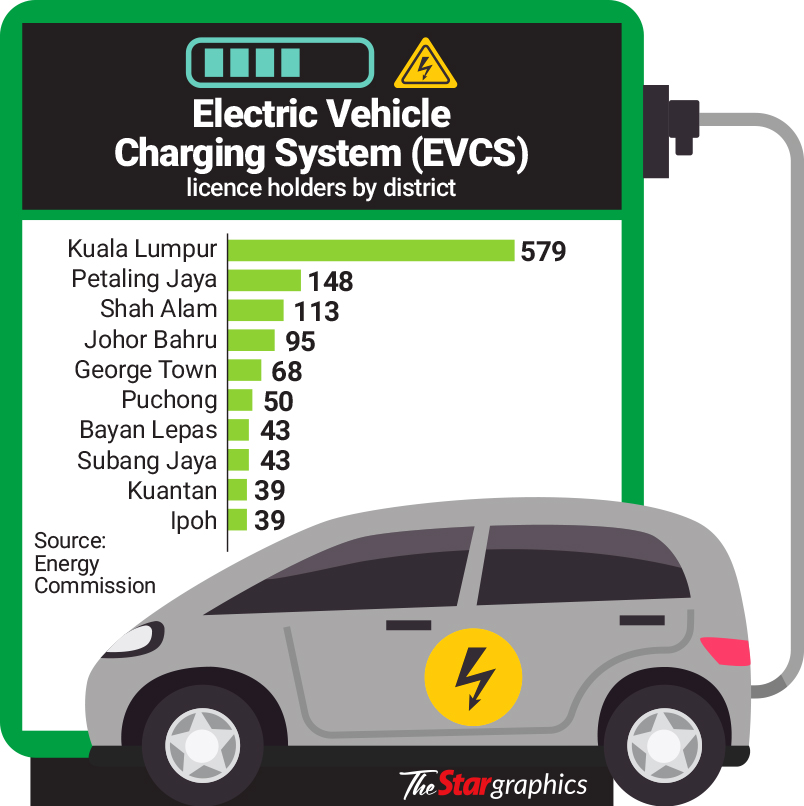
The commission’s data shows that Kuala Lumpur leads with the highest number of EVCS licence holders at 579.
This is followed by heavily urbanised districts like Petaling Jaya (148), Shah Alam (113), Johor Baru (95), George Town (68), Puchong (50), Bayan Lepas (43), Subang Jaya (43), Kuantan (39) and Ipoh (39).
In contrast, Terengganu currently has the fewest EVCS licence holders, with just 22, followed by Melaka (40), Negri Sembilan (45), Kedah (45) and Pahang (71).
Meanwhile, Mohd Shamsor noted that the introduction of sub-RM100,000 models, such as the eMas 5 at around RM60,000, has fundamentally shifted the landscape, making EVs highly accessible.
He added that national carmaker Proton remains the largest contributor to the current wave of EV sales.
Beyond competitive pricing, uncertainty over the RON95 subsidy amid the ongoing Middle East crisis also hangs heavily over the automotive market.
While the MAA is still assessing the exact impact of subsidy fears on the March sales spike, Mohd Shamsor said the association does not rule out that it is a contributing factor.
“This is further supported by the current global situation, which has created greater uncertainty in fuel prices,” he said.
“Taken together, both domestic expectations and global developments may influence buyer behaviour and accelerate interest in battery electric vehicles (BEVs).”
For now, Mohd Shamsor said most EV makers bundle home charging facilities with their vehicles, which is generally sufficient to meet the daily usage requirements of city commuters.
However, with the MAA expecting this sales momentum to sustain throughout 2026, the pressure on public infrastructure will only intensify.
Dismissing the idea that the March figures were just a temporary spike driven by festive promotional campaigns, Mohd Shamsor described the industry’s outlook for 2026 as “structurally healthy”.
“This is driven by the shift towards electrification, improving supply chain resilience, the entry of new brands and ongoing product refresh cycles,” he said.
Moving forward, he stressed that the pace of expansion will heavily depend on policy clarity and the accessibility of charging infrastructure as the market becomes more crowded.
“Malaysia is still at the EV adoption stage.
“MAA will continue to engage closely with the government to ensure that upcoming policies are practical, balanced and supportive, enabling sustainable industry progress for both new entrants and existing players,” he said.
Presently, RON95 is capped at RM1.99 per litre for most consumers despite the price of Brent Crude breaching US$100 per barrel.
Finance Minister II Datuk Seri Amir Hamzah Azizan said the cost of petrol and diesel subsidies borne by the government has risen to RM6bil.