PETALING JAYA: It’s advice that’s worth repeating as the weather transitions towards El Nino, the climate pattern which pushes up global temperatures.
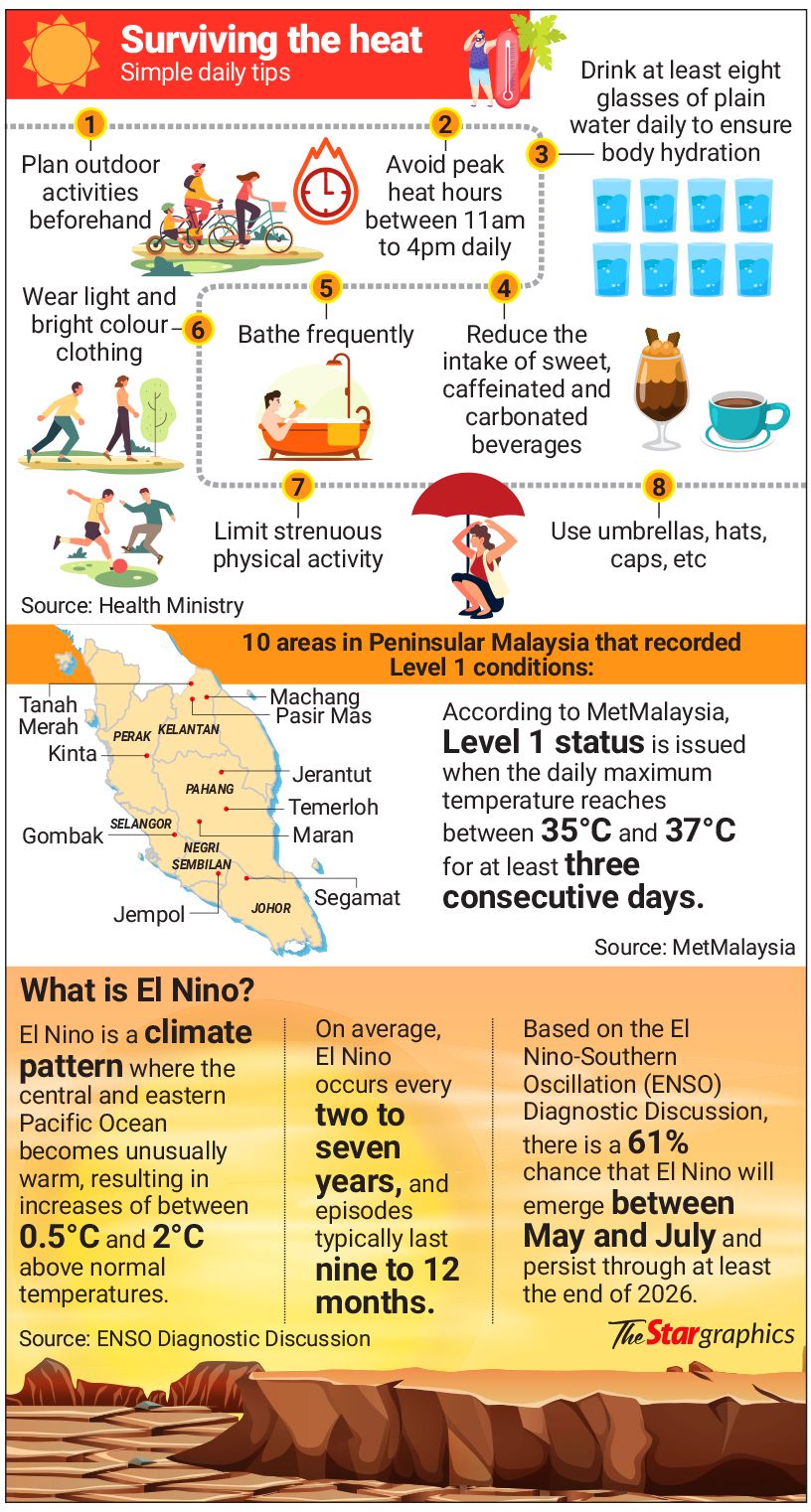
“Prioritise regular hydration, reduce outdoor exposure during peak heat hours, wear light-coloured clothing and maintain well-ventilated or cooled indoor environments.
“Particular attention must be given to vulnerable groups, including the elderly, children and outdoor workers,” said senior lecturer and director of the Disaster Management Institute at Universiti Utara Malaysia, Dr Chong Khai Lin.
ALSO READ: Heatwave calls for tour itinerary adjustments
She said that cloud seeding can play a role in mitigating the immediate impacts of dry conditions, but only as a short-term, conditional intervention.
Its effectiveness depends on the presence of suitable cloud systems and sufficient atmospheric moisture, she said.
“It cannot be relied upon during prolonged dry spells when cloud formation is limited,” she said.
In Malaysia, she said cloud seeding has been deployed during past droughts and haze episodes with some localised success.
“But it does not address the underlying drivers of heatwaves or regional climate variability.”
Cloud seeding, she said, can support rainfall under the right conditions, but it is not a solution to heatwaves.
“Rather, it is a tactical response within a much larger climate challenge,” she said.
With forecasts indicating a 61% probability of El Nino developing between May and July, the risk of suppressed rainfall, higher temperatures and extended dry periods becomes more significant.
“What people are experiencing now is not just high temperatures but compounded heat stress, where humidity makes the heat more dangerous than it appears.”
El Nino, which means “Little Boy” in Spanish, occurs every two to seven years, and episodes last nine to 12 months.
It is a naturally occurring climate pattern associated with the warming of the ocean surface in the central and eastern tropical Pacific Ocean, resulting in temperature increases of between 0.5°C and 2°C above normal levels.
Based on the El Nino-Southern Oscillation Diagnostic Discussion, there is a chance of El Nino persisting through the end of 2026.
As of April 9, the Malaysian Meteorological Department (MetMalaysia) said there are 10 areas placed under Level 1 hot weather alert, with daily temperatures reaching between 35°C and 37°C for at least three consecutive days.
The affected areas are Tanah Merah, Pasir Mas and Machang in Kelantan; Jerantut, Temerloh and Maran in Pahang; Kinta (Perak), Gombak (Selangor), Jempol (Negri Sembilan) and Segamat (Johor).
Climate and environmental expert Dr Serina Rahman from the National University of Singapore warned that heatwaves are likely to worsen due to climate change and rising emissions.
“Given the high costs involved, how can we keep doing cloud seeding? It is difficult to see how heatwaves can be effectively contained as weather cannot be controlled.
“We have let climate change spin out of control and what we are experiencing now is a result of that, where it seems that the heat will only worsen,” she said.
She said that ongoing conflicts and expanding industrial activities, including the establishment of data centres, are likely to contribute to rising emissions, which could further intensify global temperatures in the years ahead.
On coping measures, she said people should try to keep cool by staying indoors where possible, using fans and ensuring proper ventilation, although not everyone would have such benefits due to cramped living conditions.
“For those who must work outdoors, such as fishermen, farmers and manual labourers, it is important to seek shelter where possible. Minimise direct sun exposure and stay well hydrated,” she said.
Prof Datuk Dr Aileen Tan of Universiti Sains Malaysia said climate change is raising the overall baseline temperature, making El Nino events more severe when they occur.
“Higher temperatures are becoming more common and extreme heat events are occurring more frequently and, in many cases, with greater intensity.
“This is no longer just an isolated heatwave but reflects a broader change in our climate system,” she said.
She said that Malaysia has made progress in areas such as climate monitoring and regional cooperation on haze management, but gaps remain, particularly in peatland management, enforcement of zero-burning policies and the development of early warning systems for overlapping risks such as heatwaves and haze.
“We need a more proactive and integrated approach, including stronger regional collaboration and greater investment in climate-resilient land and urban management.
“Ultimately, this is not just an environmental issue. It affects public health, economic stability and livelihoods across the region, so improving preparedness requires a shared, sustained effort,” she said.