



PETALING JAYA: Beauty filters and curated livestream personas are increasingly influencing how people present themselves online, but psychologists warn that the real concern arises when digital identities begin to replace individuals’ sense of self.

In today’s digital environment, she said, individuals can create online avatars that attract admiration or emotional attachment, even if they differ significantly from reality.
“People may fall in love with the image rather than the person behind it,” she said.
While some individuals consciously use curated appearances as part of personal branding or income generation, she said psychological risks emerge when filtered identities start shaping how people see themselves.
“If someone feels comfortable with both their online persona and their offline self, there may be no issue. The concern begins when individuals start disliking who they are without filters,” she said.
She said research increasingly links frequent use of beauty filters to body dissatisfaction, heightened self-criticism and anxiety, especially when users compare themselves to digitally altered standards.
Such pressures, she said, affect both women and men, although men’s concerns often centre on body shape or muscularity.
Meanwhile, founder and president of the Mental Illness Awareness and Support Association, Anita Abu Bakar, said the technology itself is not inherently harmful, but repeated exposure to idealised images can gradually reshape internal standards of attractiveness and self-worth.
She said casual use of filters has become part of modern digital culture and can sometimes help individuals feel more confident.
However, Anita cautioned that reliance on altered appearances may signal deeper issues tied to identity and validation.
“Frequent exposure to heavily filtered faces can slowly redefine what is perceived as normal or attractive,” she said, citing research from the University of Waterloo linking media imagery to body dissatisfaction among adolescents.
She said livestreaming environments may intensify these effects by creating a strong sense of authenticity and closeness with viewers.
Citing a 2025 study in Royal Society Open Science, Anita said the study also found that digitally enhanced faces were rated not only as more attractive but also as more trustworthy and sociable, illustrating how appearance can influence perceptions of personality.
While platforms such as TikTok have introduced limits on some beauty filters for minors, she said safeguards should be paired with digital literacy and mental-health awareness.
“Filters are tools. The concern arises when self-worth becomes tied to a filtered identity or when validation depends on an altered appearance,” she said.
Eve Psychosocial Rehabilitation Centre general manager Rozana Anthony said Social Comparison Theory explains how it can shape identity and belonging, but when pitted against digitally perfected images, the result can be discouraging and damaging.
“Skin with natural texture, asymmetrical faces or bodies that do not match the ‘ideal’ can suddenly feel inadequate. What starts as awareness can slowly evolve into self-doubt and dissatisfaction.
“Research in Developmental and Social Psychology shows that repeated exposure to unrealistic beauty standards affects self-esteem and emotional well-being. Some young people may become overly focused on perceived flaws, a pattern linked to conditions such as Body Dysmorphic Disorder.
“These pressures also shape how young people view each other. When certain appearances are repeatedly celebrated, popularity and acceptance can become tied to fashion, status or looks rather than kindness or character,” she said on how false beauty standards can be harmful.
Rozana said social media reinforces another layer of pressure as the pursuit of digital approval can make relationships performative rather than grounded in shared experiences, trust and empathy.
This can lead to superficial connections replacing meaningful ones, she added.
As such, she urged parents, educators, elders, influencers and the media to restore balance by reminding young people early that their worth lies not in filtered perfection or online approval but in their character, kindness and humanity.
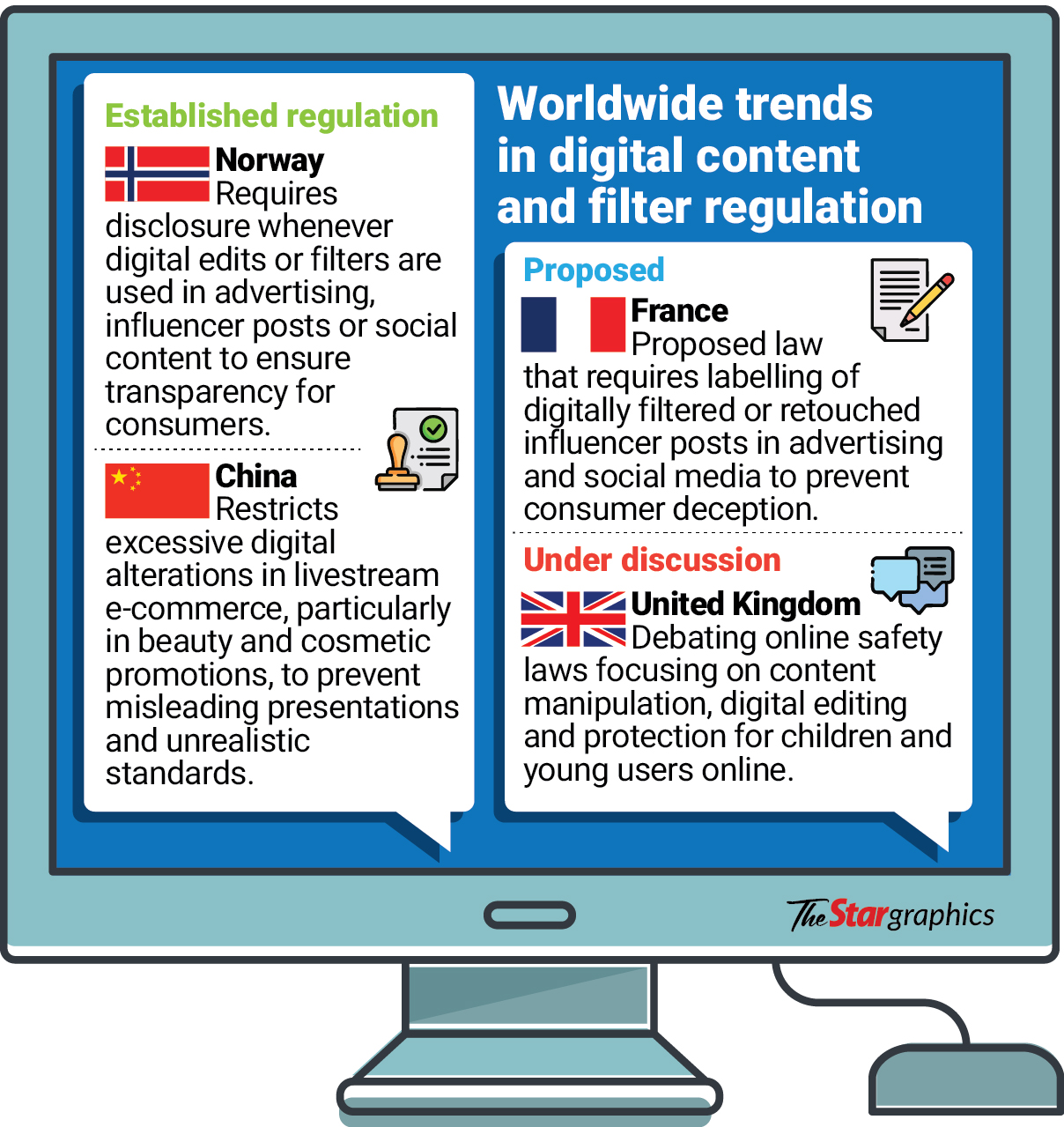
Recently, the Chinese Entertainment Industry Association issued regulations on beauty filters and heavy makeup in its huge influencer industry, prohibiting them from using excessive beauty enhancements, inducing consumer spending or engaging in ranking comparisons that encourage viewers to compete financially for attention.
Several cases were reported involving a 62-year-old man who spent 500,000 yuan and then borrowed an additional 100,000 yuan on virtual relationships, and another man spending over 300,000 yuan on an influencer who was dating four other men.

