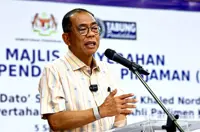
JOHOR BARU: Malaysia must shift decisively from planning to delivery in 2026 as the country moves into the implementation phase of the 13th Malaysia Plan (13MP), says Economy Minister Akmal Nasrullah Mohd Nasir (pic).
He added that the year ahead would be critical, with ministries, agencies and states expected to mobilise with discipline, speed and accountability to deliver measurable outcomes amid an increasingly uncertain global environment.
“2026 must be the year we move from planning to delivery,” he said, adding that the 13MP has been aligned with the Madani Economic Framework to drive structural reforms, overcome the middle-income trap and ensure growth benefits all Malaysians.
Akmal, who is also Johor Baru MP, said this when delivering his keynote address during the Johor Dialogue forum held at Menara MBJB here on Monday (Feb 9).
He said the dialogue was being held at a decisive moment, as Johor enters a new phase of transformation driven by the Johor-Singapore Special Economic Zone (JS-SEZ), which he described as a key engine for national and state-level growth.
Akmal noted that while global growth is moderating, supply chains remain vulnerable and geopolitical competition is intensifying. Despite this, Malaysia’s economy has shown resilience with 2025 growth estimated at 4.9%, exceeding official projections.
Looking ahead, he said Malaysia’s growth for 2026 is projected at between 4% and 4.5%, reflecting steady fundamentals but also external headwinds from global trade uncertainty.
Inflation remains under control at 1.6% as of December 2025, while services, manufacturing and construction continue to support growth, he added.
On investments, Akmal said Malaysia recorded RM285bil in approved investments in the first nine months of 2025, with Johor contributing RM91bil, signalling strong confidence from both domestic and foreign investors.
“Strategic investments, including a recent RM880mil high-technology commitment by Intel, reflect investor confidence in Malaysia’s long-term potential,” he said.
He added that the strengthening of the ringgit reflected improving investor sentiment and sound macroeconomic fundamentals, but cautioned that it must be managed carefully to preserve export competitiveness and support inclusive growth.
Akmal said Johor’s success would depend on its ability to strengthen cross-border partnerships, particularly with Singapore, and build an integrated ecosystem spanning manufacturing, logistics, digital services and green industries.
In this regard, he said the JS-SEZ would play a central role in reshaping Johor’s economic landscape, generating high-skilled, high-wage jobs and increasing economic complexity.
“The JS-SEZ is not just about attracting investments. It is about raising productivity, creating value and delivering high-quality outcomes for our people,” he added.
Akmal said the zone is expected to help Johor achieve its gross domestic product target of RM260bil ahead of schedule, while creating up to 20,000 high-skilled jobs in high-growth sectors.
Beyond Johor, he stressed that development under the 13MP would remain inclusive, with targeted investments to bridge gaps between developed and underdeveloped regions.
“No region, state or locality should be left behind,” he said, citing efforts to transform rural areas into specialised production hubs linked to global supply chains.