
KUALA LUMPUR: The 2026 Formula One (F1) season marks a near-total reset for the high-octane sport, following significant regulatory changes which incorporate breakthrough advancements in technology and engineering.
The race this year will see major changes to the grid, featuring smaller, lighter chassis and a radical shift in power unit architecture.
For the Mercedes-AMG PETRONAS F1 team, this transition could be the culmination of years of behind-the-scenes engineering, anchored by a decade-and-a-half of technical synergy.
At a recent roundtable held at the PETRONAS Twin Towers, the team’s leadership and drivers outlined a strategy built on reliability and data mastery.
Strategy and synergy
Team representative and chief communications officer Bradley Lord opined that the 2026 regulations are less of a hurdle and more of an opportunity to showcase the depth of the team’s resilience and its integrated 15-year partnership with PETRONAS.
“We’ve been partners for over 15 years and obviously have developed a very close working relationship during that time,” Lord stated.
“It’s been a hugely in-depth project where we really work hand in glove, in a completely integrated way. I’d say we’re closer than ever to where we want to be and are working absolutely flat-out to be ready for the season.”
Gearing up for the season
Lord emphasised that the challenges for the new season are not merely technical but logistical, requiring the development of an entirely new supply chain and infrastructure to support the most advanced technical regulations in F1 history.
This preparation was put to the test during the pre-season, where the team logged more mileage than any other on the grid.
The team conducted three separate test sessions: one in Spain’s Circuit de Barcelona-Catalunya and two at the Bahrain International Circuit.
“Obviously, it’s hugely positive that we did as many miles as we did. However, just because we did the most miles in testing doesn’t mean we can be completely confident or take anything for granted going into the start of the season,” said Lord.
He added that at the start of new rule cycles, it’s crucial to ensure the reliability of the new systems in the long run.
“We’ve got to be very diligent about working on reliability and making sure that none of the new aspects, particularly the new power units, catch us out when we get into the race weekend proper.
“It’s one thing to fix things during testing, where you have the luxury of time, but when we get into the race weekend, the work is much more compact, and there is a curfew that you’re not supposed to break,” he explained.
Lord also said that with the internal combustion engine now contributing roughly 50% of power and the electrical system providing the other half, the driver’s role in harvesting and deploying the energy has become a tactical weapon.
“It’s changing how we approach and structure race weekends. It’s going to be another area where individual drivers will be able to make a difference, in terms of understanding what to do and how they can optimise the energy when battling other cars on track,” he said.
Lord said the team did not treat the start of the season at Albert Park in Melbourne, Australia, as a “warm-up” or test phase for the campaign.
“The priority is collecting points as much as it is collecting data.
“We want to make a strong start. Data collection will be important throughout the start of the season because we’re all on a very steep learning curve with the new cars and power units,” he said.
Inside the cockpit
While the engineers are focused on adapting to the new regulations and collecting as much data as possible to prepare for the season, drivers George Russell and Kimi Antonelli are focused on the “personality” of the team’s new car, the W17.
This year’s regulations have moved away from the ground effect heavyweights of the previous three years, returning to a more nimble design.
The W17 is now 30kg lighter and 200mm shorter than last year’s W16.
“It’s a totally different era of cars, and it’s more akin to the previous era of 2021,” noted Russell.
“It feels much nicer to drive. I think we all realised that the previous generation was just too big, it was too heavy – it felt like a bus going around the corners. Whereas, now, it feels more like a racing car.
“Being lighter is an amazing step forward and I hope that we can continue to reduce the weight in the years to come.”
Russell described the 2026 pre-season preparations as the “most intense” he has ever experienced as the team moved away from the traditional three days of testing to an exhaustive nine-day programme across two countries.
Despite the intensity, he believes the team has the potential to disrupt the status quo.
“We’ve definitely got the potential to fight for a great result. Between the top four teams at the front – McLaren, Red Bull, Ferrari and ourselves – it could be a good fight.
“We hope and are trying very hard to be the ones at the front of that race,” he said.
For Kimi Antonelli, who is entering his sophomore year, the W17’s handling has been a welcome improvement.
“This year, it feels much lighter, much more agile at changes of direction and at slower speeds. We’ve had a few issues during the tests, and there’s still a lot of boxes to be ticked, especially on reliability.
“But, the team is doing everything they can to make sure we’re all set for the season and that we’re in the best position to fight for a win,” said the 19-year-old.
He added that the limited track time at Albert Park meant that there was no room for a slow start.
“It’s a different track compared to testing, and we have less time to get up to speed with the car and systems, but we’ll get a better idea of where we are once we get on the track. We just need to be on it straight away,” said Antonelli.
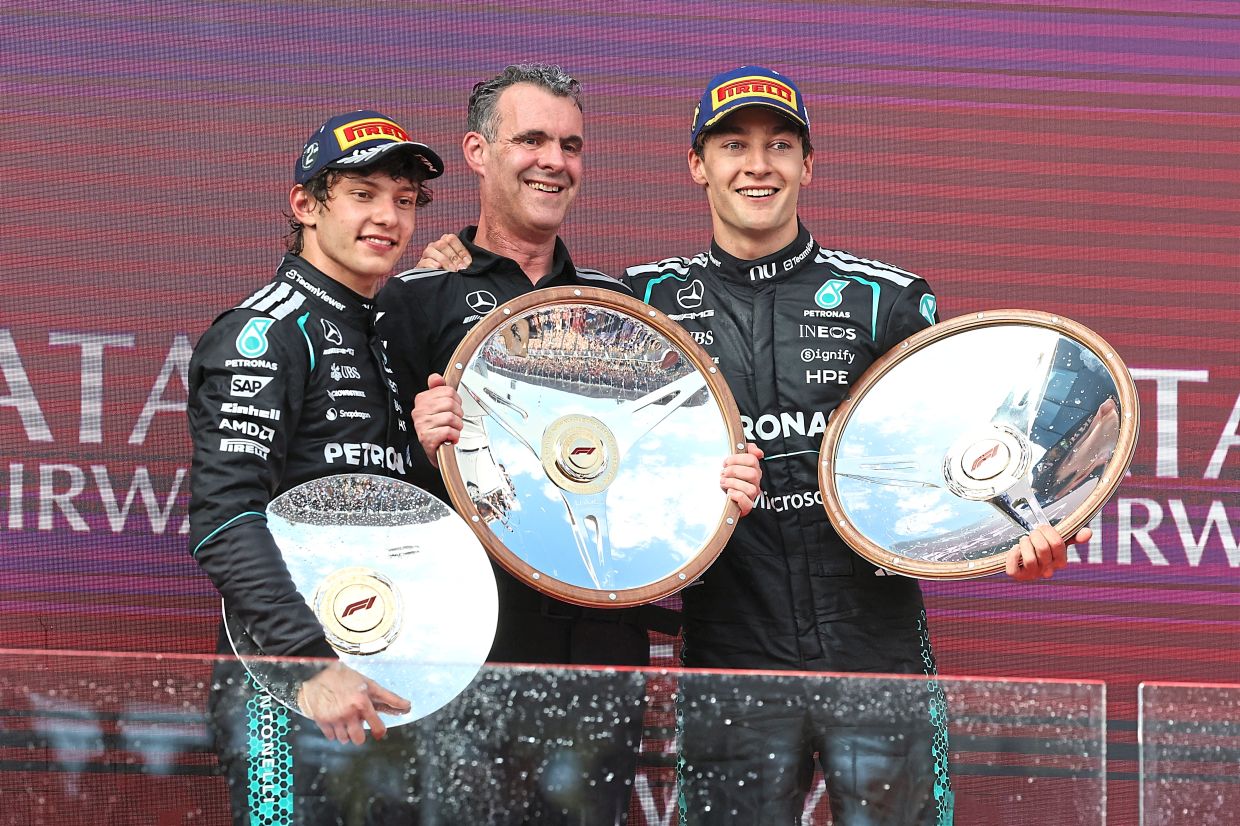
Russell and Antonelli dominated the F1 season opener in Albert Park, claiming pole position and securing a one-two finish on March 8.
They continued their dominance in the second race in Shanghai, China, with Antonelli securing his maiden victory by winning first place and Russell finishing in second.