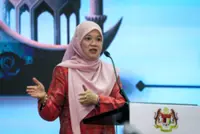
TEACHERS must remain at the heart of Malaysia’s education transformation, says Prime Minister Datuk Seri Anwar Ibrahim.
He said the country’s ambitions to advance in areas such as technology and artificial intelligence (AI) could only be achieved through the commitment and dedication of educators, with schools serving as the foundation for national development.
“Through the sincerity, dedication and commitment of educators, this country can be elevated in status, whether in the economy or in the fields of information technology, AI and so on,” he said during his address at the Education Ministry’s monthly assembly on July 28.
Anwar added that the government’s education reforms, including the Malaysia Education Blueprint 2026-2035 (RPM 2026-2035), curriculum changes, and science, technology, engineering and mathematics (STEM) initiatives, require significant effort to implement.
“It sounds simple in policy, but implementing it for hundreds of thousands of students and millions of children is challenging,” he noted.
He highlighted efforts to improve teachers’ career prospects, including better opportunities for salary progression and promotion, so educators would not feel compelled to leave the profession.
“The task of teaching and the profession of teaching itself must be regarded as noble, which is why every time we discuss schemes and priorities, we do not leave out the Education Ministry and the teaching profession. Whatever we can do, we do,” he said.
In her address at the ceremony, Education Minister Fadhlina Sidek described teachers as the frontliners of the education system, noting that they are central to tackling the increasingly complex challenges faced by students and schools.
“Issues such as bullying and students’ mental health cannot be addressed in isolation. This requires the education system to strengthen its support for teachers while building a more resilient generation of students,” she said.
Fadhlina’s emphasis on teachers comes as the ministry rolls out new programmes aimed at strengthening education and school communities, including “Pakat, Tekad and Nekad”.
Pakat, she said, focuses on preschool education by encouraging greater collaboration between schools, parents and communities, while Tekad represents the ministry’s commitment to implementing the RPM 2026-2035.
Nekad, meanwhile, aims to nurture students who are caring, empathetic and compassionate towards others, particularly their peers.
Fadhlina said these initiatives form part of broader school reforms that require changes not only to teaching, but also to the culture, ecosystem and mindset of the entire school community.
“Reform could not simply mean installing air-conditioning or smartboards, but must involve changes in how schools work, teach and respond to issues including mental health, bullying and student well-being.
“This places teachers at the centre of turning the ministry’s new programmes and wider reforms from policy into practice, as educators are ultimately responsible for translating these priorities into students’ everyday school experience,” she said.
Other highlights from the ministers’ speeches...
Prime Minister Datuk Seri Anwar Ibrahim
> Form Six: Pre-university education will remain under the Education Ministry for the time being, with the arrangement subject to review after several years.
> Bullying cases: Principals should be commended for disclosing bullying cases, which must be addressed regardless of scale.
> Language proficiency: Malaysia must strengthen mastery of Bahasa Melayu, improve English proficiency and provide opportunities to learn other languages.
> Equitable access: Education policies must promote equitable opportunities as Malaysia advances in STEM, digitalisation and AI.
> TVET transformation: Malaysia’s technical and vocational education and training (TVET) transformation has progressed rapidly over the past three years, alongside STEM reforms, to accelerate education reform. Education Minister Fadhlina Sidek
> School reform: 10 schools in each district – five primary and five secondary – will receive up to RM100,000 each for transformation efforts.
> Year One intake: Strong response continues for the 2027 school session admission programme for six-year-olds.
> 2027 school intake: Infrastructure works are progressing well, with several upgrades completed ahead of schedule. Teacher deployment is based on projected enrolment.
> School safety: Strengthening safety and public confidence remains a key priority under the Safe School Guidelines.