A RISING number of missing children cases in Malaysia has raised concerns among child protection stakeholders.
With cases nearly doubling in recent years, they are pressing for urgent reforms to address vulnerabilities at home, in schools and online.
According to media reports on May 9, the latest data from Bukit Aman shows that 1,219 cases were reported last year, a significant increase from the 594 cases recorded in 2021.
The trend has continued this year, with 98 cases reported in January alone.
The federal police headquarters cited teenagers as the most vulnerable group, with children aged 13 to 15 accounting for the highest number of cases over the past five years at 2,507.
Among the main factors identified for the disappearances are running away from home, running away from school or shelters, and becoming victims of crime.

“Many missing children cases are not isolated incidents but the culmination of vulnerabilities that have developed over time, particularly among teenagers.
“We keep treating missing as the problem. Missing is already the outcome. The failure is earlier, and quieter, than we want to admit,” she told StarEdu.
Hartini, who has worked in child protection and community advocacy for over three decades, said 3,847 children aged 13 to 18 were reported missing in Malaysia between 2020 and September 2024, with 54% aged 13 to 15 and 74% being girls.
She said teenagers are especially susceptible because they are independent enough to move around on their own but may lack the experience to recognise manipulation and exploitation.
“They are hungry for belonging – exactly what predators offer,” she said.

“Stronger counselling services, regular welfare check-ins, and closer school-home communication can help identify vulnerabilities before a student disappears.
“Key reforms should include mandatory risk-assessment protocols for vulnerable students and clear procedures for responding to unexplained absences,” she said.
Digital literacy
Another pressing concern, Hartini noted, is the growing use of online grooming tactics by predators who build trust with children over months through multiple digital platforms before encouraging them to leave home or school.
She described the tactic as “compound phishing”, where perpetrators gradually establish emotional connections before making requests that place children at risk.
“The rise of such threats underscores the need for schools to move beyond traditional safety education.
“We need real digital literacy. Our curriculum teaches children not to talk to strangers. It does not teach them to recognise grooming. Those are not the same thing,” she said.
She also recommended that online grooming tactics such as compound phishing be formally recognised as a child protection concern.
Agreeing, Noor Azimah said given the growing influence of the digital environment, online safety education should be strengthened, alongside greater collaboration between government agencies and technology platforms to address cyber grooming, exploitation and harmful online contact.
School safeguards
On May 11, Education Minister Fadhlina Sidek said improvements were being made to the Safe School Management Guidelines to address current challenges and ensure continued protection for students and school staff.
She said this effort has already been initiated through the Education Institution Safety Reform Committee, which includes representatives from various parties.
Hartini, who previously served on the task force reviewing the Education Ministry’s Safe School Management Guidelines, said strengthening these guidelines alone would not be enough if schools lacked a culture that encouraged teachers to report concerns and gave students the confidence that speaking up would lead to meaningful intervention.
She pointed to situations where children suddenly stop attending classes or withdraw from their usual routines, arguing that such cases should trigger immediate action.
“A child who stops attending school must be flagged within 24 hours, not days,” she said.
She also said refugee and stateless children – who often fall outside formal protection mechanisms – must be explicitly named in these guidelines, with community-based touchpoints that reach them outside the school system.
“Fears of engaging with authorities can discourage families from reporting disappearances, creating blind spots that leave children vulnerable to exploitation,” she concluded.
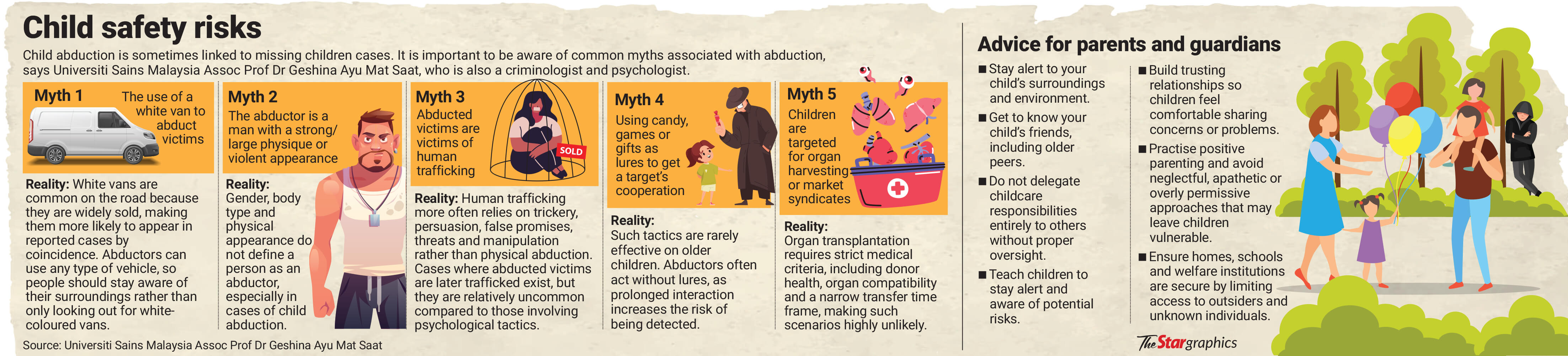
Growing up vigilant

Technology today has made it easier to get help when lost. Familiarity with location-tracking apps that can share live locations can also be useful when needed.
Christopher Foong, 16

Swastik Ram, 17

Isabel Tang Mea, 15