
RANKINGS are not the destination; what matters is relevance, contribution and impact.
And advancing these aspirations, says Universiti Teknologi PETRONAS (UTP) president Mohamed Firouz Asnan (pic), calls for collective commitment, long-term collaboration, and a shared belief that universities can, and should, play a meaningful role in shaping a better future.
Commenting on the varsity’s performance in the recently released Times Higher Education (THE) Asia University Rankings 2026, he said the milestone reflects a long-term focus rather than a single-year surge.
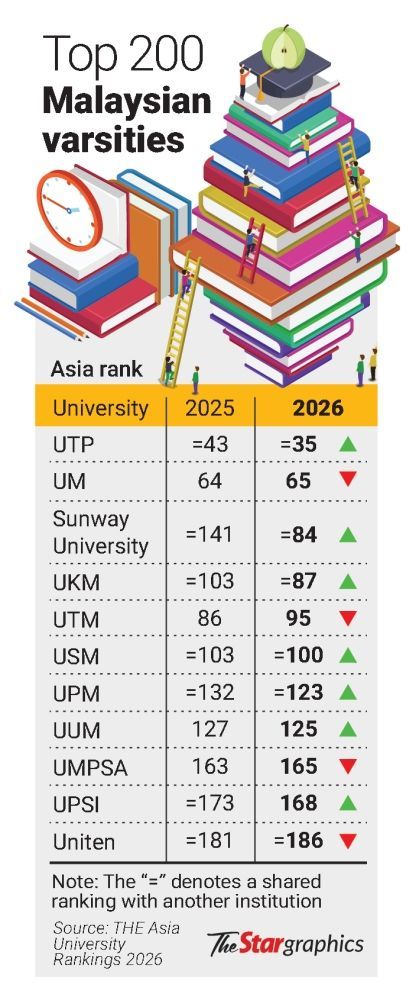
UTP became the first Malaysian varsity to enter the top 40 Asian universities in the latest edition of the rankings. It rose eight places to 35th this year (see infographic), sharing the spot with China’s Tianjin University.
Ranked first among Malaysian universities for four consecutive years, the institution has been on a steady upward trajectory. It rose from 63rd in 2023 to =55th in 2024 and 43rd in 2025. The “=” denotes a shared ranking with another institution.
UTP’s rise has been underpinned by broad-based improvements across key performance indicators, particularly in industry engagement and research applications. It also recorded gains in teaching performance and academic reputation.
“This moment is significant not because of a position on a table, but because it reflects what years of consistent effort can achieve when an institution stays focused on purpose,” Mohamed Firouz said in a May 5 press release.
He added that the recognition affirms that the varsity’s focus on “research that matters, deep industry collaboration and the development of future-ready talent” is translating into outcomes that are increasingly visible beyond Malaysia’s borders.
“The strong and enabling commitment of the Malaysian federal government and the Perak state government has played an important role in creating the conditions for an industry-integrated university to thrive, innovate and deliver long-term impact,” he said.
Looking ahead, Mohamed Firouz said UTP remains focused on turning knowledge into impact, supporting innovation across industries, contributing to regional and national priorities, and enabling graduates and alumni to thrive as professionals, leaders and contributors to society.
UTP’s performance comes amid a broader upswing in Malaysia’s higher education landscape, with multiple institutions improving their standings in this year’s rankings.
Universiti Malaya (UM) remains the country’s second-highest-ranked institution, although it slipped one place to 65th.
Out of the 27 Malaysian institutions ranked this year, a record six universities are in the top 100, double last year’s tally.
Sunway University placed =84th, Universiti Kebangsaan Malaysia (UKM) =87th, Universiti Teknologi Malaysia (UTM) 95th and Universiti Sains Malaysia (USM) =100th.
Others in the top 200 include Universiti Putra Malaysia (UPM), Universiti Utara Malaysia (UUM), Universiti Malaysia Pahang Al-Sultan Abdullah (UMPSA), Universiti Pendidikan Sultan Idris (UPSI) and Universiti Tenaga Nasional (Uniten).
Overall, nine Malaysian universities improved their positions while a further eight retained their spots from last year.
In total, 929 universities from 36 countries/territories are ranked this year, up from 853 universities from 35 countries/territories last year.
Mainland China leads the rankings again, with Tsinghua University in first place for the eighth consecutive year, while Peking University retains second place.
China holds five of the top 10 spots, with Fudan University and Zhejiang University retaining their positions at seventh and eighth, respectively. Shanghai Jiao Tong University moved up one place to ninth.
Institutions from Singapore, Japan and Hong Kong complete the rest of the top 10, with little change at the top from the 2025 rankings.
“It is encouraging to see strong results from South-East Asia, one of the most dynamic regions in the world.
“Malaysia, in particular, has made great strides in the rankings this year and will be one to watch, as it increasingly becomes a major higher education player not just in the continent but also in the world,” said THE chief global affairs officer Phil Baty in an April 22 statement.
The performance indicators used in the THE Asia University Rankings are grouped into five areas: teaching (the learning environment); research environment (volume, income and reputation); research quality (citation impact, research strength, research excellence and research influence); international outlook (staff, students and research); and industry (income and patents).
The full rankings can be viewed at: https://www.timeshighereducation.com/world-university-rankings/2026/regional-ranking.