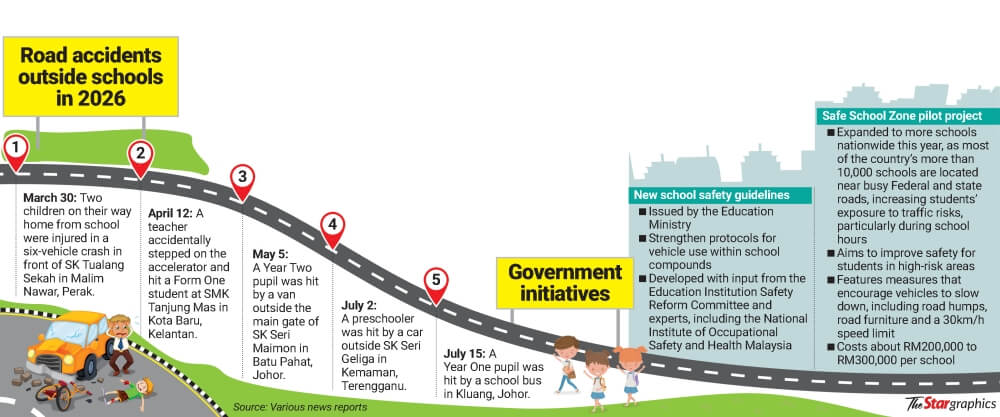
WITH the recent string of road accidents happening just outside school gates, stakeholders are calling for stronger safeguards to be put in place.
A comprehensive approach, they say, is needed to address the multiple factors behind these incidents and create a safer school drop-off and pick-up experience for everyone.

He noted that the rapid rate of urbanisation has led to more vehicles on the road, intensifying competition for road space, particularly when schools start and end.
“Most schools are located close to arterial roads that have not been built with adequate pedestrian flow and parked cars in mind, especially during the peak hours of pick-ups and drop-offs.
“In addition, illegal parking, double parking, as well as abrupt U-turns and stops, pose additional risks of crashes,” he told StarEdu, commenting on the recent string of accidents involving students just outside schools (see timeline).

Law said the rising number of motorcycles weaving between vehicles makes it worse as children find it harder to determine if it is safe to cross. Other reasons include drivers speeding in school zones, being distracted by mobile phones, not yielding the right of way to pedestrians, unsafe overtaking manoeuvres, and disregarding traffic signs, signals and crossing guards.
He, however, stressed that not all incidents can be attributed to driver negligence, as road design, lack of pedestrian facilities, ineffective traffic management, and poor enforcement all can increase the chances of crashes.
Practical measures
Improvements to the school environment can be made through wider sidewalks, raised pedestrian crossing points, traffic-calming devices and increased driver visibility, Law suggested.
“There needs to be traffic planning that keeps pedestrians apart from vehicles and improves the organisation of dropping off and picking up children,” he said, adding that road safety lessons need to be consistently taught from an early age instead of just having sporadic campaigns.
He also suggested using a more hands-on approach with students, as it can be a more effective way to ingrain the message in them.
“The school can organise road crossing drills, create traffic conditions for them, use games, and hold regular road safety lesons to help children recognise danger and act safely,” he said, adding that the material can be adjusted to suit the students’ age.
While commending steps taken by local and federal governments to improve safety, Law said more can be done as the implementation and enforcement of such measures differ among schools.
The measures in place, he noted, include clear signage at school zones, zebra crossings, warning signs, speed bumps, pedestrian barriers, and school crossing guards or traffic control officers.
“Campaigns have been conducted to sensitise drivers about the need to reduce speed in the vicinity of schools,” he said, adding that schools, depending on space, have designated areas for picking up and dropping off children.
He also said schools would have their own traffic and safety procedures, which would have been formulated after consultations between the school administration and the Education Ministry, relevant local authorities, police and road transport agencies.
“However, the effectiveness of such procedures depends on the cooperation of parents and drivers and the presence of appropriate facilities and strict implementation of measures,” he said.
Ensuring effectiveness
National Union of the Teaching Profession secretary-general Fouzi Singon said teachers should remind students about road safety and supervise them within the school premises, particularly during arrival and dismissal times.
“But teachers cannot act as traffic police or be responsible for students once they leave the school. Parents should ensure their children do not cross roads carelessly, ride motorcycles without proper licences or safety equipment, speed, or use mobile phones while travelling,” he said.
Parent Action Group for Education Malaysia chairman Datin Noor Azimah Abdul Rahim said parents must follow traffic rules and stop practices that put children at risk.
“Parents should model safe behaviour, comply with school traffic arrangements, report potential hazards and work with schools to improve safety measures. Active parent involvement through parent-teacher associations can also help identify risks early and support practical safety improvements,” she concluded.