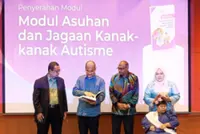
CARING for children with autism requires knowledge and skills to provide responsive, inclusive and meaningful support.
Aiming to equip more caregivers, parents and educators in this area, Universiti Malaya (UM), through its Education Faculty, launched a module designed to support the care of children with autism up to age four.
Named the Autism Childcare and Caregiving Module (Manja), it is the first of its kind in Malaysia and was developed with grant funding from the Social Welfare Department (JKM) under the Women, Family and Community Development Ministry.
Highlighting a neurodiversity-based approach, the module emphasises the strengths and uniqueness of children with autism, while placing particular focus on early intervention – a critical gap in Malaysia’s early childhood care landscape.
At the launch on April 10, the module was officially handed over to JKM, paving the way for wider implementation nationwide, including in childcare centres and communities.
UM Education Faculty dean Prof Dr Ahmad Zabidi Abdul Razak said the module is not only research-based but also designed to be practical, helping caregivers, educators and parents provide more responsive and inclusive care.
“UM is committed to supporting the national inclusivity agenda in line with the Sustainable Development Goals 2030. The development of Manja, with government support, reflects an integrated effort to strengthen the support ecosystem for children with autism,” he said in a press release.
The launch ceremony of the initiative – the result of strategic collaboration between the university, government agencies, professionals, non-governmental organisations (NGOs) and parents – was officiated by JKM director-general Datuk Che Murad Sayang Ramjan.
Also present was Department of Persons with Disabilities Development (JPOKU) director Patmanathan R. Nalasamy.
The event, held at the Education Faculty Auditorium in Kuala Lumpur, also saw the Autism Childcare Advocacy Programme conducted in collaboration with JKM and JPOKU.
Che Murad Sayang said advocacy in the care of children with autism is crucial in building a society that is more aware, informed and empathetic towards their needs.
“Through continuous efforts, parents, caregivers and the community can be empowered with the skills and support needed to manage daily challenges, thereby reducing stigma and misconceptions surrounding autism.
“This approach also contributes to creating a more inclusive, safe and supportive environment that nurtures the potential of children with autism, enabling them to thrive and contribute to society,” he said.
Some 300 participants attended the programme, comprising childcare providers, early childhood educators, parents, welfare officers, academics and NGO representatives.
The programme also featured an advocacy forum, along with the sharing of practical caregiving strategies.
In line with its inclusive approach, it also provided facilities such as a calm room and autism-friendly activities.